
A self-custody Visa that pulls from your USDC on Base
 Available in US
Tuyo is one of the more interesting crypto cards on the market right now, and for a specific kind of user. It is a Visa, the card sits inside an app, and the balance it spends from is not a custodial account but your own USDC on the Base network. If that already sounds like what you want, the rest of this review will tell you whether the details hold up. If it sounds confusing, the short version is that Tuyo is built for people who already hold their own crypto, do not want to hand it to a centralised exchange, and would like a card that simply spends it at the point of sale.
The catch is geography. Tuyo is not available everywhere, the rewards programme it launched with is being shut down, and a physical card is still promised but has not arrived. You will also need to be comfortable with the fact that Tuyo Inc. is not a bank and that the company behind the Visa is a partner called Signify Holdings, which trades as Rain. None of that makes Tuyo a bad card, but it is the picture you should have going in.
The conditions described here are current as of October 28, 2026.
Verdict
Tuyo earns a 7.3 out of 10 in this review. That is a solid score for a card that is still relatively new, and it reflects three real strengths, namely the self-custody model, the free issuance and the genuinely broad set of networks you can deposit from. It also reflects three real weaknesses, namely the long prohibited-jurisdiction list, the upcoming end of the BNPM rewards scheme and the fact that a physical card is still in the works.
If you already hold USDC, prefer to keep it in your own wallet, and live somewhere Tuyo serves, this is a card worth considering. If you are a complete newcomer to crypto, or if you live in one of the excluded countries, you will want to look elsewhere.
Here is the breakdown of how the score is built.
| Criterion | Mark | Reason |
|---|---|---|
| Who can get it | 7 / 10 | 27 countries are closed by verified residence, including Russia, Belarus, Turkey, Ukraine, the United Kingdom, India, China and Vietnam, and 25 US states and territories are excluded; the rest of the world is open |
| Cost | 7 / 10 | Issuance and monthly fees are free; 1% for non-USD currency plus 1% for purchases outside the US, together up to 2% per purchase; crypto conversion is 0.25% |
| Top-up options | 9 / 10 | USDC on Base, plus any token on Base, Ethereum, Arbitrum, BNB Smart Chain and Polygon with conversion to USDC; fiat via SEPA, ACH, SPEI, Apple Pay and Google Pay |
| Reliability and complaints | 6 / 10 | Tuyo Inc. is not a bank; fiat is handled by a licensed money transmitter (Bridge Ventures), cards are issued by partner Rain (Signify Holdings) under a Visa licence; the BNPM programme ends 31 October 2026; users report app freezes and slow support |
| Everyday use | 8 / 10 | Virtual Visa issued immediately, Apple Pay and Google Pay supported, ATM withdrawals up to $250 with three attempts per 24 hours; a physical card is “coming soon” with no date |
Who the card suits
- People who already hold crypto in their own wallet and want a Visa that spends it without first depositing into a centralised exchange.
- Residents of countries where ordinary banking or card access is difficult, provided the country is not on Tuyo’s prohibited list.
- Users comfortable with the Base network and USDC as their working stablecoin.
Who it does not suit
- Residents of any of the 27 prohibited countries, including Russia, Belarus, Turkey, Ukraine, the United Kingdom, India, China and Vietnam, and the 25 US states and territories on the list.
- People who need a physical card right now: only a virtual card is currently issued.
- Anyone who wants tiered cashback from day one: the BNPM programme closes at the end of October 2026, and the replacement 1.5% cashback only kicks in from 1 November 2026 and is set to run through the end of that year.
Will they give you the card
Tuyo is pickier about geography than it is about almost anything else. The rule that decides everything is your verified residence, not your citizenship. The platform-wide list of 27 prohibited countries includes Afghanistan, Bangladesh, Belarus, China, the Democratic Republic of the Congo, Cuba, India, Iran, Iraq, Lebanon, Libya, Mali, Myanmar, Nepal, Nigeria, North Korea, Russia, Somalia, South Sudan, Sudan, Syria, Turkey, Ukraine, the United Kingdom, Venezuela and Vietnam. If you live in one of those, you cannot get a Tuyo account and you cannot get a Tuyo card. Russia sits at the harshest end of the spectrum, with no platform access, no card issuance and no card payments. Belarus is closed at the platform level for issuance but payments remain available.
The card provider adds a second list of its own for issuance, and the two overlap but are not identical. The card-provider restrictions cover Belarus, mainland China, Cuba, India, Iran, Iraq, Israel, Myanmar, Nepal, Nicaragua, North Korea, Russia, Syria, Turkey, Ukraine, Venezuela and Vietnam. That means even some countries outside the platform-wide block may still be denied a card at the issuer’s discretion.
In the United States, the card is unavailable in 25 states and territories: Arizona, Delaware, Georgia, Idaho, Louisiana, Maryland, Mississippi, Missouri, Nevada, New Mexico, North Dakota, Ohio, Oregon, Rhode Island, South Dakota, Tennessee, Vermont, Washington, Wisconsin, the District of Columbia, Puerto Rico, the US Virgin Islands, American Samoa, Guam and the Northern Mariana Islands. The rule is verified residence again, so it is the state where you actually live that matters, not the state on your ID.
If you live in the rest of the world, sign-up is open and you can be approved subject to the identity checks described in the next section.
How to get it
The application runs entirely inside the Tuyo app. You download it, register an account, and pass identity verification with a government-issued photo ID, either a passport or a national ID card. The minimum age is 18, set by the Terms of Service. Tuyo does not explicitly list proof of address as a required document, but it does check “verified residence”, and the country where you actually live is the one that is screened against the prohibited list. If your application is rejected, that rejection is final; the company does not describe an appeal route.
Tuyo itself flags the common reasons a card application fails. Unclear photos of the ID document are the biggest one, followed by other document issues, and then by occupation codes the platform does not yet support. There is no processing-time figure given for the KYC step, and the app does not describe separate verification tiers the way a bank might.
Once your identity is approved, the next step is to deposit USDC on the Base network, and the virtual card is issued immediately. The card is virtual only, and a physical version is described as “coming soon” with no announced date, no announced cost and no announced delivery time. There is no metal tier and no option to pre-order the physical card the way some other issuers let you do.
What it really costs
Tuyo’s cost story is mostly good, with one combined-fee wrinkle you should be aware of before you tap the card abroad. The headline numbers are these.
| Fee or limit | Amount |
|---|---|
| Card issuance | Free |
| Monthly / yearly fee | Free |
| Crypto conversion (trading) | 0.25% volume fee, or the network fee if higher during congestion |
| USD purchase inside the US | 0% |
| Non-USD currency purchase | 1% FX fee |
| Purchase outside the US | 1% abroad fee (in addition to any FX fee) |
| Maximum combined fee on a single purchase | 2% (1% FX + 1% abroad) |
| ATM withdrawal cap | $250 per withdrawal, including any operator surcharge |
| ATM attempts | 3 per rolling 24-hour period (approved and declined both count) |
| Initial daily spending limit | $50,000 |
| Daily limit after $50,000 total spend | $100,000 |
| Daily limit after $100,000 total spend | $200,000 |
| Monthly limit | Not stated |
There is a single tier only. There is no paid plan, no premium card and no upgrade path. The crypto-to-fiat conversion is a flat 0.25%, with one useful exception: when you bridge a token from another network into Base or swap one stablecoin for another, that trade is exempt from the volume fee, so the only cost is the underlying network gas. The Cardholder Agreement for international users, dated November 2025, states the legal maximum for the Foreign Exchange Fee as 3% and for the Cross Border Fee as 3%, which is a ceiling rather than a current charge, but worth knowing if you ever dispute a fee.
What an everyday payment actually costs
Three concrete scenarios help put the fee table into perspective.
- A $40 coffee in New York paid in USD from your USDC balance: 0% fee on the purchase side, 0.25% on the crypto-to-fiat conversion you did when topping up, so the total all-in cost on that transaction is 0.25%.
- A €60 dinner in Paris paid from the same USDC balance: the 1% FX fee applies because the merchant settles in euros, and because you are outside the US the 1% abroad fee also applies, for a combined 2% on the card side, plus the 0.25% crypto conversion fee.
- A $100 online subscription in US dollars, charged to a server in Ireland: 0% on the USD side, but the 1% abroad fee still applies because the merchant is outside the US, even though the currency matches.
The 1% abroad fee is the one that surprises people, because it can stack on top of the FX fee even when the currency is the same. Tuyo is not unusual in charging a cross-border fee, but you should assume that any purchase where the merchant country differs from the United States will pick up the extra 1%, on top of whatever else applies.
The card balance itself is in US dollars. Tuyo also gives you a US account and routing number, a euro IBAN and a Mexican CLABE, so you can receive dollar, euro and peso payments. Euro deposits can be auto-converted to US dollars, which is useful if you are paid in euros but want to spend in dollars.
How to top up the Tuyo card
Topping up Tuyo starts with a transfer to the right network, and the right network is Base. The card spends from a USDC balance on Base, and that is the cheapest and most direct way to fund it. Sending USDC to a Tuyo Base address is free on Tuyo’s side; you still pay the sending network’s gas fee, which on Base is normally a few cents.
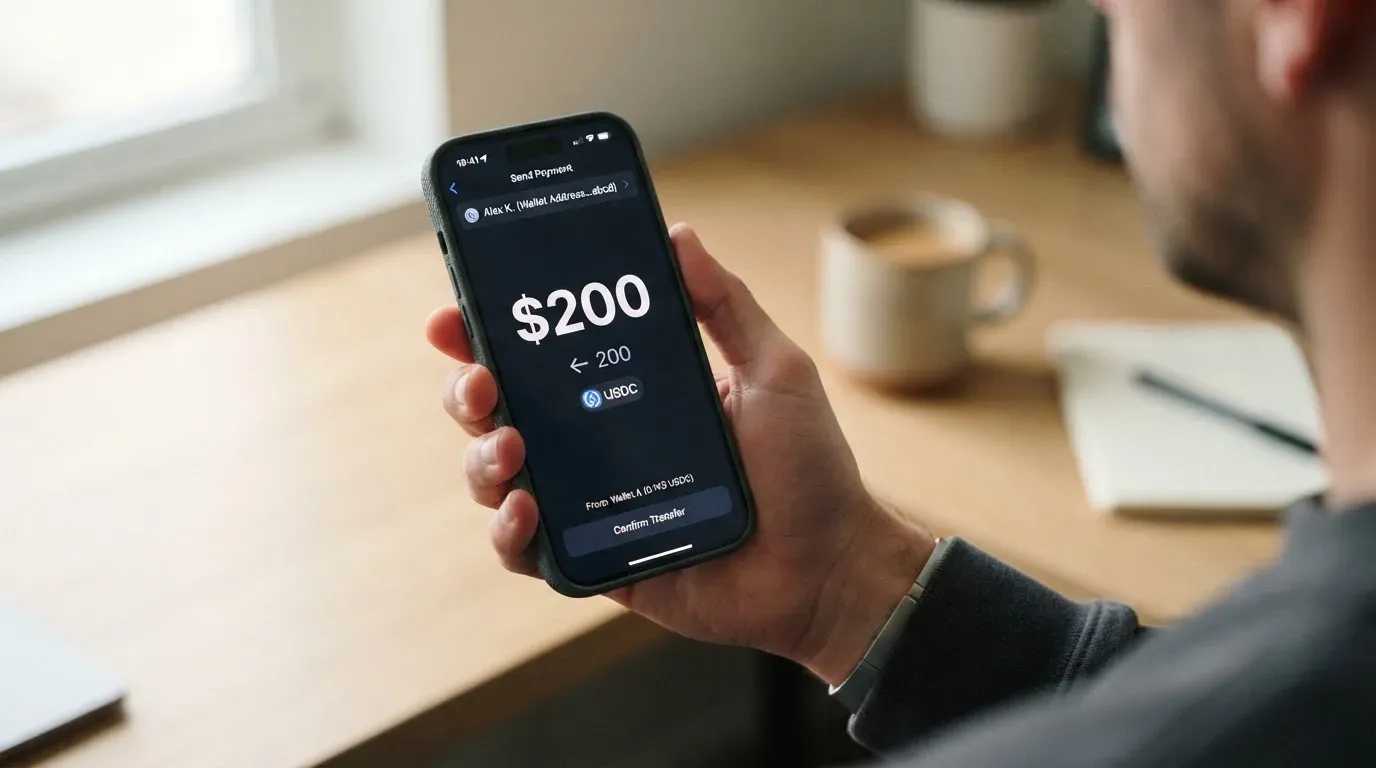
You are not limited to USDC, and you are not limited to Base. The app accepts any token on Base, Ethereum, Arbitrum, BNB Smart Chain or Polygon and converts it into Base USDC inside Tuyo. That means a wallet that holds ETH on mainnet, a token on Polygon or a stablecoin on Arbitrum can still fund a Tuyo card, with the conversion handled in the background at the 0.25% trading fee. Tuyo explicitly notes that bridging and stablecoin-to-stablecoin swaps are exempt from the volume fee, so the only cost is the gas on the source chain.
On the fiat side, Tuyo offers Apple Pay, Google Pay, debit and credit card top-ups, a linked US bank account, US dollar bank transfers via ACH or domestic wire, euro bank transfers via SEPA or SEPA Instant, and Mexican peso bank transfers via SPEI. There is no SWIFT international wire, so if your bank only sends SWIFT you will need a different route in. EUR deposits can be auto-converted to USD. The minimum top-up is not stated on the public pages. The conversion from fiat to crypto carries a “small FX spread, usually under 1%” per the FAQ.
The most underrated feature here is that the card is self-custodial. You can always withdraw your crypto back to your own wallet, even if your KYC fails or your account is restricted, with Tuyo specifically saying there are “no lock-ups, no exceptions.” Fiat withdrawals go out by bank transfer to the USD, EUR or MXN account details Tuyo issues you.
Paying with it every day
The virtual card is built to be added to a phone wallet immediately. Apple Pay and Google Pay are both supported, and once the card is tokenised you can pay contactless anywhere those wallets are accepted. The card itself is a Visa, and Tuyo has built-in freeze and unfreeze toggles, a settable PIN and an adjustable daily limit that you can change yourself in the app once you have made at least one purchase.
Some merchant categories are blocked at the card level, and when a transaction is declined you will see “Merchant not supported” in the app rather than a reason code. Apple and Google can each refuse to add the card based on their own risk checks, which can include the device, the location or the history of the Apple or Google account, and that is outside Tuyo’s control.
Rewards
Tuyo does not currently offer traditional cashback in the form the market is used to. The headline rewards programme, called BNPM, or “Buy Now Pay Maybe”, is a probabilistic system where some purchases were covered for free at Tuyo’s discretion, and that programme is closing on 31 October 2026 after the co-founder said users had exploited the rewards. The replacement, from 1 November 2026, is a flat 1.5% cashback on every purchase, with no minimums, no caps, no category restrictions and no membership requirements, but it is only guaranteed through the end of 2026.
There is also a separate points scheme called TUYOs, where you earn points from card spending, trading and the Earn strategies inside the app. TUYOs are off-chain points, not a tradable token; the FAQ describes a future token generation event, or TGE, in 2026, with at least 20% of the supply allocated to users and the community, but no token exists yet and details are not yet published.
Mobile apps and user experience
The Tuyo app on iOS asks for iOS 16.4 or later and is rated 4.4 out of 5 across 130 ratings as of late October 2026. The Android version on Google Play is rated 3.9 out of 5 across roughly 305 reviews, with more than 10,000 downloads and an update from 27 July 2026. The app supports English and Spanish per the App Store listing.
What can go wrong
The rewards change is the most visible near-term risk to the card’s value proposition. If you signed up because BNPM made a payment free some of the time, that advantage is going away at the end of October 2026, and the replacement 1.5% cashback is only confirmed through the end of that year. After that, the terms could move.
A second risk is geography, and it cuts both ways. If you are a Tuyo customer in a permitted country today, you are also a customer in a country Tuyo could decide to leave tomorrow, and the platform-wide prohibited list has already grown. If you are considering Tuyo as a primary card, treat its availability in your country as conditional.
A third risk is the company structure. Tuyo Inc. is a financial technology company, not a bank. The fiat side of the business, including fiat-to-stablecoin conversion and the virtual bank account numbers, is handled by Bridge Ventures, a licensed US money transmitter, with the relevant US and EEA compliance. Cards are issued by Signify Holdings, which trades as Rain, through licensed partner institutions under a Visa licence. Funds are not FDIC-insured, and Tuyo is not itself an electronic money institution in the EU. Tuyo Inc.’s registration jurisdiction is not stated on the company’s own pages; a third-party business directory lists Delaware.
A fourth risk is the support experience, and this is the part that recurs in user reviews. The recurring complaint themes from Trustpilot, the App Store and Google Play are app freezes after verification, support taking days to respond, country-eligibility confusion where the app says you are eligible until the card is denied, and BNPM free-purchase frequency dropping sharply after the first couple of months of use. None of these are deal-breakers on their own, but they are real patterns. The Trustpilot aggregate score for tuyo.com was not retrievable at the time of writing because the page was blocked by Cloudflare anti-bot verification.
A fifth risk is the absence of a stated dispute process. The official help centre and FAQ do not address chargebacks, disputed transactions, refund handling or time frames. The November 2025 Cardholder Agreement for international users was hosted on Notion and was not available as readable HTML at the time of writing. The card is on the Visa network, so the standard chargeback rails exist in principle, but Tuyo does not publish its own process, and that is a gap.
A sixth risk is the missing physical card. Tuyo says the plastic is “coming soon”, but does not give a date, a cost, a delivery time or a replacement fee. If you need a card you can hand to a waiter, you do not have one yet, and the timeline is unclear.
A seventh risk, less specific to Tuyo, is the operational track record of crypto card programmes in general. Visa terminated its global agreements with FTX in November 2022 and the FTX US debit card was wound down by its issuer. In 2018 Visa suspended WaveCrest in Europe, which closed a number of crypto card programmes overnight. Card programmes do not always last, and the card you have today is not guaranteed to be the card you have in two years.
What to take instead
Tuyo is not the only card of its kind, and it is worth a quick comparison with three alternatives that operate in roughly the same space, namely a self-custody-friendly or low-fee crypto Visa or Mastercard.
| Card | Score | Network | Card form | Notable fees | Top-up options | Rewards |
|---|---|---|---|---|---|---|
| Tuyo | 7.3 / 10 | Visa | Virtual only; physical “coming soon” | Up to 2% on non-USD/abroad; 0.25% crypto conversion | USDC on Base plus any token on Base, Ethereum, Arbitrum, BSC, Polygon; fiat via SEPA, ACH, SPEI, Apple/Google Pay | 1.5% cashback from 1 Nov 2026 (no BNPM after 31 Oct 2026); TUYOs points |
| MetaMask Card | 7.1 / 10 | Mastercard | Virtual, instant; Metal pre-order $199/year | “Minimal fee” per transaction, amount not stated; no foreign transaction fee | Spends directly from connected wallet on Linea, Base, Monad, Solana; mUSD, wETH, EURe, GBPe, USDC, USDT | Virtual 1% in mUSD; Metal headline 3% on first $10,000 then 1%; Blackbird $FLY bonus 5X or 7X |
| KAST | 6.1 / 10 | Visa (Platinum, Infinite, gold) | Virtual and physical, up to 10 per user | 0% on stablecoin top-up and USD spend; 0.5%–1.75% non-USD FX; $0.50 declined-transaction fee; $1/month inactivity after 12 months | USDT and USDC on Ethereum, Solana, Polygon, Arbitrum, TRON; no bank account needed | Standard 1.5% on first $2,000/month; Premium 2% on first $10,000/month; Private 3% on first $40,000/month; cashback in USD |
| TokenPocket (TP Card) | 5.8 / 10 | Visa or Mastercard depending on country | Virtual only; physical not mentioned | 1% deposit fee (refundable via rewards); FX not stated; inter-institution settlement fees possible | Crypto deposits from TokenPocket wallet on Arbitrum | No cashback stated |
Tuyo stands out from these on the self-custody story, because the card is explicitly designed to spend from your own USDC, with a withdrawal-back-to-wallet guarantee. MetaMask Card is the closest in spirit, and it has a cleaner cashback structure and a real physical card, but it is more restricted in country coverage and the fee structure is less transparent. KAST has the best low-fee profile for stablecoin-funded USD spending and a physical card, but at $1,000 to $10,000 a year for the upper tiers it is built for higher spenders. TokenPocket is the smallest and most ambiguous of the four, with fees that are hard to pin down and very limited public information on the card itself.
If your priority is self-custody plus a clean way to spend USDC, Tuyo is the strongest of the four. If your priority is a card you can hold in your hand today with predictable cashback, MetaMask Card’s Metal tier or KAST are worth a closer look. If your priority is a no-frills USD card funded by stablecoins and you do not mind the higher annual fee, KAST is hard to beat on cashback percentages.
Who I would recommend it to
I would recommend Tuyo to three specific kinds of reader. First, you are a self-custody user who already holds USDC, or who is comfortable holding USDC on Base, and you want a Visa that spends from that balance without first depositing into a centralised exchange. The Base-native design is the part of Tuyo that no other mainstream card has matched in quite the same way. Second, you live in a country that is not on the prohibited list, and you are happy to verify your residence honestly, because the verification is the one step that decides whether you can have a card at all. Third, you are comfortable with the rewards transition. The BNPM programme is ending and the 1.5% cashback that replaces it is only guaranteed through the end of 2026, so you should be choosing Tuyo for the self-custody model and the network, not for a reward that may change.
I would steer you elsewhere in three cases. If you live in any of the 27 prohibited countries or the 25 excluded US states and territories, do not bother applying; the rules are clear and an application will simply be rejected. If you need a physical card today, Tuyo will not give you one, and you should look at MetaMask Card or KAST instead. And if you are brand new to crypto and the words “self-custody” and “Base network” mean nothing to you, you will find the experience sharper on a custodial card that hides the crypto mechanics behind a more familiar interface.
For everyone in between, the honest summary is that Tuyo is a focused product built around a specific user, and it does that job well. The score of 7.3 out of 10 is the right shape for a card that gets the most important thing right, namely that your crypto stays in your wallet until the moment you spend it, while still carrying the visible risks of a young product whose rewards programme is in transition and whose support experience has drawn recurring complaints.
Frequently asked questions
What is the Tuyo card?
Tuyo is a virtual Visa debit card built into the Tuyo mobile app. It is funded by USDC on the Base network and can also be topped up with other tokens on Base, Ethereum, Arbitrum, BNB Smart Chain or Polygon, which Tuyo converts into Base USDC in the background. The card is currently virtual only, with a physical version described as “coming soon”.
How does the Tuyo card work?
You download the Tuyo app, register an account, pass identity verification with a government-issued ID, deposit USDC on Base, and the virtual card is issued immediately. Each card payment pulls from your USDC balance at the point of sale, with a 0.25% crypto conversion fee, no fee on US dollar purchases inside the US, and a 1% FX fee plus a 1% abroad fee on non-USD or non-US purchases, for a combined 2% maximum on a single transaction.
Is Tuyo a bank?
No. Tuyo Inc. is a financial technology company, not a bank. Fiat currency services such as fiat-to-stablecoin conversion and virtual bank account numbers are provided by Bridge Ventures, a licensed US money transmitter. Cards are issued by Signify Holdings, which trades as Rain, through licensed partner institutions under a Visa licence, and funds are not FDIC-insured.
Who owns Tuyo?
Tuyo is operated by Tuyo Inc. The company’s own pages do not state its registration jurisdiction; a third-party business directory lists Delaware. Cards are issued by Signify Holdings, the company that trades as Rain, which acts as Tuyo’s card-issuance partner.
Is the Tuyo card available in my country?
It depends on your verified residence. The platform-wide prohibited list covers 27 countries including Russia, Belarus, Turkey, Ukraine, the United Kingdom, India, China and Vietnam, and the card provider adds a second list with overlapping but not identical restrictions. In the United States, 25 states and territories are excluded. For everywhere else, sign-up is open subject to the standard identity check.
Does the Tuyo card require KYC?
Yes. You need to verify your identity with a government-issued photo ID, either a passport or a national ID card, and the minimum age is 18. There is a single verification level, no tiered KYC, and Tuyo states that a rejected application is final. The most common reasons for rejection are unclear photos of the ID document and occupation codes the platform does not yet support.
How do I top up the Tuyo card?
The most direct method is to send USDC to your Tuyo address on the Base network. You can also send any token on Base, Ethereum, Arbitrum, BNB Smart Chain or Polygon and Tuyo will convert it into Base USDC. On the fiat side, you can top up with Apple Pay, Google Pay, a debit or credit card, a linked US bank account, a US dollar ACH or wire, a SEPA or SEPA Instant transfer in euros, or a SPEI transfer in Mexican pesos.
How do I add the Tuyo card to Apple Wallet?
Inside the Tuyo app, open the card and look for the option to add to Apple Wallet or Google Wallet. The tokenisation request is sent to Apple or Google, and either platform can reject the request based on its own risk checks involving the device, the location or the account history, which is outside Tuyo’s control.
Is the Tuyo card safe?
Tuyo is self-custodial, which means you control the private keys and Tuyo does not hold your funds in custody. The app uses Face ID and the device secure enclave for key storage, with iCloud or Google Drive backup, and the card has a freeze and unfreeze toggle, a settable PIN and an adjustable daily limit. Funds are not FDIC-insured, fiat services are handled by a regulated money transmitter, and cards are issued by licensed Visa partners, but a chargeback process is not described in the public help centre.
Is the Tuyo card worth it?
For a self-custody user who already holds USDC and wants a Visa that spends it without first going through a centralised exchange, Tuyo is one of the more direct options on the market and earns a 7.3 out of 10 in this review. For a user who needs a physical card today, lives in a prohibited country or prefers a more traditional custodial experience, the alternatives in the table above will probably be a better fit.
Top wallet cards by score – cryptocardtop
Content created by the «cryptocardtop» team