
A Virtual Card With Three Unanswered Questions
 Available in US
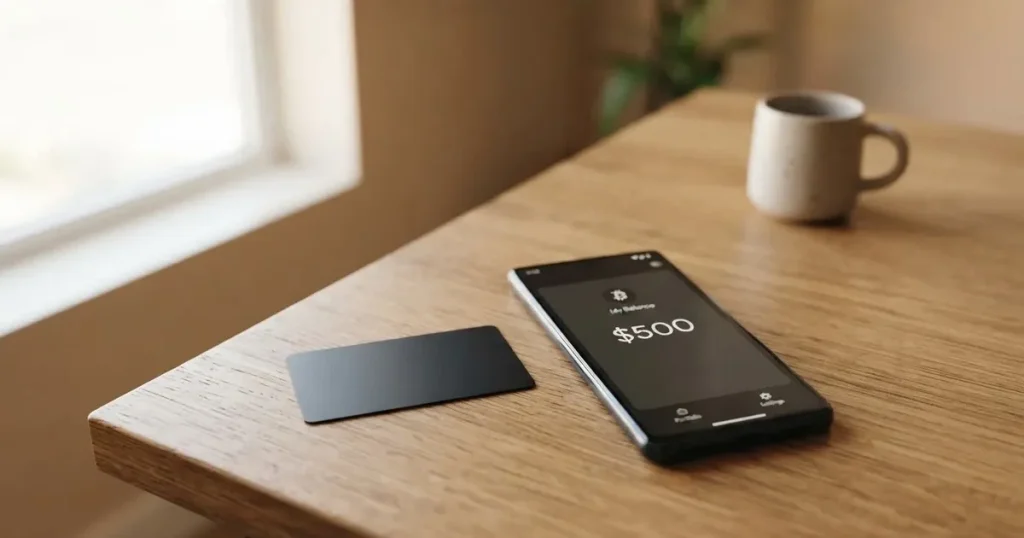
A virtual Mastercard that draws on a euro or sterling bank account and, optionally, on a crypto balance inside the hi app. That is the short version. The longer version is that the card’s own pages answer very little about who can hold it, what it costs, or which coins and networks feed it — while the public complaint record is thin and sharply negative. I went through both and this is what I can actually stand behind.
Conditions are current as of October 28, 2026.
Verdict: 4.9 out of 10
| Criterion | Mark | Why |
|---|---|---|
| Who can get it | 5 / 10 | Countries are not named on the official page; unofficial accounts say 25+ EEA states plus the UK at launch, and the UK later left |
| Cost | 8 / 10 | No fees are disclosed officially; unofficial reviews say no transaction, FX or issuance charges, with issuance free after KYC — and fees possibly later |
| Top-up options | 5 / 10 | The card is tied to a EUR or GBP IBAN and can also spend a crypto balance; coins and networks are not named |
| Reliability and complaints | 2 / 10 | Trustpilot 1.8 from 587 reviews, with withdrawal trouble, blocked cards, HI token losses and fraud allegations |
| Everyday use | 3 / 10 | Virtual only; Apple Pay and Google Pay not named officially, an ATM not disclosed |
Total: 4.9 / 10.
I want to be fair about what that 4.9 means, because a score in the middle is easy to misread. The marks that pull it up are cost and, to a lesser extent, eligibility: on paper this looks like a card with nothing to pay, and the reason you cannot get a straight answer on eligibility is that the country list is not published, not because the card is obviously closed to you. The marks that drag it down are reliability, everyday use, and top-up breadth. Three of the five lowest marks sit exactly where a card has to work hardest: can I use it today, at a shop, without surprises, and can I get money back out if something goes wrong.
Who it suits, on the evidence available: someone who already uses the hi app in Europe, already has a euro or sterling bank account, spends from that IBAN rather than from crypto, and treats the card as a convenience wrapper around a normal bank account. For that person the proposition is genuinely simple. Who it does not suit: anyone relying on the card as their primary way to spend crypto, anyone outside the European Economic Area whose only route in is a guess, and anyone for whom a virtual-only card with no published ATM or wallet support is a dealbreaker.
Will they give you the card?
Short answer: the official page does not say. The starting data points to the EEA, and the country list is not stated. That is the whole of the official position I can find, and it is thinner than it sounds.
The unofficial picture is this. At launch in 2022, per Mastercard and press coverage from that year, the card was offered to members in 25+ EEA countries and the UK. Then the UK left: Trustpilot reviews report withdrawal problems tied to that exit, in 2023 and 2024. So if you are reading older comparisons that include the UK in the eligible list, treat that as out of date.
That is the honest state of things — an unnamed starting region, an older wider list that no longer holds, and no published country table. If you are outside the EEA, or inside it but unsure, the only reliable check is the app itself: apply, and see whether the Card section becomes usable. Nobody I can point to will give you a better answer than that.
How to get it
The flow the card describes is short, which is nice: once your address is verified, you can activate the card, in the app’s Card section. What you are not told matters just as much. Age requirements, documents needed, and the identity-verification tiers are not stated on the card page. The help centre has an “Identity verification (KYC)” collection, but the page itself does not spell out what to upload.
Background worth knowing, since you will hit it whatever card you choose: KYC is not a formality. In the EU, customer due diligence covers name, address, date of birth, nationality and identity documentation, a sanctions check, the purpose of the relationship, and whether you are a politically exposed person. Nationality is screened separately from residence, because sanctions and issuer risk policy often follow citizenship and country of birth rather than just your address. If due diligence cannot be completed, the institution has to decline the transaction or the relationship, and close the account where documents stay outstanding. That is why accounts freeze pending papers — it is the rule working, not a punishment aimed at you.
The card itself is a virtual debit card, working wherever Mastercard is accepted — the page cites more than 90 million merchants — in EUR or GBP through your IBAN. Physical delivery is not stated on this page; everything you are reading concerns the virtual card.
Fees: what a payment really costs
Here is the uncomfortable shape of the hi pricing story: the costs table is mostly empty because the card does not publish it. Unofficial reviews say there are no transaction fees, no FX fees and no issuance charge, with issuance free for eligible users who complete KYC — and that fees may apply later. That last clause is the one to hold on to.

| Fee or limit | What the card says |
|---|---|
| Issuance | not stated |
| Monthly fee | not stated |
| Conversion | not stated |
| FX | not stated |
| ATM | not stated |
| Daily limit | not stated |
| Monthly limit | not stated |
Now, three everyday payments, and which fees could apply to each. I’m keeping to what the card states, which in several places means “nothing is stated” — that is not the same as zero.
- Coffee in Paris, paid from your EUR IBAN. Your balance and the transaction are in the same currency, so on the official page no conversion or FX fee is disclosed for this case. Whether the payment itself carries a fee is not stated.
- A subscription billed in dollars from a euro account. The currency mismatch is exactly where an FX fee would live, and here the card says not stated. The unofficial “no FX fees” claim is the only thing pointing the other way, and it comes with the “fees may apply later” caveat attached.
- A purchase paid from your crypto balance at hi. Spending crypto means converting at some point. The conversion rate is not stated, so you cannot compute what a euro of coffee costs when the money came in as a token.
One more thing the card does tell you: EUR or GBP, matching your IBAN currency, with the note that if your balance runs out you can top up or switch to another secondary currency. Tier-based benefits appear in the help centre under “hi Benefits”, keyed to how much HI you hold — not read, and not on the card page.
The wider category is worth holding in mind so you don’t mistake silence for generosity. On-chain network fees for a deposit are charged by the blockchain, not by the card company. And a card that looks foreign to a shop can simply be declined: some merchants treat prepaid or foreign-issued cards differently once the BIN lookup reveals the type and issuer country. That is a payment you lose, not a fee.
How to Top up
The funding model is the clearest thing about this card, and it is worth restating plainly because it is unusual. By default the card is linked to your personal IBAN currency — EUR or GBP — and transactions are covered by IBAN funds. Separately, you can also pay with crypto held at hi, in one secondary currency at a time, set in the app as your secondary payment currency. So there are two rails, and you pick which one a given purchase draws on.
What is missing is the part that matters if crypto is the point: coins and networks are not stated. No stablecoin is named, no chain is named, no deposit address scheme is shown in what I found. Top-up fees are not stated, and withdrawal terms are not stated either.
That last omission is the one I would not skip past. The complaints section of this review comes back to withdrawals repeatedly. If you are considering putting funds in with an intention of taking them out again, an unpublished withdrawal process is not a detail — it is the thing you are actually betting on.
Paying with it every day
Virtual only, as far as the official page goes. Apple Pay and Google Pay are not officially named; in the reviews, Google Pay did not work. Cash withdrawal at an ATM is not disclosed. Wallets are not stated.
Rewards, though, are promised in the card’s own words: users can earn crypto rewards with the card. No rates, no tiers, no conditions. Unofficial coverage from the 2022 launch says 1–10% back depending on tier. In the complaints record, users report that cashback was cut — 8% down to 1% in July 2023 is one example — and that tiers changed. Treat the headline rate as the top of a range that has already moved once.
The app is the hi app, with a Card section. Store ratings: the listing could not be identified through App Store search, so I have nothing to report there. Dispute handling is not stated, which matters because a card you cannot raise a chargeback through is a card where a bad transaction is simply your loss.
For context on why some of these everyday things fail: 3-D Secure adds an identity step to online payments, and under it liability for a fraudulent payment can shift — from the merchant to your bank, or, critics argue, to you. Address Verification Service compares parts of your billing address with issuer records and is mostly a US, Canada and UK thing, generally unavailable for foreign-issued cards, which can cause declines on their own.
What can go wrong
This is where the card’s silence stops being a documentation problem and becomes the substance of the review.
Trustpilot sits at 1.8 out of 587 reviews, with one review in the last 12 months. Let that last figure sit with the score for a moment: a large body of historical complaints and almost no recent ones. That is consistent with a programme that has changed shape — fewer users, or fewer users willing to write publicly — and it means the recent record is too thin to reassure anyone. The specific themes users reported, 2022 to 2025:
- Withdrawals and the UK exit, 2023–24: members told to withdraw by January, per December 2023 user reports, and difficulties doing so.
- Rewards reduced, 2022–23: the 8% to 1% cut in July 2023, and tier changes.
- Card blocked and Google Pay not working, August to September 2023, with the card reported blocked.
- HI token losing value, plus rug-pull and fraud allegations, 2023–25.
On the corporate side, the starting data names hi Technology Limited. Press from 2022 reported the card as issued by Moorwand Ltd, a Mastercard principal member, with a Contis partnership announced for the debit card and fiat accounts. The official page is silent on all of it. The help centre has a “Contact hi” collection; the help centre is in English and French, and the channels, languages and hours behind that collection were not read.
One dated item worth keeping: a help article dated 30 June 2026 says virtual debit cards are “now available”. That is recent, and it is the one piece of forward-looking good news I found. It does not answer the older questions about fees or countries, and it does not change what the complaint record says.
Security safeguards are not stated — no freeze, no limits, no 2FA description in what I could read. In this category that absence cuts both ways: the tools exist widely (instant card freeze, spending limits, 3-D Secure confirmation, tokenised mobile wallets), but whether hi offers them is unknown to me. The general risk with any custodial balance is worth stating once, because hi’s crypto side is custodial by nature: whoever holds the key controls the funds, transfers are typically irreversible, and a stolen key has no built-in recovery. The industry’s history is not reassuring — Mt. Gox, Coincheck and Ronin Network between them represent billions in reported losses — but that is background risk, not a claim about what happened to you.
What to take instead
Three alternatives, each of which publishes more than hi does. Scores are on the same ten-point scale as my hi score, so you can compare them directly.
| Card | Score | Disclosure level |
|---|---|---|
| Morse | 7.5 / 10 | Fees stated, eligibility stated, funding networks stated |
| International Visa Card | 6.7 / 10 | Fees stated, eligibility stated, physical card “Coming soon” |
| UNi Card | 6.1 / 10 | Fee policy stated, eligibility not stated |
Morse, 7.5. The most transparent of the three. Eligibility is by residence, not citizenship: at least 18, resident in a supported country, app in over 140 countries. It will not serve anyone under US sanctions, nor under UK, EU or UN ones. A list of closed-beta countries needing an invite code includes the United Kingdom, Türkiye, Switzerland, Singapore, Japan, Australia and others, and the card is “available only in certain countries” with the list unpublished — so it has hi’s opacity about eligibility, but its price list is explicit: “Zero foreign exchange fees or markups” at the real-time Visa rate, conversions at the real rate with no markup, and paying online and contactless free. Funding is the widest here: debit card, stablecoin transfer, and Account Details in USD, EUR, MXN, COP, with USDC, USDG and EURC via Solana free while other tokens and blockchains carry a fee. Fully virtual. Issuance and monthly fees are not stated — the card page says fees may apply and points to the Cardholder Agreement.
International Visa Card, 6.7. A US-issued Platinum Visa, virtual, paying in USD, with physical “Coming soon”. Its eligibility list is the most precise of any card here: not available to residents or legal registrants of Belarus, mainland China, North Korea, Cuba, India, Iraq, Iran, Israel, Myanmar, Nepal, Nicaragua, Russia, Syria, Turkey, Ukraine, Venezuela and Vietnam, with FATF grey-list countries reviewed case by case. Purchases are blocked in seven of those. Note the rule is residence or registration — citizenship is not mentioned. Pricing is explicit: $5 one-time virtual issuance, no maintenance fee, plans at Classic free, Pro $9.00/month, Max $19.00/month. Card use in USD is free on all plans; foreign currency costs the “Visa exchange rate + 2% FX fee”; deposits of any kind are free. No cashback stated.
UNi Card, 6.1. A multicurrency Mastercard spending from the UNi.Global account balance, physical or virtual not stated, eligibility not stated. What it does state is friendly: “No annual fee or foreign transaction fee”, assets converted at “live OTC rates”, “No hidden exchange fees”, and “Spend-to-Earn rewards” up to 3%. Funding not stated.
Where each beats hi: Morse on transparency of price and funding networks; the International Visa Card on a published eligibility list and a fully spelled-out fee schedule, though that 2% FX fee is real money when you spend away from the dollar; UNi Card on a stated maximum reward and a clean fee policy. Where hi is not beaten: hi’s unofficial “no fees at all” position is more generous than any of them if it holds, and none of the three publishes a comparable complaint-free record to recommend.
Who I would recommend it to
I would recommend hi to someone specific and narrow: an existing hi app member in Europe with a euro or sterling IBAN, who spends from that IBAN, and who will notice a missing country list rather than be harmed by it. For that person the card does one job simply — a virtual Mastercard in the currency they already hold — and the parts it declines to explain are parts they are not relying on.
I would not recommend it as a primary card, to anyone outside the EEA, to anyone planning to live on crypto balance through it, or to anyone who needs cash, a physical card, or a phone wallet to work reliably. The published prices, if they hold, are the strongest argument for hi; the absence of any published fee table, country list, coin list, ATM policy, wallet support or withdrawal terms is what stops that argument from being decisive.
And the 1.8 from 587 sits under all of it. Whatever the card is now, a body of users spent two to three years reporting blocked cards, reduced rewards and withdrawal problems, and the recent record is too quiet to settle the question either way. Ask your own questions of the app before you load it with money you would miss.
Frequently asked questions
What is hi card?
It is a virtual Mastercard debit card that draws on a EUR or GBP IBAN by default, and can also spend a crypto balance held in the hi app. The card’s own page says it works wherever Mastercard is accepted, citing more than 90 million merchants. Physical delivery is not stated on that page.
How does hi card work?
Payments are covered by funds in your linked IBAN in the currency of that account. You can also pay from crypto held at hi, in one secondary currency at a time, set in the app. The card’s pages do not name which coins or networks feed the crypto side, nor state a conversion rate.
Is hi a bank?
The official page does not say. Press coverage from 2022 described the card as issued by Moorwand Ltd, a Mastercard principal member, with a Contis partnership announced for the debit card and fiat accounts. The starting data names hi Technology Limited. None of that is confirmed on the card’s own pages.
Who can apply for the hi card?
The official page does not state the countries. Starting data points to the EEA. Unofficial coverage from the 2022 launch says 25+ EEA countries plus the UK, and Trustpilot reviews report the UK later exited. Applying and seeing whether the Card section activates is the only real check.
Does the hi card require KYC?
Yes, in practice: the card activates in the app once your address is verified, and unofficial reporting says issuance is free for eligible users who complete KYC. Age requirements, documents and verification tiers are not stated on the card page, though the help centre has an identity verification collection.
What does the hi card cost?
Not stated officially — that is the plain answer, and it is unusual. Unofficial reviews say no transaction, FX or issuance fees, with issuance free after KYC, and that fees may apply later. No monthly fee, ATM fee, conversion rate or spending limits are published either.
Can I add the hi card to Apple Wallet?
The card’s official pages do not name Apple Pay or Google Pay, so I cannot confirm support either way. In reviews, users reported that Google Pay did not work, and in August–September 2023 one user reported the card blocked. The app is where you would check.
Is the hi card safe?
I would not call it that on this evidence. Trustpilot shows 1.8 from 587 reviews, with reports of blocked cards, rewards cuts from 8% to 1%, withdrawal problems tied to the UK exit, and fraud or rug-pull allegations around the HI token. Security safeguards — freeze, limits, two-factor — are not stated.
Is the hi card worth it?
Only if you already live in the hi app in Europe and spend from a euro or sterling IBAN. Then the simplicity is real. If you are choosing between cards on the strength of rewards, or you plan to hold or convert crypto through it, the alternatives publish more and score higher: Morse 7.5, International Visa Card 6.7, UNi Card 6.1.
Top app and neobank cards by score – cryptocardtop
Content created by the «cryptocardtop» team