
Reading the Wenia card's own claims closely
 Available in US

The Wenia card comes with a short, tidy pitch: create it free inside an app, choose which crypto balance pays for it, then spend online anywhere a Mastercard is accepted. That pitch is genuinely attractive if you already hold the assets and cannot get an ordinary bank card to behave. It is much less attractive if you were hoping for a plastic card, a local bank account, or a spending experience that works in a physical shop.
Here is the short version of my score: 6.1 out of 10. The cost side of the ledger is the strongest part of this product — free to create, no monthly management fee, zero interest, and no extra charge when you pay in COPW, USDW or EURC. The availability and everyday-use side is the weakest: this is a digital Mastercard offered by Wenia S.A.S. in Colombia through the Wenia App, with no eligibility conditions listed, no physical card mentioned, no ATM described, and in-store payment through a mobile wallet described only as coming.
The conditions described here are current as of October 28, 2026.
Score card
| Criterion | Mark | Why |
|---|---|---|
| Who can get it | 2 / 10 | Offered by Wenia S.A.S. in Colombia through the Wenia App; availability conditions are not listed |
| Cost | 9 / 10 | Free to create, no “cuota de manejo” or monthly charges, 0% interest; COPW, USDW and EURC payments carry no extra cost, other coins may incur a conversion fee |
| Top-up options | 8 / 10 | Pay from a digital asset balance: COPW, USDW, EURC, BTC, ETH, POL, SOL, AVAX, XRP, LINK, ADA; the asset is switched in the Wenia Card section, networks not named |
| Reliability and complaints | 7 / 10 | Wenia S.A.S. (NIT 901656609-9), overseen by the Superintendencia de Industria y Comercio, Mastercard network, issuing bank not named; no complaints found |
| Everyday use | 5 / 10 | Digital Mastercard only, Apple Pay and Google Pay mentioned, in-store use via mobile wallet “coming soon”; no physical card and no ATM |
Total: 6.1 / 10
Who does this suit? In plain terms: Colombia residents paying online from a crypto balance. That is the case the product fits well, because a virtual card that spends a balance you already hold removes one of the awkwardest parts of crypto — turning it into money a shop will accept.
Who does it not suit? Almost everyone else. If you need a card you can hand over in a shop, if you need to draw cash, if you want to know exactly which network your deposit travels over, or if you live somewhere other than Colombia and were hoping the app would simply open, this is not the product for you. A 2 out of 10 on availability is not a technicality; it is the difference between a tool you can use and a tool you cannot.
Will they give you the card?
Short answer: the card’s public pages do not say who qualifies. That is worth stating plainly once, because it means every other section of this review rests on what *is* stated rather than on who is excluded.
What is stated: the product is offered by Wenia S.A.S. in Colombia through the Wenia App. That is the whole of it. The company behind it is Wenia S.A.S., registered in Colombia with NIT 901656609-9, supervised by the Superintendencia de Industria y Comercio (the SIC, Colombia’s consumer and competition authority). The page says this company issues and operates the card. The network is Mastercard. A separate bank issuer is not named.
That last detail is the one I would want a reader to notice. It is normal in this category — many crypto cards are run by a crypto brand that markets the programme while a licensed bank or e-money institution holds the card programme and the funds. Knowing that there is a licensed issuer somewhere in the chain is reassuring; not knowing who it is is not the same as there being none. If the identity of the issuer matters to you, ask support before you move anything.
Two broader points on eligibility, because people ask about these constantly. Prepaid and debit cards are generally available to adults aged 18 or over, and some issuers set higher limits. And nationality is screened separately from residence: sanctions screening and issuer risk policy are often applied to citizenship and country of birth, not just to the country you live in. Neither point tells you whether Wenia will accept you — they tell you why the answer, whatever it turns out to be, is not simply “where do you live”.
How to get it
The stated steps are short: download the Wenia App, open an account, create the card in the app, and choose the digital asset to pay with. That is the whole flow, and there is no fee attached to it.
What the card is: a digital, virtual Mastercard for worldwide online use. No physical card is mentioned. In-store use through a mobile wallet is described as coming soon — which, read carefully, means the mobile-wallet route to a physical terminal is not something the page currently promises. The card’s currency is not stated, and I would treat that as a real gap rather than a detail: without knowing the denomination, you cannot predict what a foreign merchant will do with your payment or how a conversion will be computed.
KYC details are not stated. That is not the same as saying there are none. Any regulated business in this space runs identity checks as part of anti-money-laundering and counter-terrorism-financing law, including ongoing monitoring and reporting of suspicious activity. In the EU the pattern is name, address, date of birth, nationality and identity documentation, a sanctions check, the purpose of the relationship, and a politically-exposed-person check; in the US, the customer identification programme asks for name, date of birth, address and an identification number. Colombia’s own rules apply to a Colombian product. Expect to prove who you are, and expect the account to be reviewed continuously rather than once.
One consequence worth knowing before you are halfway through an application: where due diligence cannot be completed, the institution is expected to hold off on the transaction or the relationship, and where necessary to end an existing one. Accounts get frozen pending documents far more often than people expect, and the practical way to avoid it is to submit documents that match each other exactly.
Fees: what it really costs
This is the good half of the card, and the strongest thing I can say about it. Creation is free. There is no “cuota de manejo” — the monthly management fee that quietly drains a Colombian account — and no monthly charges of any kind. Interest is 0%. And purchases paid in COPW, USDW or EURC carry no additional cost.
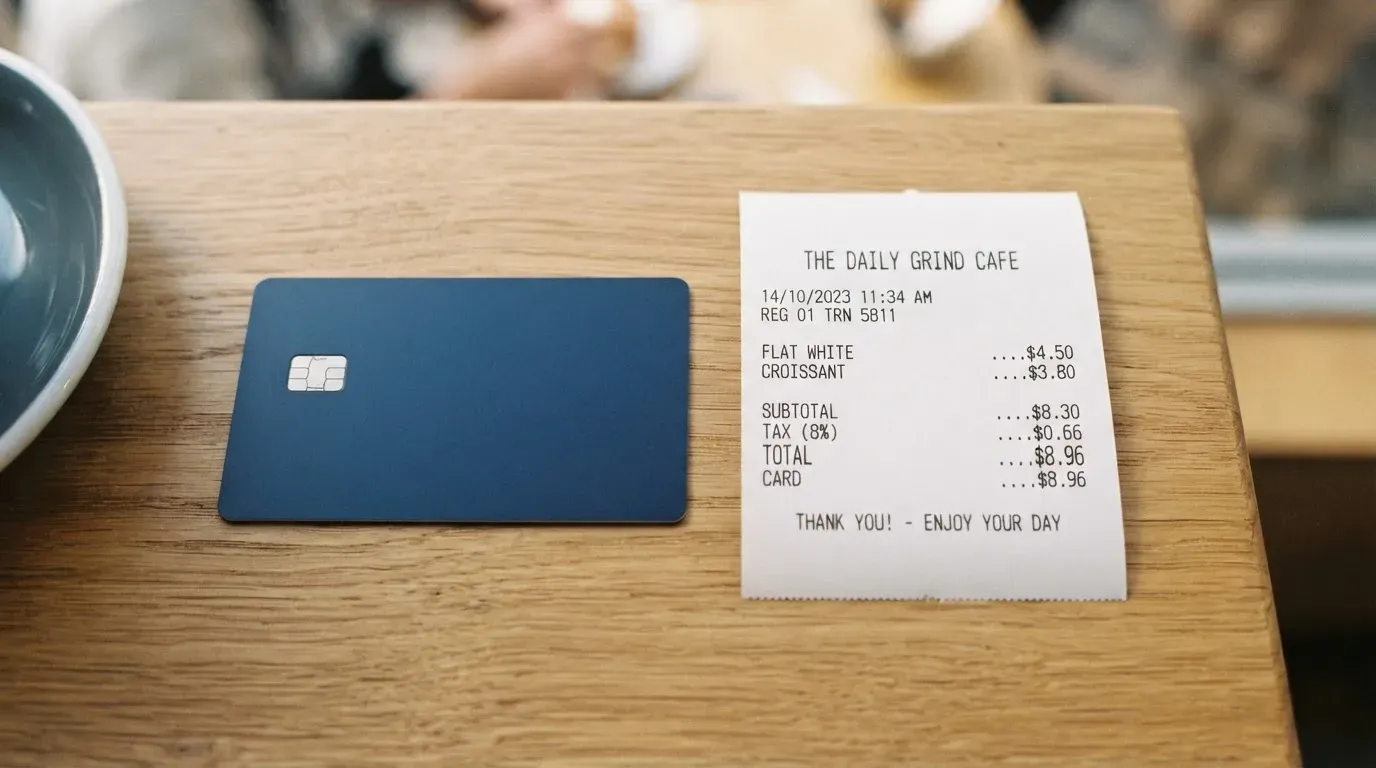
Where the numbers get fuzzy is everything else, and I would rather show you the gaps than fill them with plausible numbers.
| Item | What the card’s pages say |
|---|---|
| Card creation | Free |
| Monthly management fee (“cuota de manejo”) | None, and no monthly charges |
| Interest | 0% |
| Payment in COPW, USDW or EURC | No additional cost |
| Payment in other cryptocurrencies | A conversion fee may apply; the rate is not stated on the page |
| Foreign exchange fee | Not stated |
| ATM | Not stated (no ATM is described) |
| Spending limit | Up to 10,000 USD per month |
| Higher limits | Available on request through customer service |
| Daily limit | Not stated |
| ATM limit | Not stated |
Let me run three ordinary payments through that table, because abstract fee schedules rarely tell you what a Tuesday costs.
A subscription you pay in USDT, billed monthly. You hold USDW — Wenia’s own dollar-pegged asset — in the app, and the payment is made in one of the three no-extra-cost assets. Nothing is added on top of what you spend. This is the clean case, and it is the case the product is built around.
The same subscription paid from a Bitcoin balance. You switch the paying asset to BTC in the Wenia Card section. Now the conversion fee clause applies: choosing some other cryptocurrencies may incur a conversion fee, and the rate is not stated on the page. You are also exposed to the price of bitcoin moving between the moment you decide and the moment the charge settles. The card’s pages do not tell you what the fee is, so I cannot tell you either.
A purchase in a currency that is not your balance’s. The FX fee is not stated. This is the line I would read twice if I were you, because foreign-currency spending is exactly where a hidden percentage hides, and because a card whose own currency is not stated makes the arithmetic impossible to do in advance.
Two things that are *not* card fees but that people confuse with them. On-chain network fees — gas on Ethereum, bandwidth and energy on Tron — are charged by the blockchain for your deposit, not by Wenia. And declined payments can leave a hold on funds that stays for several days, typically up to 7. Neither appears on the table above; both can still shape what your balance looks like on any given day.
Top up: what actually funds the card
The card pays from a digital asset balance in the app, and the assets listed are COPW, USDW, EURC, BTC, ETH, POL, SOL, AVAX, XRP, LINK and ADA. You switch the asset in the “Wenia Card” section. Networks are not stated.
That last sentence is the practical trap in the whole funding flow, so let me be concrete about why. A stablecoin is not a single thing; it exists separately on many blockchains, and the same token name can be a completely different, non-transferable asset depending on which network it sits on. USDC, for example, is natively supported on 38 networks as of 16 September 2026 — Ethereum, Solana, Base, Polygon PoS, Avalanche, Arbitrum, Stellar among them. Send USDC over a network the card provider does not support, or to an address belonging to a different network, and the transfer is irreversible: it can be lost entirely, or need manual support recovery with no guarantee.
Two concrete traps inside that category. On Ethereum, fees are paid only in ETH, so a wallet holding USDT but no ETH cannot send at all. On Tron, fees are paid by burning TRX through bandwidth and energy. And “USDC over TRC20” is not a native option — Circle stopped supporting USDC on Tron in February 2024 — so an old tutorial telling you to send that is sending something that may not exist in the form you expect.
One more thing about stablecoins generally, because it bears on what “balance” means. They aim to hold a stable value, but the name is aspirational: TerraUSD collapsed in May 2022, and USDC temporarily lost its peg in March 2023 during the US banking crisis. Holding USDW or EURC means taking that risk, whatever the label says.
So the funding story is: eleven named assets, a switch in the app, and an unnamed network list. I would find out which network each deposit must go over before you send anything, not after.
Paying with it every day
This is where the 5 out of 10 lives, and it is worth being blunt: the everyday experience is thin.
What you have is a digital Mastercard that works online worldwide, plus Apple Pay and Google Pay mentioned on the home page. What you do not have, as described, is a physical card or an ATM. And in-store payment through a mobile wallet is presented as coming soon.
Apple Pay is genuinely the strongest part of the setup, so it is worth saying why. When you add a card to Apple Pay, the card number is replaced with a device-specific Device Account Number held in the Secure Element on the phone — never on Apple’s servers — and each payment generates a one-time dynamic security code. What the merchant sees is not your card number. That is a real reduction in exposure compared with typing numbers into a website, and it makes a virtual card considerably more usable day to day than it sounds on paper.
Where payments still get refused, the reasons are usually structural rather than the merchant’s mood. A merchant can look up the BIN — the 6 or 8 digit prefix identifying the issuing institution — and see which institution and which country issued the card, and may apply extra scrutiny if the issuer country differs from the customer’s billing address. Some merchants decline prepaid or foreign BINs outright, because that lookup reveals both the card type and the country. Address verification is a related quiet problem: AVS compares the numeric parts of the billing address a buyer typed — street number, ZIP — against issuer records, and it is mainly offered in the US, Canada and the UK, generally unavailable for foreign-issued cards, which can cause declines.
There is a category-level explanation for why prepaid crypto cards behave this way. A prepaid card draws on a stored balance, while a standard debit card asks your bank to withdraw from a linked account at purchase time. Many crypto cards work on the pre-loaded model: you convert or top up a balance, and the card spends only that balance, so it cannot overdraw. That is a genuine benefit — you cannot be charged for money you did not authorise — but it also means the card looks like a prepaid card to the merchant’s risk system.
Online, you may also be asked for an extra identity check. 3-D Secure adds that step to online card payments: the issuer assesses risk and either approves frictionlessly or challenges you, for example with a one-time code or biometric. Visa’s brand is Visa Secure; Mastercard’s is Identity Check. Blocked merchant categories and rewards are not stated, so I cannot tell you whether gambling, for instance, is refused — though MCC 7995 covers casinos, betting and lotteries, and many issuers block it by policy rather than by law, with the list varying by issuer.
One last everyday detail: the issuer can restrict a tokenised number — blocking it on magnetic stripe, phone or website use — and any of those restrictions can change without much warning to you.
What can go wrong
Four risks, roughly in the order I would think about them.
The issuer behind the card is not named. The page says Wenia S.A.S. issues and operates the card, and the network is Mastercard, but no separate bank issuer is identified. In this category that gap is normal but not trivial: the card network routes messages and sets rules, the licensed issuer holds the card programme and the funds, and the crypto brand is often only a programme manager and front-end. Those programmes can end. Visa terminated its global agreements with FTX on 13 November 2022 and the FTX US debit card was wound down by its issuer; WaveCrest, a Visa issuer that supplied crypto card brands, was suspended by Visa in Europe in 2018, closing every WaveCrest-issued Visa programme. Closures follow a pattern: a notice period, then loading and spending stop, then users are asked to withdraw remaining balances.
Your money sits with a provider, not with you. Whoever holds the private key controls the crypto. With a custodial wallet the provider holds the credentials, so you have to trust it completely, and a seed phrase — typically 12 to 24 words — is the unencrypted key itself; anyone who gets it can restore the wallet and spend the funds. Transfers are typically irreversible, and a stolen key has no built-in recovery, because the network can neither freeze nor return anything. The record is not theoretical: Mt. Gox (about US$350 million reported stolen, 2011–2014), Coincheck (about US$400 million, 2018), Ronin Network (US$625 million, 2022). Stablecoins are not immune to the pressure either — Tether states that it disables tokens in wallets on the OFAC sanctions list and has frozen funds tied to illicit activity.
Wrong network, gone money. Covered above and worth repeating, because it is the most likely way an ordinary user loses funds on a card like this: irreversible transfers, a network list that is not published, an address that belongs to another chain.
The account is frozen or closed during review. KYC is ongoing, not a formality. Where due diligence cannot be completed, EU rules require the institution to refrain from the transaction or the relationship and, where necessary, end existing relationships — which is exactly why accounts are closed or frozen pending documents.
On the reassuring side: no complaints or user reviews for the Wenia Card were found on Reddit, Trustpilot or in the news, and no official incidents were found. I would read that as genuinely neutral rather than as an endorsement — a young product with few users produces few complaints, and absence of evidence at this stage is not evidence of a good track record.
What to take instead
Three alternatives came up in my comparison, and the honest summary is that two of them are further along on the things this card is weak on, and one is weaker on availability.
Coinbase Card — 6.4 / 10. Available in all US states except Hawaii; account opening follows the USA PATRIOT Act identity rules (name, address, date of birth, ID), and no other countries. A Visa prepaid debit card, virtual or physical, spending cash or crypto, with all crypto converted to US dollars for purchases and ATM withdrawals. “Zero spending fees and no annual fees”, with all fees disclosed in the Cardholder Agreement and User Agreement; there are no Coinbase transaction fees, but a spread applies when Coinbase buys, sells or trades. Funding is by linking a bank account or depositing part of a paycheck into Coinbase at zero fees, and a crypto balance on Coinbase can be spent and converted to USD. Optional crypto rewards on every purchase, US card users only, at a variable rate shown in the app. The practical trade: physical card and ATM, but strictly the US.
OKX — 6.2 / 10. EU plus Norway, launched 28 January 2026, with Iceland and Liechtenstein excluded; the rule differs by whether you are an EEA user of OKX Europe Ltd., the MiCAR-licensed entity. A Mastercard, euro-denominated virtual debit card linked to OKX Pay, issued via an unnamed European licensed payment provider; no physical card mentioned. No card fee and no transaction or OKX FX fee; the conversion spread is the point to watch, given as 0.1% by an explainer in May 2026 against 0.4% in the launch press release. Funding is USDC or USDG held in OKX Pay, with other coins converted first, no auto top-up, and a decline if the balance is short. Cashback only on USDG purchases (USDC earns none), with monthly caps in EUR running from Regular 2% capped at 10 up to VIP4+ 10% capped at 1,000; a launch release advertised a 30-day promo of up to 20% for VIP and 15% for regular. Wider geography than Wenia, still virtual-only, and it depends on which figure for the spread is current.
Young Card — 5.7 / 10. The thinnest of the three on public detail: eligibility, card form, cost, fees and funding for the card itself are not stated. What is clear is the rewards structure — cashback paid in YNG tokens at a rate set by Club tier, Essential 0.1%, Gold 1.8%, Platinum 3.6%, with Bronze and Silver not stated. A rewards proposition you can only partly see, attached to a product whose basic terms are not published, is hard to recommend over anything.
| Wenia | Coinbase | OKX | Young | |
|---|---|---|---|---|
| Score | 6.1 / 10 | 6.4 / 10 | 6.2 / 10 | 5.7 / 10 |
| Where | Colombia | US states except Hawaii | EU plus Norway | Not stated |
| Card form | Digital Mastercard | Visa, virtual or physical | Mastercard, virtual | Not stated |
| Physical card | Not mentioned | Yes | Not mentioned | Not stated |
| ATM | Not stated | Yes, with conversion | Not stated | Not stated |
| Stated cost | Free, no monthly fee | No spending or annual fees | No card fee | Not stated |
| Rewards | Not stated | Optional crypto rewards | Cashback on USDG only | YNG cashback by tier |
One thing I would not do with any of them, and it is the mistake that catches new card users: assuming that a global card means global acceptance everywhere. It means the card network will route the payment. The merchant’s acquirer, their risk rules and, in some countries, local rules still apply — and in Colombia specifically, Wenia’s home market, that is where local knowledge helps you and does not.
Who I would recommend it to
I would recommend the Wenia card to someone living in Colombia who already holds COPW, USDW or EURC, pays most of their spending online, and is comfortable managing the balance in an app. For that person it is close to ideal: creating it costs nothing, keeping it costs nothing, borrowing against it costs nothing at 0% interest, and paying from one of the three core assets adds no fee at all. Add Apple Pay and the daily friction of a purely virtual card drops a long way.
I would not recommend it to someone who wants a card they can put in a wallet, someone who needs cash from an ATM, someone outside Colombia reading a review and hoping the app will open for them, or someone who plans to hold a balance across many different assets and wants to know the conversion rate in advance. The first two are simply not offered. The third is not addressed. The fourth is not published.
Before you commit, here is the short list I would work through:
- Ask who the issuing bank is. The card’s pages do not name it.
- Ask which networks each deposit must use. Not stated, and irreversible if you guess wrong.
- Ask what the conversion fee is on assets other than COPW, USDW and EURC. Not stated.
- Check whether 10,000 USD a month is enough for you, and what a higher limit requires. Higher limits are available on request.
- Confirm what happens to a declined payment’s hold. Holds can sit for up to 7 days.
And one thing not on any list, because it is not the card’s business: if you spend crypto regularly, each payment funded from crypto may be a separate taxable disposal, measured in local currency at fair market value on the date of the transaction. Whether that applies to you, and how, is a question for a tax professional in your country, not for me and not for any card review.
Frequently asked questions
What is the Wenia card?
It is a digital Mastercard offered by Wenia S.A.S. in Colombia through the Wenia App, paid from a digital asset balance you hold in that app. It is described as usable online worldwide. No physical card is mentioned, and in-store payment through a mobile wallet is described as coming soon. The card’s own currency is not stated on the card’s pages.
How does the Wenia card work?
You download the Wenia App, open an account, create the card inside the app, and choose which digital asset pays for it — one of COPW, USDW, EURC, BTC, ETH, POL, SOL, AVAX, XRP, LINK or ADA. At purchase time the chosen balance funds the payment, in the pre-loaded model most crypto cards use, so the card spends only what is there.
Is Wenia a bank?
No — not on the evidence available. Wenia S.A.S. (NIT 901656609-9) is a Colombian company supervised by the Superintendencia de Industria y Comercio, and its page says it issues and operates the card on the Mastercard network. No separate bank issuer is named, which is normal in this category but leaves a question worth asking before you fund it.
Who owns Wenia, and is it regulated?
Wenia S.A.S. is the company named on the card’s pages, registered in Colombia with NIT 901656609-9 and supervised by the Superintendencia de Industria y Comercio. The card’s pages say it issues and operates the card. For crypto assets in the EU, MiCA is the relevant framework — its stablecoin rules applied from 30 June 2024 and its provider rules from 30 December 2024 — but Wenia is a Colombian product, so Colombian rules are what apply to it.
Is the Wenia card available in my country?
The card’s pages do not list eligibility conditions, so I cannot tell you. What is stated is that Wenia S.A.S. offers the product in Colombia through the Wenia App. Availability is where this card scores lowest for me — 2 out of 10 — precisely because the conditions are not published rather than because they are restrictive.
Does the Wenia card require KYC?
KYC details are not stated on the card’s pages. In practice, any regulated provider runs identity checks under anti-money-laundering law, including ongoing monitoring and suspicious-activity reporting, and EU rules typically cover name, address, date of birth, nationality, identity documents, a sanctions check and a politically-exposed-person check. Where due diligence cannot be completed, the expectation is to hold off and, if needed, close the relationship.
Is the Wenia card free?
Creating it is free, and there is no “cuota de manejo” and no monthly charges. Interest is 0%. Payments made in COPW, USDW or EURC carry no additional cost. Paying with other cryptocurrencies may incur a conversion fee and the rate is not stated. The foreign exchange fee is also not stated, and no ATM is described.
How do I top up the Wenia card?
You pay from a digital asset balance in the app, and you switch which asset is used in the “Wenia Card” section. The listed assets are COPW, USDW, EURC, BTC, ETH, POL, SOL, AVAX, XRP, LINK and ADA. Networks are not stated, so find out which network a deposit must go over before sending — an irreversible transfer to the wrong network can be lost or need manual recovery.
Is the Wenia card safe, and can I use it in Apple Wallet?
Apple Pay and Google Pay are mentioned on the Wenia home page. Adding a card to Apple Pay replaces the card number with a device-specific Device Account Number stored in the phone’s Secure Element, never on Apple servers, with a one-time dynamic code per payment. Beyond that, safety depends on factors the pages do not cover, including who holds your funds and who the unnamed issuing bank is.
How do I withdraw money or close my account?
Neither is described on the card’s pages. No ATM is offered or mentioned, and no withdrawal process is stated, so the only route the card’s own material points to is spending the balance. Account deletion is likewise not covered. If cash access or an exit route matters to you, raise both with Wenia’s customer service before you deposit anything you would not want stuck.
Top exchange cards by score – cryptocardtop
Content created by the «cryptocardtop» team