
MP card review: a wallet with two cards attached, and a price list worth reading twice
 Available in US
The MP card is not really a bank card in the ordinary sense. It is a payment card attached to a crypto wallet, sold by a company called MP Network Inc under the brand name MPChat, and it draws its money from a balance you load yourself. Two card options exist today: a virtual one called Cloud Card and a physical Visa called Boundless Card. My score for it is 7.1 out of 10 — a good score for a card of this kind, and not a good score if what you need is a card that behaves exactly like the one already in your bank wallet.
Let me be specific about who this suits and who it does not. If you cannot get an ordinary bank card, or you would rather not sit through a bank’s own onboarding and its account review, this is genuinely worth a look: it opens on a phone, it accepts two major stablecoins, and it gives you both a virtual card and a physical one from the same wallet. If instead your priority is a predictable all-in cost, a long public track record, or a card that is accepted everywhere without odd looks at the checkout, look elsewhere first. There is no published user-review history to judge this by, and the fee schedule is good on paper and worse in practice once you spend outside dollars.
The conditions described here are current as of October 28, 2026.
| Criterion | Mark | Why |
|---|---|---|
| Who can get it | 8 / 10 | 23 countries closed including Russia and Belarus, plus a list of disputed territories; the rest of the world is open, decided by where your document was issued and where you live |
| Cost | 5 / 10 | Cloud Card 10 USDT, Boundless 100 USDT, no monthly fee; 0.80% per transaction, crypto conversion $0; ATM 2% with a $1 minimum |
| Top-up options | 7 / 10 | USDC and USDT into the MP wallet, described as non-custodial, via Binance Pay or on-chain, then on to the card; the networks are not listed |
| Reliability and complaints | 7 / 10 | MP Network Inc holds a US MSB registration, El Salvador BSP and DASP licences and a Hong Kong TCSP; the issuing bank is not named; the Flash Card is retired as of 30 September 2026; no user reviews found |
| Everyday use | 9 / 10 | Virtual Cloud and physical Boundless Visa; Apple Pay and Google Pay, with Alipay and WeChat Pay on Cloud as well; ATM access on Boundless |
| Total | 7.1 / 10 | A capable wallet card with an unusually good everyday-use score, held back by an unnamed issuing bank, no review history and a fee that bites hardest on non-dollar spending |
Will they give you the card?
Yes for most of the world, and no quite firmly for a long list of places. MP states the card is unavailable in 23 countries “due to regulatory compliance”: Afghanistan, Belarus, Central African Republic, Cuba, DR Congo, Dominican Republic, Guinea-Bissau, Haiti, Iran, Iraq, Lebanon, Libya, Mali, Myanmar, North Korea, Russia, Somalia, South Sudan, Sudan, Syria, Venezuela, Yemen and Zimbabwe. Both Russia and Belarus are on that list, which tells you something about how the company reads its own compliance obligations.
There is a second, quieter list. KYC cannot be completed in parts of Ukraine — Crimea, Donetsk, Luhansk, Zaporizhzhia, Kherson — and also in Abkhazia, South Ossetia, Northern Cyprus, Somaliland, Transnistria and Nagorno-Karabakh. So there are two separate gates: a country-level blocklist and a territory-level one.
Eligibility, in the card’s own words, is “based mainly on your document’s place of issue and your registered residential address”. That phrase matters more than it first appears, because it means your nationality is not the only question, and neither is your address alone. You can live in an open country holding a document from a closed one and still be refused. The pages also state plainly that documents cannot be switched in order to get around a regional restriction — which, read strictly, means you cannot pick a different passport to get past the list. There is no citizenship-by-country table to consult before you apply; the address on your ID and where you actually reside are the operative facts.
What is *not stated* on the pages I read: proof of address is not mentioned as a requirement, and the Cloud Card’s card network is not named. If either of those matters to you, ask support before you send documents.
How to get it
The signup path is short and entirely in the app. MPChat runs on iOS and Android. You register, then go to Assets and tap Activate Now, fund the wallet, choose a card type and buy. There is no branch, no paper application, no call.
KYC is level one: you need to be 18 or older, give basic personal information, present a government-issued document (passport or national ID) and pass a selfie liveness check. One identity can verify only one account — a second account on the same identity is listed as a rejection reason. Your document needs an expiration date more than three months away, which in practice means renewals close to expiry will fail.
The rejection reasons the card publishes are worth reading before you try, because most of them are avoidable in one sitting: under 18, an unsupported country, blurry or cropped or printed or expired documents, a face mismatch or another person in frame, a second account on the same identity, and a mismatch between your name, date of birth and document number. Processing time is not stated, so plan for it not being instant.
There are two account tiers. Registered means a phone-number sign-up: transfers capped at 1,000 USD a day, 10,000 USD in total, and no card. KYC1 is the tier that gets you the card, with unlimited transfers and withdrawals up to 200,000 USD a day. You cannot get from Registered to a card without passing KYC1.
| Account tier | What you get | Limits |
|---|---|---|
| Registered | Phone sign-up, no card | Transfers capped 1,000 USD/day, 10,000 USD total |
| KYC1 | ID plus selfie liveness, card application | Unlimited transfers; withdrawals up to 200,000 USD/day |
On the card itself: the Cloud Card is virtual, billed in USD, issued in Singapore, with no ATM function. The Boundless Card is a physical Visa, BIN 45659910, USD. There was a third option, the Flash Card, virtual Visa with BIN 40433705 — it has been retired, so you will not find it offered.
Delivery for Boundless is the soft spot. The delivery time and region are “subject to the announcement on the Boundless Card application details page”, and postage, if any, is set there too. In other words the shipping cost and the wait are not on the pages I read. Reissue and replacement are clearer: $5 for the first card, $10 for each later one, with at least 31 days between reissues.
Fees: what it really costs
Here is the honest version. The headline numbers look good and the small print is where your money goes. Setup is 10 USDT for the virtual Cloud Card and 100 USDT as a “card opening fee/card production fee” for the physical Boundless. The monthly fee is $0. The retired Flash Card was 10 USDT.
| Item | Fee or limit |
|---|---|
| Cloud Card (virtual) | 10 USDT |
| Boundless Card (physical) | 100 USDT card opening / production fee |
| Monthly fee | $0 |
| Crypto-to-fiat conversion | $0 |
| Transaction fee | 0.80% of each transaction |
| FX / cross-border | Pass-through set by the card issuer, varies by country or region |
| Small-value fee | $0.15 per transaction of $1 or less |
| ATM (Boundless only) | 2%, minimum $1 |
| ATM limits (Boundless) | $1,500 per transaction, $1,500 per day (max 5), $15,000 per month |
| ATM availability | Unavailable in mainland China, prohibited in Singapore |
| Cloud Card ATM | None |
| Declined payment | $0.80, first 5 per month waived |
| Dispute / chargeback | $35 per case |
| Refund | $0 |
| Reversal | $0.80 if the reversal rate reaches 15% or more |
| Online withdrawal | 2.1 USDT per transaction, plus 0.1% on same-day withdrawals above 5,000 USDT |
| Rewards balance | Mentioned; cannot pay reissue fees, rate not published |
Now the three everyday payments, because a percentage only means something when you attach it to something you would actually buy.
A $40 grocery shop in dollars. The transaction fee is 0.80% of $40, so 32 cents, and the $0.15 small-value fee does not apply because the payment is above $1. Crypto conversion is $0, and because you are spending in the card’s own billing currency there is no FX layer on top. All-in, about 32 cents. The card’s own summary puts USD spending at roughly 1% all-in once the network and the issuer’s own charges are counted, which is the figure to hold in your head.
A €25 dinner paid from a dollar balance. Now it hurts. The 0.80% transaction fee is 20 cents. On top sits the FX/cross-border charge, which MP does not set itself — it is a pass-through determined by the issuing bank and varies by country and region. MP’s own guidance is that non-USD spending runs about 1.8% to 2.2% all-in. Add the layers up and you can see the gap: the fee that looks small is not the fee you pay. If you live outside the dollar area, this is the number that should decide whether you use the card at all.
A $0.80 parking fee. Below $1 you pay the $0.15 small fee on top of the percentage, and at this size the fixed charge competes with the 0.80% rather than sitting politely beside it. Small-value payments are where this fee structure is least sensible. Use the mobile wallets for these instead — see below.
Two things the card does not price that will still reach you. Online withdrawal costs 2.1 USDT per transaction plus 0.1% on same-day withdrawals above 5,000 USDT, and the minimum top-up is not stated anywhere I looked. And a single dispute costs $35 — more than most things you would be disputing. So do not use this card for purchases you might need to charge back.
The spending limits the card publishes come in three sets, which map to the card names by position rather than by an explicit label, so treat that attribution as inferred: single transaction $100,000 / $20,000 / $100,000; daily spending $250,000 / $1,000,000 / $250,000; monthly $1,000,000 / $5,000,000 / $1,000,000; annual $2,000,000 / $10,000,000 / $2,000,000, with the middle set also carrying 100 transactions a day. Read that as generous on paper rather than as an assurance; the issuer and the risk checks sit above these numbers.
How to top it up
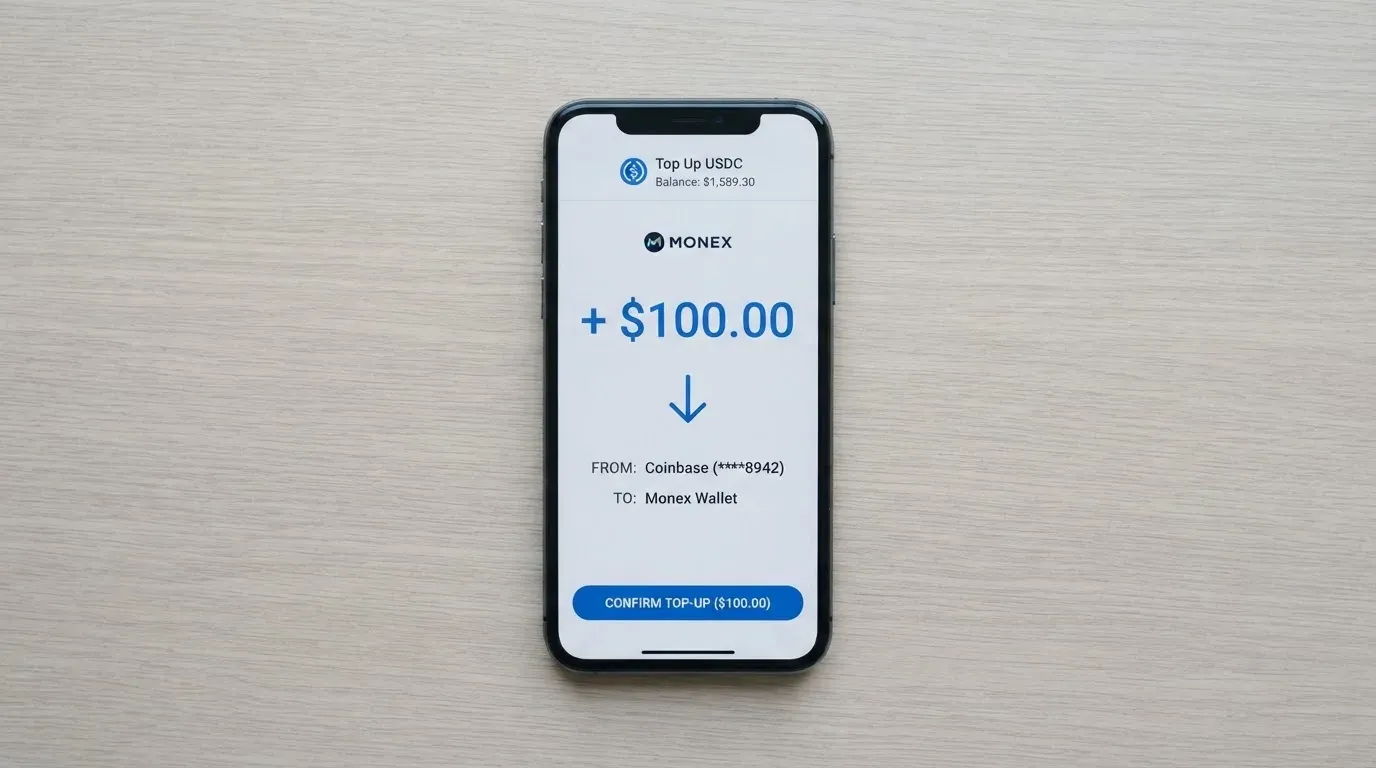
You start with stablecoins, and the route is short. Deposit USDC or USDT into the MP Wallet, which MP describes as non-custodial, either through Binance Pay or on-chain, and then transfer from the wallet to the card. There is no bank transfer step described for topping up.
The gap to know about before you send anything: the specific networks are not listed on the pages I read. That is not a small thing. If you send USDT over a network MP does not support, or to an address belonging to a different network, the transfer can be lost or need manual support recovery with no guarantee of success — blockchain transfers are irreversible, and there is no chargeback for a mistaken address. Before your first deposit, confirm in the app which networks are live for USDT and USDC, and send a small test amount first.
One background point worth having, since you will meet it in a wallet interface sooner or later: sending a token also costs the network’s own fee, charged by the blockchain rather than by the card provider. On Ethereum that means gas paid in ETH, so a wallet holding USDT with no ETH cannot actually send it. Some networks price this through internal resources rather than a per-token fee, burning their own native token instead.
An issuance or top-up fee is not listed on the fee page. The minimum top-up is not stated. And if you close the account, what happens to the balance is not stated either.
Paying with it every day
This is the card’s strongest suit, and it earned the 9 out of 10. The Cloud Card links with Alipay, WeChat Pay, Google Pay and Apple Pay. The Boundless card supports Apple Pay and Google Pay. That is where I would actually put your spending: pay through the phone wallet rather than handing over the physical card or typing the number into a website, because the mobile route is faster at a till and cleaner online. It also keeps the card number off sites you would rather it was not on.
A virtual card is the safer of the two for anything you would not want a stranger to see. The physical card adds ATM access, at 2% with a $1 floor — worth knowing that the ATM is unavailable in mainland China and prohibited in Singapore, so this feature is not universal even where the card itself works.
What I could not establish: store ratings for the app were not obtained, blocked merchant categories are not stated, and there is no published rewards rate. The card does mention a “rewards balance” that cannot be used to pay reissue fees, which tells you a rewards programme exists without telling you what it pays. Time frames for disputes are not stated either.
Where this card runs into friction is the friction every crypto card meets. A card number carries an issuer identification number at the front, and merchants can look it up to see which institution and country issued it — and may apply extra scrutiny if that country differs from the customer’s billing address. This card’s cards are issued in Singapore, so a Singapore BIN on a European billing address is exactly the shape of thing that can invite a second look. Address verification, which compares what you type at checkout against issuer records, is generally unavailable for foreign-issued cards and is a common cause of declines. Some merchants decline prepaid or foreign-issued cards outright because the lookup reveals both. None of that is MP-specific, and none of it is fixable from your side.
What can go wrong
The three things I would actually worry about are the product’s own record, the missing issuer, and the network question above.
On the record: the Flash Card was permanently retired on 30 September 2026, with issued cards converted to Cloud Cards and balances moved to Total Assets. Programmes do close. This is the single most useful thing the company has done recently that you can read about — it published the closure rather than letting balances quietly stop working — but it also demonstrates the point. When this card or this company changes direction, your balance moves on their schedule, not yours.
On the issuer: the cards are issued in Singapore and the issuing bank is not named. Licences are listed in the help centre — a US MSB registration, El Salvador BSP and DASP, a Hong Kong TCSP — in a statement dated 13 August 2026, with the issuing authorities not named either. A named issuer is the most useful single fact on a card’s page, and this page does not have one.
On reviews: I searched for user reviews of MPChat and found none. No Trustpilot page, no Reddit discussion, nothing to read. That cuts both ways. There is no pile of complaints, and there is also no long public record of anyone else’s daily experience.
On security specifically, what is published is that the wallet is non-custodial, that card funds are “securely backed within a regulated trust framework”, and that spending limits can be managed in the app. Instant freeze in the app and two-factor authentication are not confirmed on the pages I read, and neither are blocked merchant categories — so do not assume either exists.
One last thing worth knowing about the balance in general: blockchain transfers are irreversible, and stablecoins themselves can move off their peg. TerraUSD collapsed in May 2022 and USDC temporarily lost its peg in March 2023 during the US banking crisis. The dollar-pegged tokens this card accepts are the most ordinary part of the stack, not the least.
What to take instead
If MP’s 0.80% plus a variable FX pass-through is not competitive for where you live, these are the three I would weigh against it.
| MP | TokenPocket | MetaMask | KAST | |
|---|---|---|---|---|
| Score | 7.1 / 10 | 5.8 / 10 | 7.1 / 10 | 6.1 / 10 |
| Card | Virtual and physical Visa | Mastercard/Visa debit, virtual | Mastercard virtual, Metal physical | Virtual and physical Visa Platinum/Infinite |
| Setup cost | 10 USDT virtual, 100 USDT physical | NFT creation fee partly covered, user pays a small portion | Virtual free; Metal $199/year | Standard 0 USD/year, Premium 1,000 USD/year, Private 10,000 USD/year |
| Transaction fee | 0.80% | 1% charged on crypto deposit into the card, refunded later via rewards | “Minimal fee”, amount not stated; no MetaMask fees | 0% on USD card spend |
| FX | Issuer pass-through, varies | Not stated | No foreign transaction fee, Mastercard rate used | 0.5%–1.75% on non-USD |
| Rewards | Rate not published | No cashback stated; deposit fee refunded via rewards | 1% cashback Virtual, 3% Metal up to $10,000 then 1%, in mUSD | 1.5% / 2% / 3% USD cashback by tier, with caps |
TokenPocket is the cheapest to try and the most awkward in practice. Its card runs on Arbitrum, with balances in EUR24 and USD24, and its fees are different in shape from everyone else’s: the 1% is charged on the deposit, not the purchase, and is meant to come back later as rewards or reduced transaction fees — which means you are trusting a refund. Coverage is regional rather than global: Visa debit for a list of European countries and territories, Mastercard debit for Australia, Canada, Hong Kong, Japan, Taiwan, New Zealand, Singapore, South Korea and the UK, with the Americas described as planned for Q2 2025. Its cards are virtual.
MetaMask ties MP on score and beats it on transparency and on the cost of spending outside the US. You sign up in 45 listed countries and territories, other regions go to a waitlist, and US and UK sign-ups were temporarily closed per the FAQ. Proof of residency is required and, importantly, ineligible regions limit sign-ups rather than spending. The virtual card is free and instant; the Metal card is $199 a year. There is no foreign transaction fee, so non-dollar spending uses the plain Mastercard rate, and cashback is 1% on Virtual or 3% on Metal up to the first $10,000. It spends directly from your connected wallet on Linea, Base, Monad or Solana. The issuer is named (Monovate) and the card provider is named (Crypto Life), which is more than MP’s pages give you. One card per user.
KAST is the one to look at if your problem is the cost of spending. Standard costs nothing, with 1.5% cashback on the first $2,000 a month; Premium is 1,000 USD a year with 2% on the first $10,000; Private is 10,000 USD a year with 3% on the first $40,000. Stablecoin top-up is 0%, USD card spend is 0%, transaction fee is 0%, Apple and Google Pay are 0%. The catch is FX: 0.5% to 1.75% on non-USD spending depending on where you live, where you spend and which programme, plus 0.10 USD on non-USD transactions under 25 USD and 0.50 USD for a declined transaction. Its country list is not published — the app shows a residence-based list at KYC and references a Restricted Locations list with no countries named — and if you live in a supported country but hold an ID from a restricted region you may still fail. A VPN does not help.
None of these is a clean winner. MetaMask has the clearest issuer story; KAST has the cheapest spending; TokenPocket is the smallest commitment.
Who I would recommend it to
I would recommend MP to someone specific: a person who cannot open an ordinary bank card, or who has simply decided not to try, and who wants a virtual and a physical card from the same crypto wallet without a second relationship. If that is you, the 10 USDT virtual card is a cheap way to find out whether it works for you, and the 100 USDT physical card is worth it only if you genuinely need to tap a card on a terminal.
I would not recommend it to someone whose main worry is cost in a non-dollar currency. At 1.8% to 2.2% all-in on non-USD spending, plus a $35 dispute fee and a small-value charge that bites under a dollar, you are paying a premium for flexibility rather than the reverse.
And I would hold back for anyone asking whether it is safe in the sense of settled. What I can tell you is what is published: the wallet is described as non-custodial, card funds are described as securely backed within a regulated trust framework, and spending limits can be managed in the app. What I cannot tell you is the issuing bank, which is not named.
Support, if you need it before signing up: in-app under Me – Customer Support, by X, by email at [email protected], and a help centre at help.mp.net in English, Simplified and Traditional Chinese. Hours are not stated.
Frequently asked questions
What is MP card?
MP is a payment card offered by MP Network Inc under the brand MPChat, drawn against a balance you load into its crypto wallet rather than a bank account. It comes as a virtual Cloud Card or a physical Visa called Boundless. The company describes itself as a financial technology company, not a bank.
Is MP a bank?
No. MP Network Inc, registered at 8 The Green, Suite B, Dover, DE 19901, USA, calls itself a financial technology company, not a bank. It lists a US MSB registration, El Salvador BSP and DASP licences and a Hong Kong TCSP. The issuing bank behind the cards is not named on its pages.
How do I get the MP card?
Register in the MPChat app for iOS or Android, go to Assets, tap Activate Now, fund the wallet, then choose and buy a card. The virtual Cloud Card is 10 USDT; the physical Boundless Card is 100 USDT. You must pass KYC1 first — ID plus a selfie liveness check.
Does MP card require KYC?
Yes, for the card. A phone-only Registered account allows transfers up to 1,000 USD a day and 10,000 USD in total, with no card. KYC1 needs a passport or national ID with more than three months to expiry plus a selfie liveness check, and unlocks the card and withdrawals up to 200,000 USD a day.
Is MP card available in my country?
Not in 23 countries, including Russia and Belarus, plus parts of Ukraine and several disputed territories where KYC cannot be completed. Eligibility depends mainly on where your document was issued and where you are registered as resident. The pages state documents cannot be switched to get around a regional restriction.
How much does MP card cost?
The virtual Cloud Card is 10 USDT and the physical Boundless is 100 USDT, with no monthly fee. Then: 0.80% per transaction, $0 crypto conversion, $0.15 on payments of $1 or less, issuer-set FX on non-USD spending, 2% at ATMs with a $1 minimum, and $35 per dispute case.
Is MP card free?
The Cloud Card is close to free at 10 USDT and there is no monthly charge, but it is not a no-cost card. Spending costs 0.80% per transaction, roughly 1% all-in in dollars and 1.8% to 2.2% outside dollars. Withdrawing online costs 2.1 USDT per transaction plus 0.1% above 5,000 USDT in a day.
How do I top up the MP card?
Deposit USDC or USDT into the MP wallet — described as non-custodial — via Binance Pay or on-chain, then transfer the balance to the card. The pages I read do not list which networks are supported, and blockchain transfers are irreversible, so check the supported network in the app and test with a small amount first.
Is MP card safe to use?
The wallet is described as non-custodial and card funds as securely backed within a regulated trust framework, with limits manageable in the app. What is not established: the issuing bank is unnamed, app ratings were not available, and a search found no user reviews of MPChat at all — so there is no independent track record to lean on.
Is MP card worth it?
If you cannot get a normal bank card, it is worth 10 USDT to try. If you spend mainly outside the dollar area, the issuer’s FX pass-through lifts you to roughly 1.8% to 2.2%, and a MetaMask or KAST card may cost you less. The $35 dispute fee also argues against using it on anything you might need to charge back.
Top wallet cards by score – cryptocardtop
Content created by the «cryptocardtop» team