
A self-custody Visa that spends USDC, USDT, AVAX and WAVAX straight from your Avalanche wallet
 Available in US

The Avalanche Card is a Visa payment card that draws on USDC, USDT, AVAX and WAVAX held in your own Avalanche wallet. It is built by Ava Labs and powered by Rain Liquidity, and it promises something that most crypto cards do not: you keep custody of the assets until the moment of payment. There is no monthly fee, no issuance cost, and a 1% foreign exchange fee. The catch is that eligibility is narrow, the bank’s name is not published, and the public materials are thin on the details that matter for daily use, such as ATM access, daily limits, and dispute handling.
This review is written for anyone, anywhere, who is having trouble getting an ordinary bank card and is weighing a crypto-backed alternative. I have gone through the card’s public pages, its app, and the third-party sources that follow it, and I report here what I found, what is confirmed, what is not, and where I think a different card would serve you better.
The conditions described here are current as of October 28, 2026.
Verdict
I give the Avalanche Card 6.9 out of 10. It is a clean, well-designed self-custody product with no monthly fee, but it sits behind a short eligibility list, an unnamed issuing bank, and a support operation that users describe as slow. If you live in a supported country, hold USDC on the Avalanche network, and want to spend that balance in shops without selling on an exchange first, it does the job. If you want a card with cashback, ATM access clearly defined, and a real customer service hotline, you should look elsewhere.
Score breakdown
| Criterion | Mark | Why |
|---|---|---|
| Who can get it | 7 / 10 | Many US states, Latin America and the Caribbean are open; 18 countries and 16 US states are excluded. Unofficial sources say 172 countries are reachable. |
| Cost | 8 / 10 | Virtual and physical issuance, shipping, and monthly fee are all $0. The published FX fee is 1%, though unofficial disclosures put it between 2% and 3%. |
| Top-up options | 6 / 10 | USDC, USDT, AVAX and WAVAX as collateral on the Avalanche network; Ava Labs has added sAVAX, and more assets are planned. |
| Reliability and complaints | 6 / 10 | Powered by Rain Liquidity; the issuing bank is not named by the card’s site. No official incidents, but the app sits at 3.1 out of 5 in the App Store from only 22 ratings, and users report slow support. |
| Everyday use | 7 / 10 | Virtual and physical Visa, with Apple Wallet and Google Pay. ATM access is not part of the product, by unofficial accounts, though comparison sites disagree. |
The natural audience for the card is a Latin American or US-based holder of USDC on Avalanche who wants to convert stablecoin balance into everyday purchases without first cashing out. Outside that profile the fit gets weaker, and I would be honest about that before signing up.
Who will they give you the card
Eligibility is based on legal residence and age. You need to be at least 18 and live in a supported country or region. The card’s site says the programme is open in “many U.S. states, Latin America, and the Caribbean” and that the list is expanding. The closed list is specific: 18 countries are excluded, including Belarus, Cuba, India, Iran, Iraq, Israel, Mainland China, Nepal, Nicaragua, Nigeria, North Korea, Russia, Sri Lanka, Syria, Turkey, Ukraine, Venezuela and Vietnam. Sixteen US states are also excluded: Arizona, Delaware, Georgia, Idaho, Louisiana, Maryland, Nevada, New Mexico, North Dakota, Ohio, Oregon, Rhode Island, South Dakota, Vermont, Washington and Wisconsin.
Unofficial sources put the total number of countries where you can sign up at around 172, with 18 restricted. That figure lines up with the official list for Russia and Turkey, so it is plausible, but I would treat the precise count as unconfirmed.
The reason these restrictions exist is the standard anti-money-laundering and sanctions framework that any card programme must respect. A residence-based test, combined with KYC, is how the issuer satisfies those obligations. If your country is not on the supported list, there is no workaround, and using a VPN to fake your location will not help, because identity documents still need to match the address on file.
If you live in a supported country but hold citizenship only of an excluded one, you are also likely to be refused. Nationality is screened alongside residence, and dual citizens with an excluded-country ID are typically rejected.
How to get it
The signup is a single KYC process, not a tiered one. You provide your legal name, email, date of birth, either a Social Security Number or a national ID, a government-issued photo ID, a selfie, and a valid phone number. Expired IDs and P.O. boxes are not accepted. The site says approval usually takes seconds and can take up to 72 hours. Proof of address is not mentioned on the public pages, so I would assume it is not required, though the issuer can ask for more documents if it needs to.
After approval you can issue a virtual card immediately and order a physical one. The site allows up to three virtual cards and one physical card per account, with one of each active at a time. The card is a Visa, which means it works wherever Visa is accepted. The currency that the card settles in is not stated publicly.
The physical card ships for free and most users report receiving it in 14 to over 30 business days, depending on location. Replacement fees are not stated, and shipping is limited to the same list of eligible countries that governs signup.
There is no metal or premium variant. The Avalanche Card is a single product with one level of service.
Fees: what it really costs
The headline numbers are friendly: virtual card $0, physical card $0, shipping $0, monthly account fee $0, and a published foreign exchange fee of 1%. The site also says “no gas fees or conversion fees are charged by Avalanche Card”, meaning the network fees for a deposit come from the blockchain itself, not the card.
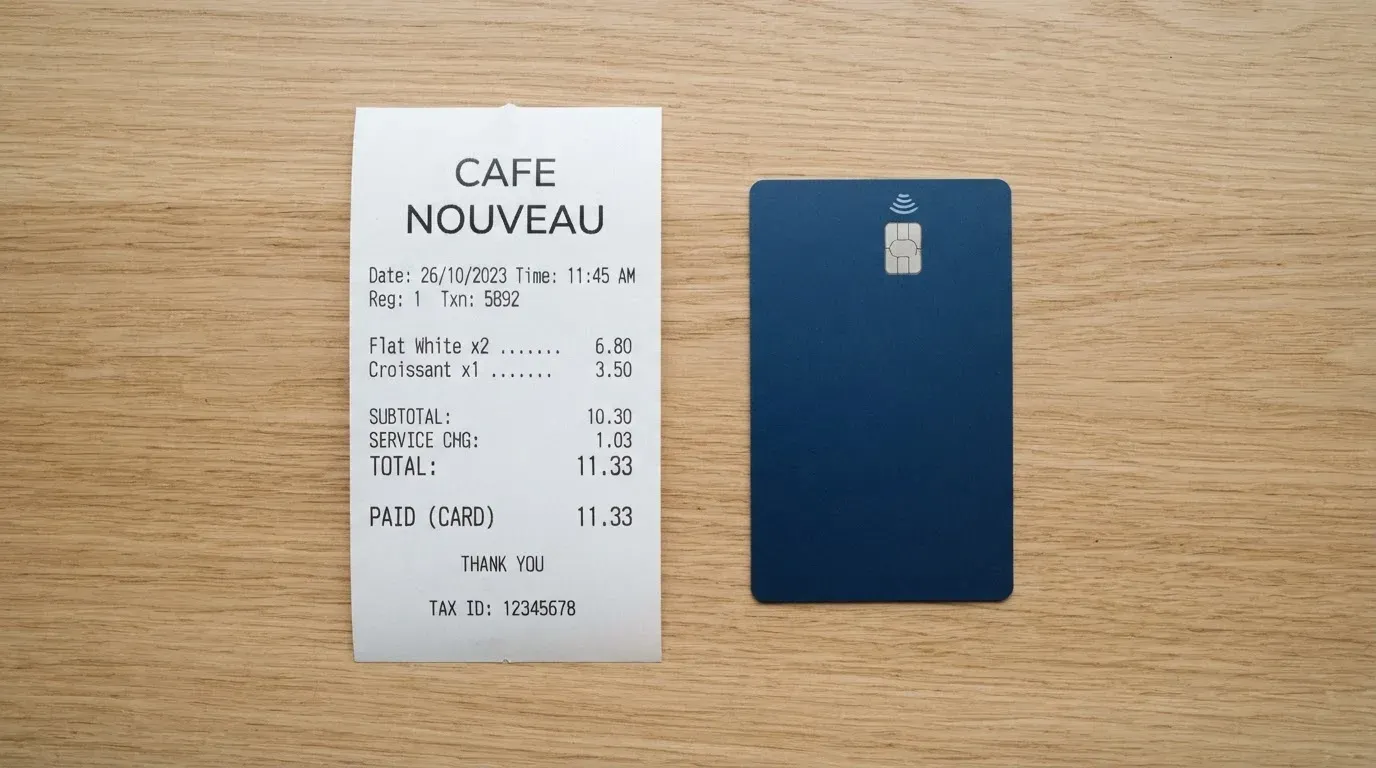
Here is the full costs table, with every figure taken from the card’s public pages.
| Fee or limit | Amount |
|---|---|
| Virtual card issuance | $0 |
| Physical card issuance | $0 |
| Card shipping | $0 |
| Monthly account fee | $0 |
| Foreign exchange fee | 1% (published) |
| Network gas on deposit | Paid by user to the blockchain, not by Avalanche Card |
| ATM withdrawal | Not stated |
| Daily spending limit | Not stated |
| Monthly spending limit | Not stated |
| Card currency | Not stated |
| Multi-currency balances | Not stated |
Now, three everyday situations to show how those numbers play out.
Buying coffee in your home country with USDC. You have $20 of USDC in your Avalanche wallet. You tap the card at a café. The 1% FX fee does not apply because the transaction is in your card’s home currency. You pay network gas to fund the card or to top up from your wallet, but Avalanche Card itself does not charge a conversion fee. The merchant receives the local currency and the $20 leaves your USDC balance.
Buying something online from a US merchant while you sit in Brazil. The merchant charges in US dollars. The card’s published FX fee is 1%. On a $100 purchase you pay $1. No additional conversion or “gas” fee is added by the card. If the merchant’s bank applies a cross-border surcharge, that is a separate line on your statement, not the card’s fee.
Refunding a card purchase. The card site says nothing about how disputes are handled, the time frame for refunds, or whether a chargeback is even possible. Unofficial sources point to a US agreement that caps liability for unauthorised use at $50 before notice and $0 after prompt notice, and that disputed transactions do not earn rewards. I would not rely on that without confirming it with the card’s own materials, which I could not find.
Two footnotes worth flagging. The official 1% FX rate is contradicted by unofficial disclosures that put the figure at 2% for US cardholders and up to 3% internationally. The same sources also mention a 2% late-payment fee on outstanding balances and a $10 statement-copy fee, neither of which appears on the card’s public page. I have not been able to verify the 1% figure on the live site for the audience of every country, and I would treat the published number as the best-case rather than a guarantee.
ATM access is the other open question. The card’s site does not address it. Unofficial sources disagree: one says cash withdrawal is not part of the current product, another says it is unlimited with no fee, and a third says the terms are not disclosed. Until the card publishes its own line on this, I would not plan a budget around ATM access at all.
Top up: how to fund the card
The card’s homepage lists USDC, USDT, AVAX and WAVAX as collateral. The FAQ mentions only USDC and AVAX, which is a small inconsistency. Ava Labs’s help page adds sAVAX, and Rain’s own article on the launch lists all five: native AVAX, WAVAX, USDC, USDT and sAVAX. The card’s site says more assets are planned.
Every top-up runs on the Avalanche blockchain. The card’s site does not name a minimum top-up, and adding or withdrawing funds happens inside the app. When you fund the card, the assets stay in your own wallet until the moment you spend; the card programme is a self-custody model, which I will come back to in the safety section.
Because transfers happen on Avalanche, you need a small amount of AVAX in your wallet to pay the gas fee, even if you are topping up with USDC or USDT. This is a quirk of EVM-compatible networks: gas is paid in the native asset, and a stablecoin-only wallet cannot send a transaction on its own.
If you try to deposit on the wrong network, for example sending USDC on Ethereum to an Avalanche address, the funds will not arrive. Crypto transfers are irreversible, and the card site is explicit that blockchain deposits sent to an unsupported address can be lost or require manual support recovery with no guarantee. I would treat “wrong network” as a permanent loss unless you can get a human to act on it.
Paying with it every day
The card works at any merchant that takes Visa, online or in person, including contactless terminals. The virtual card can be added to Apple Wallet or Google Pay for phone payments. The physical card is a regular Visa, with delivery in 14 to over 30 business days depending on where you live.
The card’s app, “Avalanche Card – Pay Anywhere” by Rain Liquidity LLC, sits at 3.1 out of 5 in the Apple App Store from only 22 ratings. The Google Play listing was not checked in the course of this review. A 3.1 from so few reviews is not a verdict on the card itself, but it is thin evidence either way.
On rewards, the card’s site says nothing about cashback. Unofficial sources mention “Avax Points” rather than cashback, with rates shown only in the app, redeemable at 1 cent per point for travel or 0.7 cent for statement credit. I would not plan spending around a programme the card itself does not promote.
Blocked merchant categories are not stated. Some issuers block gambling, cryptocurrency purchases, or cash-equivalent transactions, but the Avalanche Card’s public pages do not list which merchant category codes are restricted.
Two practical things to keep in mind for everyday use. First, 3-D Secure applies to online card payments in the same way as any other Visa: the issuer may send a one-time code or biometric challenge at checkout. Second, if you travel, your card may look “foreign” to merchants in another country because the issuing bank is US-based. Address Verification Service is mainly available in the US, Canada and the UK, so a foreign billing address can occasionally cause a decline that is the merchant’s risk engine rather than the card’s.
If a transaction is declined, the authorisation can place a hold on funds that lingers for several days, up to about a week in some cases. This is a feature of the card network rather than the Avalanche Card specifically, but it is the kind of detail that surprises people when they first use a prepaid-style card.
What can go wrong
The card’s site is run by Ava Labs, and the card is powered by Rain Liquidity, a financial technology company that is not a bank. Cards are issued by “partners licensed in their respective jurisdictions” and the bank’s name is not published on the card’s site. Ava Labs’s own help page does name Rain Liquidity, and Rain’s site footer says its debit cards are issued by Cross River Bank (a US bank and FDIC member), with Rain Products, Inc. as programme manager. That description is not tied explicitly to the Avalanche Card, but it is the most concrete information I could find about who is on the other side of the transaction.
Because the assets stay in your own Avalanche wallet until the moment of payment, the card is self-custody. Rain Liquidity is not a custodian, the user owns and controls the funds, and wallet recovery is by iCloud backup or PIN. Two-factor authentication is not mentioned in the public materials. Ava Labs is clear that the card, Avalanche, and any cryptocurrency are not FDIC-insured.
Customer support runs through the contact options on the Avalanche Card site. Channels, hours and languages are not listed. Ava Labs does not handle support for the card, Rain does. Unofficial reports describe support as slow or generic on withdrawal and access problems, though these are single-source claims.
There is no Trustpilot or Reddit page dedicated to the Avalanche Card. Search results return other companies called “Rain”, which makes user feedback hard to find. The thin signal is the App Store rating, the absence of a major incident, and the fact that comparison sites disagree on basic facts like the FX fee and ATM access.
Two structural risks worth being clear about. The first is regulatory: the card programme depends on a US bank that has not been named. If that bank withdraws, as WaveCrest did from European crypto cards in 2018, or as Visa did from FTX in November 2022, the programme can be wound down. Typically there is a notice period, then a freeze on new loads, then a window to withdraw the balance. The second is sanctions and policy risk. Rain’s own materials say it can change limits, set spending power to zero, or restrict activity. Users have no contractual guarantee that the terms will stay the same.
Finally, the stablecoins themselves are not risk-free. USDC and USDT aim to track the US dollar, but neither is insured, and USDC briefly lost its peg during the March 2023 US banking stress. Tether has frozen funds linked to illicit activity. If you are topping up with AVAX or WAVAX, you are also exposed to crypto-market volatility between top-up and spend.
What to take instead
The Avalanche Card is a reasonable option for its narrow audience, but the crypto card market is wider than that. Three alternatives worth comparing.
MetaMask Card (7.1 / 10)
Sign-up is open in around 45 listed countries, including much of Europe, Latin America and Canada. The card is a Mastercard issued by Monovate and provided by Crypto Life, with a free Virtual tier and a Metal tier at $199 per year. It spends directly from the connected wallet on Linea, Base, Monad and Solana, with named tokens including mUSD, wETH, EURe, GBPe, USDC and USDT. The Virtual card earns 1% cashback in mUSD, Metal earns a headline 3% capped at the first $10,000 spent then 1%. There is also a $FLY dining bonus through the Blackbird app.
If you want a self-custody Mastercard with cashback, and you live in one of the listed countries, MetaMask is the stronger product on rewards.
KAST (6.1 / 10)
KAST is a USD-denominated stablecoin card with three tiers: Standard, Premium ($1,000 a year) and Private ($10,000 a year). The card is a Visa Platinum, Visa Infinite metal or Visa Infinite gold, and you can hold up to 10 cards. Top-up is in USDT, USDC, PYUSD and RLUSD, on Ethereum, Solana, Polygon, Arbitrum and TRON. The spend fee is 0% in USD, the non-USD FX fee is 0.5% to 1.75%, and cashback is tiered: 1.5%, 2% or 3% on the first $2,000, $10,000 or $40,000 of monthly spend. KAST is restricted to residents of supported countries, with no published list.
If you want high cashback and a USD balance, KAST is the closer match. It is also more expensive, and the tiered pricing only makes sense if you will spend enough to clear the annual fee.
TokenPocket (5.8 / 10)
TokenPocket’s TP Card is a Visa or Mastercard debit card depending on region. It is available in a list of European countries on Visa and in Australia, Canada, Hong Kong, Japan, Taiwan, New Zealand, Singapore, South Korea and the UK on Mastercard. It runs on Arbitrum and balances are held in EUR24 and USD24. The card charges a 1% fee on crypto deposits, which is later refunded through rewards, and there are no other fees stated.
TokenPocket is the simplest of the three, but it has a narrower eligibility map and an Americas launch that was planned for Q2 2025.
| Card | Score | Network | Cashback | Notable feature |
|---|---|---|---|---|
| Avalanche | 6.9 | Visa | None published | Self-custody, USDC/USDT/AVAX/WAVAX on Avalanche |
| MetaMask | 7.1 | Mastercard | 1% to 3% | Multi-network, free Virtual, $199 Metal |
| KAST | 6.1 | Visa | 1.5% to 3% | USD balance, three tiers, up to 10 cards |
| TokenPocket | 5.8 | Visa / Mastercard | Deposit fee refunded | Arbitrum-based, EUR24/USD24 balances |
Who I would recommend it to
I would recommend the Avalanche Card to a specific kind of reader. If you live in a supported US state or in Latin America or the Caribbean, hold USDC or USDT on the Avalanche network, and want to spend that balance directly without first cashing out to a bank, this is one of the cleanest self-custody cards on the market. The lack of monthly fees and the 1% published FX fee are real, the Apple Pay and Google Pay support is convenient, and the self-custody design means your funds are not sitting in a third-party account.
I would not recommend it if you are outside the supported residence list, if you need a card with clear ATM access, if you earn a large spending volume and want meaningful cashback, or if you prefer a programme that names its issuing bank and publishes a full fee table. The card’s biggest gap is information: too much of what should be in the public terms is instead in unofficial disclosures, and the disagreement between the official 1% FX rate and the unofficial 2% to 3% rate is not reassuring.
A short checklist before you sign up.
- Confirm your country and your US state are on the supported list. The 18 excluded countries and 16 excluded US states are explicit, and the list is expanding, so check the live page.
- Decide which collateral asset you will use. USDC and USDT are the most stable; AVAX and WAVAX carry market risk between top-up and spend.
- Keep a small AVAX balance for gas. You will need it to send any transaction on Avalanche, even a USDC transfer.
- Check the FX fee in your jurisdiction. The published 1% applies to the public FAQ; the actual agreement you sign may state 2% or 3% depending on where you live.
- Ask support, before signing up, how disputes and chargebacks are handled. The card’s site is silent on this.
- Plan for a 14 to 30+ business-day wait on the physical card, and use the virtual card in the meantime.
The Avalanche Card is a workable piece of financial plumbing for a specific audience. Outside that audience, one of the alternatives above will serve you better.
Frequently asked questions
What is the Avalanche Card?
The Avalanche Card is a Visa payment card, virtual and physical, that draws on USDC, USDT, AVAX and WAVAX held in your own Avalanche wallet. It is built by Ava Labs and powered by Rain Liquidity. The card is designed to let you spend crypto-backed balances in everyday shops without first cashing out to a bank account.
How does the Avalanche Card work?
When you pay, the card converts the chosen collateral from your Avalanche wallet into the local currency of the merchant. The conversion happens at the moment of payment, and your assets stay in self-custody until then. You fund the card by sending USDC, USDT, AVAX or WAVAX on the Avalanche network to the card address in the app, and the card’s available balance updates.
Is Avalanche a bank?
No. Avalanche is a blockchain network, and Ava Labs is the company behind it. The card is “powered by Rain Liquidity, a financial technology company and not a bank”. Cards are issued by partners licensed in their respective jurisdictions, and Ava Labs is clear that the card and any cryptocurrency are not FDIC-insured.
Who owns Avalanche?
Avalanche is an open-source blockchain protocol; Ava Labs is the company that develops and supports it. The Avalanche Card is a separate product, built by Ava Labs in partnership with Rain Liquidity. The card’s issuing bank is not named on the card’s public pages, though Rain’s own materials reference Cross River Bank as the issuer of its debit cards.
Is the Avalanche Card available in my country?
The card is open in “many U.S. states, Latin America, and the Caribbean”, with the list expanding. Eighteen countries are excluded: Belarus, Cuba, India, Iran, Iraq, Israel, Mainland China, Nepal, Nicaragua, Nigeria, North Korea, Russia, Sri Lanka, Syria, Turkey, Ukraine, Venezuela and Vietnam. Sixteen US states are also excluded: Arizona, Delaware, Georgia, Idaho, Louisiana, Maryland, Nevada, New Mexico, North Dakota, Ohio, Oregon, Rhode Island, South Dakota, Vermont, Washington and Wisconsin. Unofficial sources say around 172 countries are reachable, but the official list is the one that matters.
How do I get the Avalanche Card?
Sign up on the card’s site, complete the single KYC process with your legal name, email, date of birth, SSN or national ID, government-issued photo ID, a selfie and a valid phone number, and wait for approval. After approval, you can issue a virtual card immediately and order a physical one. Approval usually takes seconds and can take up to 72 hours.
Does the Avalanche Card require KYC?
Yes. The card programme requires a full identity check before it issues a card, including a government-issued photo ID, a selfie, and either a Social Security Number or a national ID number. Expired IDs and P.O. boxes are not accepted. The card’s site does not say that proof of address is required, but the issuer can ask for additional documents if it needs to.
How do I top up the Avalanche Card?
You top up the card by sending USDC, USDT, AVAX or WAVAX on the Avalanche network from your wallet to the card address shown in the app. You need a small AVAX balance to pay the gas fee, even if you are sending a stablecoin. The card’s site does not state a minimum top-up, and you can add or withdraw funds at any time in the app.
Is the Avalanche Card free?
There is no monthly fee, no issuance fee and no shipping fee. The published foreign exchange fee is 1%, though unofficial disclosures put the actual fee at 2% in the US and up to 3% internationally. Network gas fees for blockchain deposits are paid by you, not by the card.
Is the Avalanche Card safe?
The card is self-custody: your assets stay in your own Avalanche wallet until the moment of payment, and Rain Liquidity is not a custodian. Wallet recovery is by iCloud backup or PIN, and two-factor authentication is not mentioned in the public materials. The card, Avalanche, and any cryptocurrency are not FDIC-insured. The biggest structural risk is the unnamed issuing bank: if that partner withdraws, the programme can be wound down.
Top wallet cards by score – cryptocardtop
Content created by the «cryptocardtop» team