
Kontigo card review
 Available in US
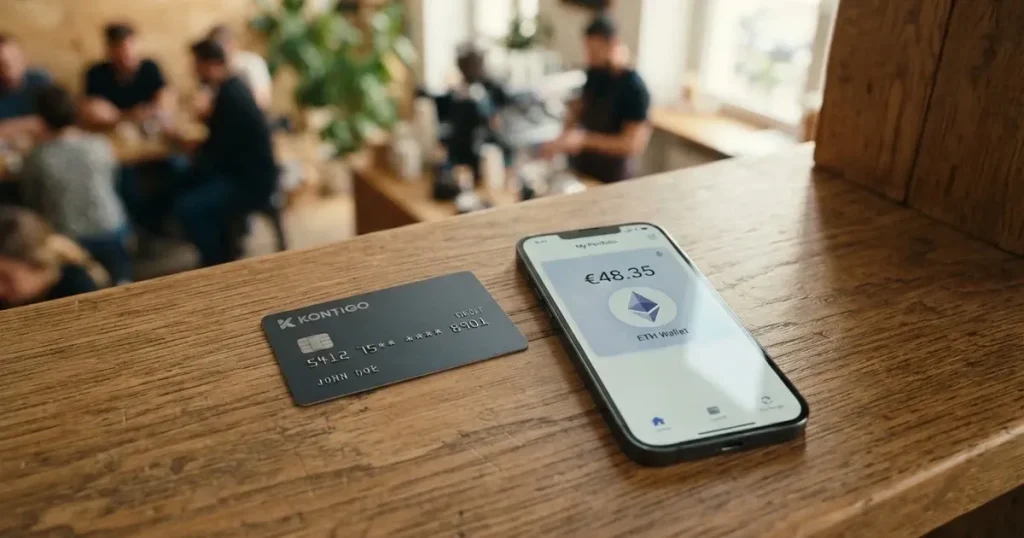
The Kontigo card is pitched as the first international credit and debit card in USDC that earns yield, and a lot of the copy on its site is aimed at Latin American users who want to save and spend in stablecoins. That framing matters: the card is not a general-purpose global product, and the information the company makes public is thinner than what you get from the bigger crypto-card brands. This review goes through what the card actually says, what it does not say, and where that leaves you if you are thinking about applying.
The conditions described here are current as of October 28, 2026.
Verdict
I spent time going through the Kontigo site, the published terms, the help center and any third-party reporting I could find. My honest take is that the card is interesting in concept but thin on disclosed detail, and the score reflects that. The country list is not stated, the issuer and licences are not stated, the fees are not stated in numerical form, and a number of the things you would normally check before signing up — ATM withdrawal fees, daily and monthly limits, card form, supported wallets — are simply not on the public pages.
The reader I have in mind here is someone whose ordinary bank card is hard to get or hard to use where they live, and who is weighing a stablecoin card as a way to spend from a USDC balance. If that is you, the sections below should help you decide whether Kontigo is the right place to start, or whether you would be better off with one of the more transparent alternatives further down the page.
Score table
| Criterion | Mark | Reason |
|---|---|---|
| Who can get it | 5 / 10 | Countries of issue not stated; sanctioned and high-risk jurisdictions are excluded; footer lists ten Latin American and Iberian countries without tying them to card availability |
| Cost | 5 / 10 | Fees and spreads are shown in the app rather than published; the site claims USDC sending, receiving and top-ups are “without commissions” but does not put a number on conversion, FX or ATM use |
| Top-up options | 4 / 10 | The card spends directly from a USDC balance and the app runs on Base, but other coins and other networks are not stated on the card pages |
| Reliability and complaints | 4 / 10 | Kontigo, Inc. is a Delaware corporation; the issuer, BIN sponsor and licences are not named; assets are held in the user’s own custody; a third-party report describes a hack that drained around 340,905 USDC from 1,005 accounts, with the company saying refunds were processed |
| Everyday use | 5 / 10 | Card form, mobile-wallet support and ATM behaviour are not stated; the site refers to hybrid, credit and debit cards without telling you which one you would actually get |
| Total | 4.7 / 10 | A promising USDC card with too many public gaps to score higher |
Will they give you the card
The first question is always the same: can you even get one where you live. Kontigo is unusually quiet on this point. The terms say availability depends on your country of residence and that sanctioned or high-risk jurisdictions are not permitted, but the company does not publish a list of supported countries for the card itself. The site’s footer has a “Paises” section that lists Argentina, Bolivia, Brazil, Chile, Colombia, El Salvador, Spain, the United States, Mexico and Peru, but that list is not labelled as the card’s availability list and there is no statement tying each country to a specific product.
If you are reading this from outside those ten countries, that does not mean you cannot use Kontigo, and if you are inside one of them, it does not mean the card is guaranteed to be available to you. The public information is simply not specific enough to answer the question in advance, and you would have to download the app and start the identity check to find out. That matters if you are comparing cards in a hurry: with most competitors you can at least skim a supported-countries list before you sign up.
A second point worth flagging is the eligibility rule the terms do spell out. The card is closed to residents of sanctioned and high-risk jurisdictions, which is standard for any regulated product. If you are unsure whether your country of residence is on the relevant lists, that is a question to resolve before you hand over identity documents. USDC is also a US-dollar stablecoin, so anyone dealing with it should be aware of the wider sanctions framework around dollar-denominated instruments, and the issuer will be applying that framework on top of its own rules.
How to get it
Signing up starts with the standard identity check that any regulated financial product has to run. The terms require verification before you can use the services: name, date of birth, address, nationality, identity documents, and financial information where the company needs it, along with sanctions and credit checks. One account per user.
A few practical things are not stated. There is no published description of what the card application looks like step by step, no published processing time, no published list of reasons an application would be rejected, and no published verification tiers. The developer documentation mentions that deposit methods depend on your KYC level, but the levels themselves and the thresholds attached to them are not in the public material. If you are the kind of person who likes to know what will happen at each stage before you start, you will not find that information here, and you should plan for the possibility that the process takes a few days and that the company may ask for additional documents part-way through.
One unofficial Spanish-language report describes a “stablecoin card with Bitcoin cashback” and 10% USDC yield, framed as a promotional offer. I have not been able to confirm that from Kontigo’s own pages, and I would treat that yield and cashback figure as promotional and unverified until the company publishes terms for it. If a specific headline rate is the reason you are considering the card, treat the unofficial number as marketing and wait for the in-app confirmation before you commit.
What it really costs
This is the section where the Kontigo story is weakest, and it is the section I would ask you to read carefully. The company does not publish a fee schedule for the card. The terms say that fees, commissions and spreads are shown in the app and may change, and the home page claims that sending, receiving and topping up in USDC is “without commissions”. That phrase is doing a lot of work in the marketing, and it is worth pulling apart.
USDC transfer fees and card-spend fees are different things. A USDC transfer on a blockchain costs a network fee — the gas paid to the network — and on Base that tends to be a few cents for a simple transfer, but it is not zero. “Without commissions” most likely means that Kontigo does not add its own charge on top of that, which is a normal and welcome thing for a card provider to do. It does not mean the spend itself is free, because every time you pay in a currency other than USDC the merchant’s local currency is acquired from your USDC balance, and that conversion is where most crypto cards earn their margin. The rate used and any spread on it are, in Kontigo’s case, the things that live in the app and that you would only see when you actually try to pay.
The Kontigo site does not publish the card’s fee schedule, including conversion, foreign exchange and ATM withdrawal fees, nor does it list monthly or issuance fees, or daily and monthly limits. There is also no published information on the card’s home currency; the terms only note that fiat accepted includes USD and other local currencies, and that liquidated balances may be held in a fiat currency the company chooses, such as USD.
The way I would read that, if I were applying, is: assume there is a spread on every non-USDC payment, assume there is some kind of fee structure that you will see for the first time inside the app, and do not commit a balance you are not prepared to convert at a rate you have not seen. The honest version of “free in USDC” on this card is “free to send and receive USDC”, not “free to spend anywhere in the world”.
Costs at a glance
The numbers below are drawn from the published material. Where the company has not published a figure I have written “not stated” rather than guess.
| Fee or limit | Value |
|---|---|
| Card issuance | not stated |
| Monthly fee | not stated |
| Conversion fee (crypto to fiat at point of sale) | not stated (rate shown in app) |
| Foreign exchange fee | not stated (rate shown in app) |
| ATM withdrawal fee | not stated |
| Daily spending limit | not stated |
| Monthly spending limit | not stated |
| USDC top-up fee | “without commissions” per home page; on-chain network fee still applies |
| Home currency | not stated (fiat accepted includes USD and other local currencies) |
A few everyday payments
To make this less abstract, here is what three common transactions would look like, given what is and is not published.
Coffee in a local currency: the card converts USDC into the local currency at the merchant. The rate is whatever the app applies at that moment, and the spread on that rate is the part Kontigo can keep. You will see the final local-currency amount on the receipt; the rate itself is in the app.
Online purchase in US dollars: this is the case where the marketing is most accurate. If the merchant prices in dollars and the card settles in dollars, you should not be paying a foreign-exchange fee, and the only thing to watch is whether the app’s conversion path introduces a spread on the way from USDC to USD, even when the merchant currency is the same.
ATM withdrawal in cash: the company has not published a fee or a limit. In practice, you should expect some combination of a flat fee and a percentage, and the ATM operator will add its own surcharge. Withdrawals from a USDC balance also force a conversion into local currency at the ATM, which is the worst possible moment to discover an unfavourable spread, because you cannot put the cash back.
Top up
The card is designed to be topped up in USDC. A user testimonial on the site says purchases are paid directly from the USDC balance, and a Kontigo article confirms that the app runs on Base. The terms do not describe a top-up flow for the card specifically, and the home page repeats the “without commissions” line for top-ups, with the same caveat about on-chain network fees that I went through in the costs section.
A few practical things to know before you send anything.
Base is an Ethereum layer-2 network, and the USDC you send has to be USDC on Base. If you send USDC on Ethereum mainnet, on Solana, on Polygon or on any other network, the funds will not arrive at the address Kontigo gives you, and a blockchain transfer cannot be reversed. Circle, the issuer of USDC, supports USDC on dozens of networks, and you should double-check both the network and the address in the app before you confirm. Tron is a useful comparison here: Tether’s USDT runs on Tron, but Circle stopped supporting USDC on Tron in February 2024, so if you are used to moving stablecoins on TRC-20 you cannot do that into Kontigo.
Other coins and other networks are not stated on the card pages. If you are holding BTC, ETH, USDT or any non-USDC balance, the published material does not tell you whether you can swap inside the app and load the result, or whether you have to convert somewhere else first and send in USDC. The safe assumption is the second: convert to USDC, send on Base, and only then does the card see a balance to spend.
The home page also says you can save in USDC “without commissions”, and the help center lists topics like Kontigo Cash and Kochinitos that sound like product areas within the app. I have not read the contents of those pages, and the help center itself is in Spanish, so the level of detail available in English is lower than the marketing material suggests.
Paying with it every day
What you actually do at the till is the part of the picture the public material is quietest on, so a lot of what follows is “not stated” rather than “no”. The site refers to “the first international credit and debit card in USDC that earns yield”, and the footer lists hybrid, credit and debit cards, but it does not tell you which one you would be issued. The card network, whether the card is virtual or physical or both, and whether it works with Apple Pay and Google Pay are not stated.
On the rewards side, the card is marketed as one “that earns yield”, but the rate and the form of the payout are not stated. There is no published cashback figure for everyday spending, and the unofficial 10% USDC yield I mentioned earlier is a promotional number I would not treat as confirmed. If earning on your balance is part of the reason you are looking at the card, that is something to confirm in the app at the point of sign-up rather than something to take from the marketing page.
The app is available on Google Play and the App Store, and the site says it has “over 10,000” user reviews, but the actual store rating is not stated in the public material. As a sanity check, that is a number worth looking at directly in the store before you install, because store ratings tend to be a quicker read on everyday reliability than the marketing copy.
On the consumer-protection side, the terms describe a good-faith negotiation period of up to fifteen business days after written notice, after which any dispute goes to the courts of Delaware, with local consumer-protection authorities still available. Chargebacks are not mentioned, and the terms ask you to report unrecognised transactions as soon as possible. That is a thinner dispute framework than you would get from a regulated bank, and it is a point to weigh if a significant amount of your spending would go through the card.
What can go wrong
There are three broad risk buckets for a card like this, and Kontigo touches all three in different ways.
The first is the company and the licence stack behind it. Kontigo, Inc. is a Delaware corporation, and the footer explicitly says the company does not provide financial services or take deposits, with assets held in the user’s own custody. The card issuer, the BIN sponsor and the licences that the programme runs on are not named on the public pages. With most crypto cards you can at least see the bank or e-money institution that issues the card and the regulator that supervises it. Here, that information is not published, which means a chunk of the usual due diligence on the issuer is not available to you before you sign up.
The second is custody and key control. The footer and the terms are consistent: assets are held in user custody, transactions are generally final, and Kontigo cannot access or recover your private keys. The flip side of that is the standard self-custody trade-off: you are solely responsible for your credentials, and a lost seed phrase or a clipboard-hijack that swaps a copied address is not something the company can fix for you. Standard safeguards you would normally look for — app-based two-factor authentication, an instant card-freeze button, insurance against unauthorised transactions — are not stated in the public material.
The third is what has already happened. A third-party report (date not independently verified) describes a hack that drained 340,905.28 USDC from 1,005 user accounts, with the company saying refunds were processed. The same report mentions a US$20 million seed round in December 2025, which is consistent with a company in growth mode rather than one in steady state. Neither of those facts is a deal-breaker on its own, but together they tell you that the product is young, that there has already been at least one security incident affecting user balances, and that the company’s response to that incident is the main public evidence of how it treats customers when things go wrong.
There is also a basic operational risk that applies to every crypto card and is worth keeping in mind. The card networks themselves do not issue cards to consumers; they license issuers, and they can suspend programmes. Visa’s well-known example is the termination of its global agreements with FTX in November 2022, after which the FTX US debit card was wound down by its issuer. An earlier example is WaveCrest, a Visa card issuer that supplied several crypto card brands and was suspended by Visa in Europe in 2018, closing every WaveCrest-issued Visa programme at once. If a programme you depend on is suspended, the typical pattern is a notice period, a stop on new loads, a stop on spending, and a request to withdraw your balance. That is a useful template for thinking about what your exit looks like if anything similar ever happens to Kontigo.
One reassuring data point: my own search for Kontigo card complaints on Trustpilot and Reddit did not turn up any user reports, and the Trustpilot hits that did come back were for an unrelated brand called Tuyo. That is not proof of an issue-free product — it is a thin public footprint — but it is at least consistent with the picture of a small user base rather than a product with a visible trail of angry customers.
What to take instead
If the gaps in the public material put you off, the three cards below are the alternatives I would look at first. They are all stablecoin or multicurrency cards with stronger published detail than Kontigo, and they are useful as a benchmark for the kind of disclosure you should expect.
International Visa Card. Score 6.7 / 10. A U.S.-issued Platinum Visa card, virtual for now, with a physical card marked “coming soon”. It is not available to residents or legal registrants of Belarus, mainland China, North Korea, Cuba, India, Iraq, Iran, Israel, Myanmar, Nepal, Nicaragua, Russia, Syria, Turkey, Ukraine, Venezuela or Vietnam, with FATF grey-list countries reviewed case by case. Purchases are blocked in North Korea, Cuba, Iran, Russia, Syria, Ukraine and Venezuela. The rule is by residence or registration, not by citizenship. Virtual card issuance is $5 one-time with no maintenance fee. Plans are Classic (free), Pro ($9.00 a month) and Max ($19.00 a month). Card use in USD is free on all plans; foreign currency uses the Visa exchange rate plus a 2% FX fee. Deposits of any kind are free, including USDC and USDT into the USD account at 1:1, with USD, EUR, SEPA, SWIFT and FedNow deposits also supported. No cashback is stated.
UNi Card. Score 6.1 / 10. A multicurrency card on the Mastercard network that spends from the UNi.Global account balance. Availability by country is not stated. There is no annual fee and no foreign transaction fee, and assets are converted at live over-the-counter rates with “no hidden exchange fees”. Spend-to-Earn rewards go up to 3%. The card-issuance fee and the funding options are not stated.
Morse. Score 7.5 / 10. Eligibility is by residence rather than citizenship, with users required to be at least 18 and a resident in a supported country, and Morse unable to serve customers subject to US, UK, EU or UN sanctions. The app is available in over 140 countries for peer-to-peer use, with local add and withdraw in over 70. A list of countries needs an invite code during the closed beta includes American Samoa, Australia, Cape Verde, Guernsey, Hong Kong SAR China, Isle of Man, Japan, Jersey, New Zealand, Serbia, Singapore, Switzerland, Thailand, Turkey, the United Kingdom and Western Sahara; the card itself is “available only in certain countries” and you have to check the app. The Morse Card is fully virtual for now and runs on Visa as a prepaid debit card, spending from the Morse Balance in any currency. Issuance and monthly fees are not stated, though the card page flags that “fees may apply” and points to the cardholder agreement. Foreign exchange is described as zero markups using the real-time Visa rate, with conversions on Morse at the real exchange rate and no markup, and online and contactless payments described as free. Funding is by debit card, stablecoin transfer or Account Details in USD, EUR, MXN and COP (BRL with a Brazilian CPF), with USDC, USDG and EURC via Solana free and other tokens and blockchains carrying a fee; Bitcoin, USDT, Ethereum and other tokens can also be deposited. The Morse Wallet is self-custodial. No cashback is stated on the card pages.
How the three alternatives compare
| Feature | International Visa Card | UNi Card | Morse |
|---|---|---|---|
| Network | Visa | Mastercard | Visa |
| Form | Virtual (physical coming soon) | not stated | Virtual |
| Monthly fee | Free, $9 or $19 | None | not stated |
| FX fee | 2% on foreign currency | None | None |
| Funding | USDC, USDT, USD, EUR, SEPA, SWIFT, FedNow | not stated | Debit card, stablecoins, Account Details in four currencies |
| Rewards | none stated | up to 3% | none stated |
| Custody | custodial | custodial | self-custodial |
The honest read across these three is that Morse is the closest competitor in spirit to Kontigo — self-custodial, multicurrency, with a real zero-markup FX claim — while the International Visa Card is the most transparent on the numbers and UNi Card is the most generous on rewards.
Who I would recommend it to
Putting all of this together, the people I would suggest the Kontigo card for are a fairly narrow group. If you are a Latin American user with a USDC balance who already understands Base, who is comfortable with a self-custody wallet and who can absorb the published gaps on issuer, licence and fees in exchange for early access to a USDC-native product, the card is a reasonable thing to look at. The promise of yield and the direct USDC-to-payment path are real, and the help center exists even if the English-language coverage is thin.
Who it is not for is a longer list. If you need a published fee schedule before you commit money, this is not the card. If you need a named issuer and a regulator you can look up, this is not the card. If you want a card you can take to an ATM tomorrow with a clear fee and a clear limit, this is not the card. If you want Apple Pay or Google Pay support and need it documented, this is not the card. And if the reason you are looking at a stablecoin card is that ordinary banking is hard where you live, you should compare Kontigo against the International Visa Card, UNi Card and Morse on the published detail above, because each of them gives you a clearer answer to the “what does it cost and who is behind it” question that a Kontigo application leaves open.
The way I would approach the decision, if I were in your shoes, is to download the app, run through the identity check, look at the fee screen before you top up, send a small USDC test amount on Base, and only then move a balance you are prepared to convert at whatever spread the app applies. The fact that this is a reasonable way to onboard is itself a tell — the card is asking you to trust it before it tells you very much, and that is a fair trade for some readers and a bad one for others.
Frequently asked questions
What is the Kontigo card?
The Kontigo card is a payment card that Kontigo markets as the first international credit and debit card in USDC that earns yield, spending directly from a USDC balance held in the user’s own custody. The site also refers to hybrid, credit and debit card variants in its footer.
How does the Kontigo card work?
A USDC balance on Base is loaded into the app, and card payments draw on that balance at the point of sale. Where the merchant’s currency is not USDC, the app converts the balance into the local currency at a rate that is shown inside the app and may include a spread.
Is Kontigo a bank?
No. The footer of the Kontigo site says the company does not provide financial services or take deposits, and assets are held in the user’s own custody. The card issuer, the BIN sponsor and the relevant licences are not named on the public pages.
Who owns Kontigo?
Kontigo, Inc. is a Delaware corporation. The terms and footer do not name the issuer, BIN sponsor or any payment-services licence, and a third-party report (date not independently verified) describes a US$20 million seed round in December 2025.
Is the Kontigo card available in my country?
The card’s own supported-countries list is not published. The terms say availability depends on country of residence and excludes sanctioned and high-risk jurisdictions, and the site footer lists Argentina, Bolivia, Brazil, Chile, Colombia, El Salvador, Spain, the United States, Mexico and Peru under a “Paises” heading without tying them to the card.
How do I get the Kontigo card?
You download the app, complete the identity check the terms require (name, date of birth, address, nationality, identity documents, and financial information where needed, with sanctions and credit checks), and proceed from there. The card-specific application steps, processing time and rejection reasons are not published.
Does the Kontigo card require KYC?
Yes. The terms require identity verification before you can use the services, including a sanctions check and the possibility of a credit check, with one account per user. The thresholds attached to any verification levels are not described in the public material.
How do I top up the Kontigo card?
You send USDC to the address the app gives you, on the Base network, and the card spends from that balance. Other coins and other networks are not stated on the card pages, and you should always check both the network and the address in the app before you confirm.
Is the Kontigo card safe?
The assets are held in the user’s own custody, transactions are generally final, and Kontigo cannot recover lost private keys. The standard safeguards you would normally check — app-based two-factor authentication, an instant freeze button, insurance — are not stated in the public material, and a third-party report describes a hack that drained 340,905.28 USDC from 1,005 accounts, with the company saying refunds were processed.
Is the Kontigo card worth it?
It depends on what you need. The card is interesting if you specifically want a USDC-native, self-custody product and you are comfortable with the gaps in the public material. If you need a published fee schedule, a named issuer, clear ATM behaviour or documented mobile-wallet support, one of the alternatives above will give you a more complete answer before you commit.
Top app and neobank cards by score – cryptocardtop
Content created by the «cryptocardtop» team