
A dollar card on USDC, built for Colombia — and thin on published detail everywhere else
 Available in US
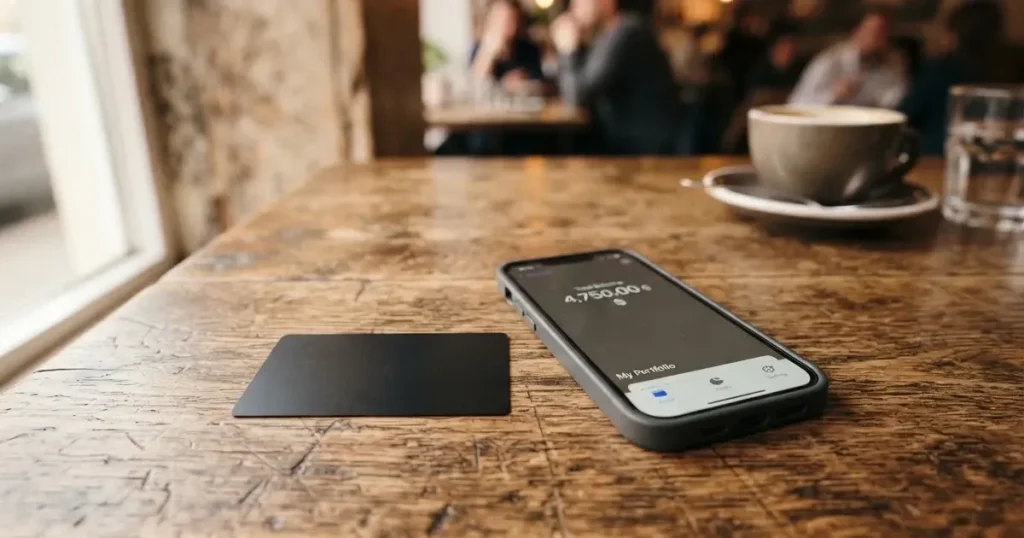
If you have been searching for an ordinary bank card and finding the door closed — no local account, no salary in the currency you spend, a passport instead of a national ID — then a card like VIIO is interesting precisely because it exists. It is a Visa card you hold as a phone number and as plastic, paid for out of a balance of USDC or USDT, and the company behind it, Persimon S.A.S., does business under Colombian law. That much is real, and it is the core of why the card gets attention.
The problem is everything around the edges. When I went through the card’s own terms and pages, I found a set of crisp statements about fees and balances, and then a series of blanks: the countries where the card is actually issued are not published, the conversion rate you get is not itemised, the crypto deposit fee is not named, the networks you can deposit over are not listed, the issuing bank is not named, and there is no published account of complaints either good or bad. Those blanks are not necessarily bad signs — a young product often just has not written everything down — but for someone deciding where to keep real money, what is not stated has to be treated as unknown, not as fine.
So here is my honest summary: VIIO is a competent, cheap and unusually practical card for a Colombian resident who wants a dollar card funded from stablecoins, and it is currently a poor fit for anyone who needs to know in advance exactly what a purchase will cost or whether they will be eligible. My score, out of ten, is 6.6.
The conditions described on this page are current as of October 28, 2026.
The verdict: 6.6 out of 10
| Criterion | Score | Why |
|---|---|---|
| Who can get it | 5 / 10 | Merchants in 200+ countries, but the list of issuing countries is not disclosed; the contract is governed by Colombian law and the product targets Colombia |
| Cost | 8 / 10 | Virtual issuance 0 USD, reissuance 0 USD, monthly 0 USD; plastic free at the moment, 5 USD if the balance is under 50 USD; “The Card currently does not charge any fee”; conversion percentage not stated |
| Top-up options | 6 / 10 | USDC and USDT balances, top-ups via PSE, bank transfer and crypto to an address or QR; networks not disclosed, crypto top-up fee not named |
| Reliability and complaints | 6 / 10 | Persimon S.A.S. (VIIO Colombia), issuer not named; no official incidents or reviews found; iOS 4.0 out of 5 from 12 ratings |
| Everyday use | 8 / 10 | Virtual with dynamic CVV and physical contactless, Visa ATMs worldwide, virtual card links to Apple Pay; Google Pay not disclosed |
| Total | 6.6 / 10 | Cheap and practical where it applies, too quiet where it matters |
The single strongest thing about this card is cost. There is no monthly fee, no issuance fee for the virtual card, no reissue fee for the virtual card, and the terms state plainly that “The Card currently does not charge any fee.” For someone whose alternative is a traditional bank’s dollar account with a monthly charge and a conversion spread, that is genuinely attractive.
The single weakest thing is disclosure. So much of what a new customer needs is simply not published — and I would rather tell you that plainly than dress it up.
Who this suits, and who it does not
VIIO suits a Colombian resident who holds USDC or USDT, wants a dollar-denominated Visa card to spend without going through a local bank’s dollar account, and is comfortable that the contract is with a company under Colombian law. If that is you, the card does the job well and costs almost nothing to hold.
VIIO does not suit you if you live somewhere the company will not confirm issuing the card, if you are a crypto person who wants to keep the stablecoin in your own wallet until the second of payment, or if your decision depends on a known exchange rate, a known deposit fee or a known list of blocked countries. The information to make that decision is not on the pages I read.
Will they give you the card?
The short answer: probably yes if you are in Colombia and can complete verification; I cannot tell you yes for anywhere else, because the card does not say.
Here is what is actually written. The card’s own terms do not give a list of countries where it issues. What the card page does say is that merchants can accept it in “200+ countries” — and that is a statement about where the card *works*, not about who can *hold* it. Those two things get confused constantly and it matters: a card that is accepted in two hundred countries may still be issued in one. The help centre points to a Colombian bank and to PSE for topping up, and there is a question there about using a passport without a Colombian ID — I did not read the answer, so I will not guess at it, but its existence tells you the question is being asked.
The contract is governed by Colombian law. The product is built for Colombia. Those two facts together are the clearest signal available about where the intended customer is.
There is one more thing worth knowing about how eligibility is decided generally, because it explains a lot of confusing outcomes. Verification rules do not test citizenship alone. They record your nationality and screen it separately from where you live, because sanctions screening and issuer risk policy are applied to country of birth as well as to address. Two people with the same address can get different answers. And when due diligence cannot be completed, the rule is to hold the transaction or the relationship, and where necessary to close it — which is why accounts get frozen pending documents rather than simply declined at the door.
What is not stated, once, so you can stop looking for it: the identity verification *levels*. The card does not publish tiers of verification and how they change your limits. Nor does it publish the document list it will accept at signup. If you are the kind of person who wants that list before you start, you will not find it here.
My advice: before you send any document, open the app and see how far the flow takes you. That costs you nothing and tells you more than any page I could summarise.
How to get it
Getting VIIO is a short process, and the thresholds are low — which is the first thing you should know.
You confirm that you are of legal age, you supply the information the app requests, you agree to keep it updated at least once a year, and you consent to credit bureau checks. Then:
- The virtual card is free once you have topped up your account with at least 3 USD.
- The physical card needs a balance of at least 50 USD before it is issued.
- The card arrives deactivated and you activate it in the app.
That is the whole sequence. There is no branch, no appointment, no notarised anything — the entire process happens in the app, and the two balance thresholds are the only gates I found.
Two things you should check yourself. First, delivery of the physical card — which countries it ships to, how long it takes and what it costs — is not stated on the pages I read. If you are outside Colombia and you want plastic in the post, that is a real unknown and it is worth asking support before you commit. Second, replacement. If you lose the physical card, a replacement costs 5 USD. A virtual reissue is 0 USD, and free if the card is defective or if a disputed charge is resolved in your favour.
Fees: what a VIIO payment really costs
This is the section I would read twice, because the card is genuinely cheap on everything it does publish and genuinely silent on the one number most people care about.
| Fee or limit | What VIIO states |
|---|---|
| Virtual card issuance | Free |
| Virtual card reissue | 0 USD |
| Physical card issuance | “No cost (currently exempt)”; 5 USD if balance is under 50 USD |
| Monthly fee | 0 USD |
| Card use (terms) | “The Card currently does not charge any fee.” |
| Conversion / FX | Not itemised — purchases “Depend on the VISA type and exchange rate”; no percentage listed |
| ATM withdrawal | “Depend on the ATM operator”; VIIO’s own fee not listed; free allowance not stated |
| Daily and monthly limits | Not stated per verification level |
| Tiers | Single tier — virtual and physical card, no paid plans |
Two words in that table deserve your attention. The first is *exempt*. The physical card is described as “No cost (currently exempt)”, which is the language of a promotion, and the terms add that fees may be reinstated. The 5 USD line for a balance under 50 USD may be the permanent rule or the ceiling of the exemption — the card does not say which. Either way, do not build a plan that assumes the 5 USD will never apply.
The second word is *depend*. For conversion, the card says purchases “Depend on the VISA type and exchange rate”, and separately that you can “Pay in any currency, VIIO handles the conversion”. Both are true and neither tells you the number. There is no published percentage, no spread, no promise that the rate you get is the mid-market rate. This is the gap I keep coming back to, and I will not paper over it: you are spending dollars you deposited in dollars, so the conversion rate is the entire cost of the card for most users. If your spending is in Colombian pesos, the rate is your fee and VIIO does not publish it.
Three everyday payments, and which fees apply
Take a week of normal life and run it through the terms.
A coffee in pesos, in Colombia. You pay in COP from a balance denominated in dollars. VIIO converts. VIIO’s own conversion percentage is not itemised, so the only thing you can say for certain is that the rate you get is not published, and any spread sits inside the rate rather than in a line item. No separate card-use fee is listed.
A subscription in dollars, online, outside Colombia. You pay in USD from a USD balance. This is the card at its cleanest: no conversion, no currency spread, and the terms state the card currently charges no fee. This is where VIIO is at its best and where its low score would be least fair.
A cash withdrawal at a Visa ATM abroad. You can withdraw local cash at any Visa ATM worldwide, in COP, USD, CAD, AUD, EUR, GBP or MXN. But the fee “Depend on the ATM operator”, VIIO’s own fee is not listed, and no free allowance is stated. This is the least predictable of the three, because there are at least two unknown fees stacked on top of each other.
Two structural notes that affect all three. The card is prepaid in effect: your credit is capped at the value of digital assets in your account, so you cannot overdraw. And on limits, the card does not state daily or monthly limits per verification level — so if you hit a ceiling, it will not be one you read about in advance.
Top up: the three ways money gets in
You have three routes, and the choice of route changes your cost more than any card fee does.
PSE, from Colombian pesos. Currently no cost — again, “currently exempt”. PSE is the Colombian instant-payment scheme, and pointing to it is a good sign about the intended customer.
Bank transfer, in pesos. No charge from VIIO; your bank may charge you for the transfer.
Crypto, by address or QR. You send USDC or USDT to a wallet address or a QR code. The card does not name the networks it accepts, and it does not state a fee for a crypto top-up. So the cost of this route is the one number I most want and cannot give you.
The minimums follow from the card section: the virtual card needs a minimum top-up of 3 USD, and the physical card’s issuance threshold is a 50 USD balance.
The networks question, and why it can cost you the deposit
Because the networks are not disclosed, let me explain what is at stake, because it is a common and expensive trap across the whole category and not a VIIO-specific fault.
A stablecoin is not a single thing. USDT, for example, exists on Ethereum, Tron, Solana, Polygon, Avalanche and others. USDC is natively supported on 38 networks. The token looks identical wherever you see it; the route does not. Circle stopped supporting USDC on Tron in February 2024, so sending USDC on that network to a provider expecting something else is not a supported path.
Blockchain transfers are irreversible. If you send on a network the provider does not support, or to an address belonging to a different network, the funds can be lost entirely, or need manual recovery through support with no guarantee of success. That is why I would not deposit a large sum before you have confirmed, in writing, exactly which networks VIIO accepts.
There is a related fee fact worth holding onto: the network fee — gas on Ethereum, bandwidth and energy on Tron — is charged by the blockchain, not by the card company. You pay it whether the card charges anything or not. And on the other side of the ledger, a withdrawal of your balance back to a crypto wallet is charged at the network fee only, with none from VIIO.
Withdrawals of the balance itself — in COP, USD, CAD, AUD, EUR, GBP or MXN — are “No cost (currently exempt)” as well. Whether you can get a residual balance back if you close the account is not addressed anywhere I read.
Paying with it every day
In normal use the card behaves well, and this is the section where VIIO scores its joint highest.
You get two instruments. The virtual card has a dynamic CVV, so the security code changes — which means a screenshot of your card details is far less useful to a thief than it would be on an ordinary card. The physical card is contactless. Both are Visa, and both draw on what the card calls your Digital USD balance.
- The virtual card links to Apple Pay. Google Pay is not disclosed either way, and blocked merchant categories are not stated.
- There is no rewards programme disclosed — no cashback, no points, nothing to earn.
- The app on iOS (the Colombian App Store listing) scores 4.0 out of 5 from 12 ratings. That is a decent number, but twelve ratings is a very small sample; it tells you almost nothing about reliability at scale.
- Support is by email at [email protected] and a help centre at intercom.help/viio_help/en, open Monday to Friday, 9 am to 5 pm — the time zone is not stated, which matters if you are not in Colombia. The help centre exists in Spanish and English.
When something goes wrong, there is a process and it has a clock. You must request a reversal for fraud, an unauthorised purchase, non-delivery or defective goods within five business days of becoming aware of the problem, and it is handled under Article 51 of the Colombian Consumer Protection Statute. Five business days is not long. If you see something wrong on a statement and you intend to claim, that is your deadline — not some comfortable later date.
One thing to know about why cards like this get declined, because it explains the odd failures that have nothing to do with you. Every card number begins with six or eight digits that identify the issuing bank and its country, and merchants can look that up before you tap. If the issuer country differs from the address you typed as your billing address, the merchant may apply extra scrutiny or decline you outright. Some merchants decline prepaid and foreign-issued cards for exactly this reason. So if VIIO works perfectly and a payment fails somewhere, the cause may be that your card looks Colombian to a shop in another country — not that anything is wrong with your balance.
What can go wrong
I want to be plain about the risks here, because “no complaints” is not the same as “no problems”.
The empty record cuts both ways. I found no official incidents involving the card, and no Trustpilot or Reddit reviews surfaced in a complaints search. For a young product that is normal and arguably a good sign. But it also means the number of people who have used this card in anger, and had a bad time, appears to be very small. You have no community to ask. There is no page describing how complaints are actually handled, and the Trustpilot detail is simply not there. If the card fails for you, you will be one of the first, and you will be writing that first email to [email protected].
The entity behind the card is small and its protections are stated oddly. The company is Persimon S.A.S., branded Persimon (VIIO), operating as VIIO Colombia. The footer says it “does not provide or offer regulated financial services”, and the terms say VIIO “does not collect public funds” and “does not receive or manage user money”. Read those together carefully — the card’s whole purpose is to hold and spend your money, so the statement that it does not receive or manage user money is either referring to a different layer of the structure or means the funds sit somewhere the terms do not describe. Either way, that is a question worth asking support directly rather than assuming. The issuing bank is not named on the pages I read, and the custodial status of the balance is not stated.
A card programme can simply end. This is not hypothetical in this category. Visa terminated its global agreements with FTX on 13 November 2022 and the FTX US debit card was wound down. WaveCrest, a Visa issuer that supplied crypto card brands, was suspended by Visa in Europe in 2018, closing every WaveCrest-issued Visa programme it ran. The pattern when a programme closes is usually a notice period, then loading and spending stop, then you are asked to withdraw what is left. A 2026 closure reported by a secondary source — new loads ending 8 July 2026, spending stopping 8 August 2026 — is a single unconfirmed source, so treat it as an illustration of the shape these things take rather than as fact about any particular provider. The lesson is simple and general: do not leave a large balance sitting on a crypto card.
Stablecoins are not, despite the name, stable. A stablecoin aims to hold a stable value, and sometimes it does not: TerraUSD collapsed in May 2022, and USDC briefly lost its peg in March 2023 during the US banking crisis. Two coins, USDC and USDT, account for about 90% of stablecoin market capitalisation by the BIS’s July 2025 count, and Circle says USDC is redeemable 1:1 for dollars and fully backed by cash and cash equivalents with monthly reserve attestations. That is reassuring about USDC in particular — but it is a claim by the issuer, verified by attestation rather than by you.
Two things you cannot verify yourself. Because the card does not state its verification levels or its limits, you cannot predict whether a large payment will be approved or held. And because a declined authorisation can leave a hold on your funds for as long as seven days, a payment that fails may still reduce your available balance for a week. Plan your balance around that possibility, not just around the purchase.
What to take instead
If any of the above is a dealbreaker for you, there are three alternatives in the same general space that I have read on the same basis. None is a clean winner; they trade the same problem around differently.
If you want the published numbers to be complete
An international Visa card — I scored it 6.7, a hair above VIIO. It publishes almost everything VIIO does not. You get a U.S.-issued Platinum Visa, virtual, paying in USD; the physical card is listed as coming soon. It is not available to residents or legal registrants of a long list of countries — Belarus, mainland China, North Korea, Cuba, India, Iraq, Iran, Israel, Myanmar, Nepal, Nicaragua, Russia, Syria, Turkey, Ukraine, Venezuela, Vietnam — and purchases are blocked in North Korea, Cuba, Iran, Russia, Syria, Ukraine and Venezuela. FATF grey-list countries are reviewed case by case. Note that the rule follows residence or registration, not citizenship.
| International Visa | UNi Card | Morse | |
|---|---|---|---|
| Score | 6.7 / 10 | 6.1 / 10 | 7.5 / 10 |
| Card | U.S.-issued Platinum Visa, virtual, USD | Multicurrency, Mastercard network | Fully virtual Visa prepaid debit |
| Cost | $5 issuance, no maintenance; plans Classic free, Pro $9.00/month, Max $19.00/month | No annual fee; issuance fee not stated | Issuance and monthly fee not stated |
| FX | Visa exchange rate + 2% FX fee | None; live OTC rates, no hidden exchange fees | Zero FX fees or markups, real-time Visa rate |
| Card use in USD | Free on all plans | No foreign transaction fee | Paying online and contactless is free |
| Top-up | USDC/USDT 1:1, plus USD, EUR, SEPA, SWIFT, FedNow | Not stated | Debit card, stablecoin, Account Details (USD, EUR, MXN, COP) |
| Rewards | None stated | Spend-to-Earn up to 3% | Not stated |
UNi Card (6.1) is the one to look at if your objection to VIIO is the unstated exchange rate. UNi promises no annual fee, no foreign transaction fee, conversion at live over-the-counter rates and “No hidden exchange fees”, plus spend-to-earn rewards of up to 3%. Its card is multicurrency on the Mastercard network, spending from your UNi.Global balance. Against that, its eligibility conditions are not stated at all, and how you fund it is not stated either — so it trades one silence for another, though a more useful silence.
Morse (7.5) is the strongest of the three, and the closest to what VIIO is trying to be. It scores highest, and the reasons are specific. It publishes its model clearly: the card is fully virtual for now, a Visa prepaid debit spending from your Morse balance in any currency, with “Zero foreign exchange fees or markups” at the real-time Visa exchange rate, and paying online and contactless is free. Funding is broad — debit card, stablecoin transfer or Account Details in USD, EUR, MXN and COP, with BRL needing a Brazilian CPF. Bitcoin, USDT and Ethereum can be deposited. And critically, USDC, USDG and EURC over Solana are free, other tokens and blockchains carry a fee, and the Morse Wallet is self-custodial — the funds stay in your own wallet rather than with a provider.
Morse’s cost is eligibility precision, in the opposite direction from VIIO’s. It works by residence, not citizenship, requiring you to be at least 18 and resident in a supported country, with the app available in over 140 countries and local add and withdraw in over 70. It cannot serve customers subject to US sanctions (also UK, EU, UN). And a set of countries is in closed beta and needs an invite code: American Samoa, Australia, Cape Verde, Guernsey, Hong Kong SAR China, Isle of Man, Japan, Jersey, New Zealand, Serbia, Singapore, Switzerland, Thailand, Türkiye, the United Kingdom and Western Sahara. The card is available only in certain countries and the list is not published — you check the app.
Who I would recommend it to
I would recommend VIIO to a Colombian resident who already holds USDC or USDT, wants a dollar Visa card without opening a dollar account at a bank, and does not mind being an early customer of a small company with an unlisted issuing bank. The economics are good: no monthly fee, no issuance fee for the virtual card, free PSE top-ups at present, and a terms statement that the card currently charges no fee. If most of your spending is in dollars — subscriptions, online services, international travel — this card is hard to argue against on cost.
I would not recommend it, yet, to someone who needs certainty. If your spending is heavily in pesos and you are choosing between cards on the exchange rate, you cannot make that comparison, because VIIO does not publish its rate. If you live outside Colombia and are relying on the “200+ countries” line to think you can get one, that line is about acceptance, not issuance. If you are the kind of user who holds self-custodied, a custodial balance in a small firm with no public complaint history and an unnamed bank is a trade many people would not make. And if you are planning to keep meaningful sums on it, do not — keep the balance you need and no more, whatever card you use.
The honest position is that VIIO is not bad. It is early, and cheap, and pointed at one country. Those are compatible things, and the price reflects it.
Frequently asked questions
What is the VIIO card?
VIIO is a Visa payment card that spends from a balance of USDC or USDT rather than from a bank account. It comes in two forms: a virtual card with a dynamic CVV and a physical contactless card. The company behind it is Persimon S.A.S., operating under Colombian law as VIIO Colombia. The card page says merchants in 200+ countries accept it, though that describes acceptance rather than where the card is issued.
How does VIIO actually work?
You top up a balance — the card calls it a Digital USD balance — by PSE, bank transfer or a crypto transfer to an address or QR code. The card then spends that balance like a prepaid card: your credit is capped at the value of digital assets in your account, so it cannot overdraw. Payments route through Visa to the merchant, and you can pay in any currency with VIIO handling the conversion, though the rate is not published.
Is VIIO a bank?
No, and the card is careful about saying so. The footer states that VIIO does not provide or offer regulated financial services, and the terms say it does not collect public funds. The issuing bank is not named on the pages I read. Visa and Mastercard do not issue crypto cards to consumers themselves — they license issuers and can suspend a programme — so someone licensed is issuing this, but the card does not tell you who.
Who owns VIIO?
VIIO is a brand operated by Persimon S.A.S., described in the brand line as Persimon (VIIO) and trading as VIIO Colombia. Press coverage from La Republica in January 2025 reported the launch of a USDC dollar card in Colombia with Visa and Dock. Later additions of Venezuela and Portugal are not confirmed on the pages I read, so I would not plan around them.
Who can get a VIIO card, and where?
The card’s own terms do not publish a list of countries where it issues. The contract is governed by Colombian law and the product is built for Colombia, which strongly suggests that is the core market. Verification rules also screen nationality separately from residence, so two people at one address can get different answers. If you are not in Colombia, ask support before sending documents rather than assuming from the “200+ countries” line.
How much does VIIO cost to hold?
Virtual card issuance is free, virtual reissue is 0 USD, and there is no monthly fee — 0 USD. The physical card is described as “No cost (currently exempt)”, though the page also lists 5 USD if your balance is under 50 USD, and the terms say fees may be reinstated. Replacing a lost physical card costs 5 USD. The terms state that “The Card currently does not charge any fee” for using the card.
What does it cost to convert money on VIIO?
This is the honest gap. The card says purchases “Depend on the VISA type and exchange rate” and that you can pay in any currency with VIIO handling the conversion, but no percentage, spread or rate is published anywhere. Because your balance is in dollars, the conversion rate is effectively your card fee. If you spend mostly in pesos, this is the number to ask support for in writing before you commit.
How do I top up a VIIO card, and what does it cost?
Three routes. PSE from Colombian pesos is currently no cost. Bank transfer in pesos carries no VIIO charge, though your bank may. Crypto top-up sends USDC or USDT to an address or QR code, and the fee is not stated. The virtual card needs at least 3 USD in the account, and the physical card needs a 50 USD balance. Always confirm which networks are supported before sending.
Is a VIIO card safe to use?
The security features are reasonable: a dynamic CVV on the virtual card, instant freeze and cancel in the app, instant alerts, and the PIN blocks after three wrong entries. What I cannot tell you is how exposed the balance itself is, because the custodial status is not stated and the terms say VIIO does not receive or manage user money — which sits oddly with a card whose purpose is holding your money. I found no official incidents and no public reviews, which means little either way.
How do I withdraw money or close my account?
Withdrawals of your balance — in COP, USD, CAD, AUD, EUR, GBP or MXN — are “No cost (currently exempt)”. Sending the balance to a crypto wallet is charged at the network fee only, with none from VIIO. ATM withdrawals are possible at any Visa ATM worldwide, but the fee “Depend on the ATM operator” and no free allowance is stated. What is not addressed anywhere I read is what happens to a leftover balance if you close the account.
Top app and neobank cards by score – cryptocardtop
Content created by the «cryptocardtop» team