
A Nigerian-only virtual dollar card with thin documentation
 Available in US
If you have looked into spending stablecoins on an ordinary card and kept running into the same wall, the Obiex card is worth putting on the shortlist — but only if you are a Nigerian resident. That single fact decides almost everything else. For anyone outside Nigeria, this review will not help you, because the card’s own pages describe it as available to residents of that country only. And even inside Nigeria, the picture is a virtual dollar card with almost every operational detail — the issuing network, the ATM, the mobile wallets, the exchange rate fee — left unstated in public material.
I scored it 4.5 out of 10. That is not a judgement of the price, which is genuinely cheap. It is a judgement of how little the card’s public documentation tells you, and of what is known about its reliability.
*Conditions described here are current as of October 28, 2026.*
Verdict: 4.5 out of 10, built for one specific user
The Obiex card is a virtual, dollar-denominated prepaid card funded from stablecoins. It costs $2 to issue, claims zero fees on funding, conversion and transactions, and — as far as its pages say — is open to residents of Nigeria aged 18 or over who complete BVN and KYC Level 2 checks. For a Nigerian resident who holds USDT or USDC and wants to pay a shop or a subscription from crypto, that is a narrow but real use case, and the price is hard to argue with.
For everyone else, it is a non-starter: the card is not offered outside Nigeria, and even within Nigeria the practical details you need to live with it day to day are not published. My score breaks down as follows.
| Criterion | Mark | Why |
|---|---|---|
| Who can get it | 2 / 10 | Nigeria only, residents 18+, BVN and KYC Level 2 required |
| Cost | 8 / 10 | $2 once for lifetime access, zero funding/conversion/transaction fee claimed; $1 for a failed payment, FX fee unstated |
| Top-up options | 6 / 10 | Stablecoins from the Obiex wallet (USDT, USDC, BUSD per the card’s page); $5 minimum; networks not named |
| Reliability and complaints | 3 / 10 | Card suspended in Q3 2022 after over $2.7M processed; return promised for Q1 2023, unconfirmed; issuer not identified |
| Everyday use | 3 / 10 | Virtual USD card only; $1,000 daily limit; Apple Pay, Google Pay and ATM not disclosed |
| Total | 4.5 / 10 | A cheap card with too much missing and a patchy track record |
The low marks are almost all about disclosure, not about money. The cost line is the strongest part of this card. But a cheap card is only cheap if it works when you need it, and the reliability and everyday-use figures are where the picture is thinnest.
Will they give you the card?
Only if you are a resident of Nigeria aged 18 or over, and only if you can clear BVN verification and KYC Level 2. That is the eligibility as the card’s own page states it. BVN is Nigeria’s Bank Verification Number, a form of identity check tied to the national identification system; KYC Level 2 is the stricter of the two verification tiers described for the platform. The card’s page mentions KYC Level 2 but does not spell out what documents you must hand over — the relevant page was not readable when this was checked.
The Obiex card is available only to Nigerian residents. There is no information regarding eligibility for Russian or Belarusian citizens or residents. The country restriction is not a soft preference; as published, it is Nigeria.
This is worth pausing on, because the general rules that govern these cards elsewhere are stricter than people expect. Identity checks are not paperwork to be tidied up later — in the EU, customer due diligence covers name, address, date of birth, nationality and identity documentation, plus a sanctions check and a politically-exposed-person determination, and if the checks cannot be completed the institution is required to refrain from the transaction or end the relationship. That is why accounts get frozen pending documents. Nationality is screened separately from residence, because sanctions and risk policy often follow citizenship and country of birth rather than just your address. So “where do I live” and “which passport do I hold” are two different questions, and a provider will usually ask both.
How to get it
The route is straightforward in outline: verify your identity on the platform to the required level, open the card, fund it, and the balance is available to spend right away. The card itself is virtual — there is no physical plastic in the plan — and it is denominated in US dollars. The wallet you fund it from converts to USD at the point of funding.
Two things are unclear. First, the card network is not identified — the page names the card as a dollar card but does not specify whether it runs on Visa or Mastercard. That matters in practice, as networks apply their own acceptance and security rules (more on that under “paying with it every day”). Second, the exact list of documents required for KYC Level 2 is not published.
What the card does tell you is the shape of the flow. Verify, open, fund, spend — with the balance available immediately once the funding lands. Whether an activation step sits between opening and spending is not stated.
Fees: what it really costs
The pricing is the most attractive part of this card and also the most confusing, because the provider’s own materials disagree with each other. The current card page states a flat $2 issuance fee that gives lifetime access. An older blog post from Obiex says the card creation fee is zero. Both pages are the company’s own. A third-party report (unofficial, and undated) also describes a one-time $2 creation fee with no maintenance fee. I would plan on the $2, since that is what the live card page says.
| Fee or limit | Amount | Source |
|---|---|---|
| Issuance | $2 flat, lifetime access | Card page (an older blog says zero — two company pages disagree) |
| Monthly fee | None stated; third-party source reports no maintenance fee | Not stated officially |
| Funding | Zero | Card page excerpt |
| Conversion | Zero claimed | Card page |
| Transaction | Zero claimed | Card page |
| Failed payment (insufficient funds) | $1 | Blog |
| FX fee | Not stated | — |
| ATM | Not stated | — |
| Daily spending limit | $1,000 | Blog (date unknown, possibly outdated) |
| Monthly limit | Not stated | — |
| Card tiers | Single tier | — |
So what does a normal day cost you? If you fund the card with, say, USDT and spend it at a shop, the provider’s stated cost is nothing — no funding fee, no conversion fee, no transaction fee. The two costs the material flags are both edge cases: a $1 charge if a payment fails because the balance was short, and an FX fee that is simply not stated. That last one is the gap that matters most for a dollar card in a country where the local currency is not the dollar. If you are paying a Nigerian naira merchant, is the merchant’s terminal converting at a fair rate, or is there a hidden spread? The card does not say, and I will not guess.
Against this, remember that on-chain network fees are separate and are charged by the blockchain, not by the card provider. If your top-up travels a network, you may pay a small gas or bandwidth fee on top of the zero the card advertises.
One caveat on the limits: the $1,000 daily figure comes from a blog of unknown date and may be out of date, and no monthly limit is stated at all. Treat both as provisional.
How to Top up
The card is funded from the Obiex wallet using stablecoins — USDT, USDC and BUSD, according to the card’s page — which the company blog paraphrases as “stablecoins such as USDT at the moment.” The provider advertises a zero funding fee, and the blog sets a $5 minimum top-up.
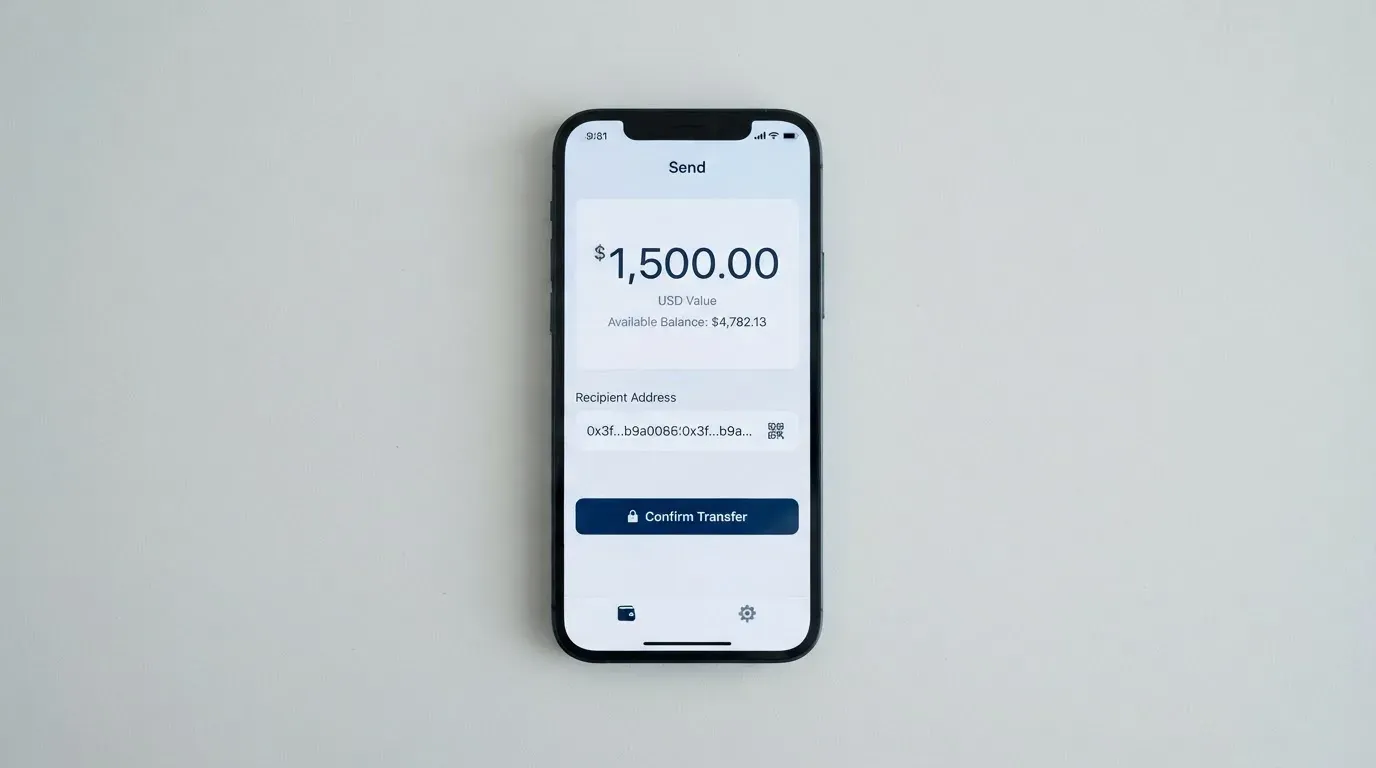
The one detail that would make or break a first deposit is not given: the networks. Which chain you send on determines whether the money arrives or disappears, and the material does not name a supported network. This is not a formality, because sending on a network the provider does not support, or to an address belonging to a different network, can lose the funds outright — blockchain transfers are irreversible, and there is no built-in way to reverse them. Recovery then depends on support intervening, with no guarantee.
A little category background, since this is where most self-inflicted losses happen. Stablecoins are dollar-pegged tokens: USDT and USDC are the two dominant ones, together holding roughly 90% of stablecoin market capitalisation according to the BIS in July 2025. They are not necessarily stable, though — TerraUSD collapsed in May 2022 and USDC briefly lost its peg in March 2023. On the sending side, the mechanics differ by chain: Ethereum-based tokens charge gas that must be paid in ETH, so a wallet holding USDT but no ETH cannot send. Tron prices fees through bandwidth and energy, often burning TRX. Circle stopped supporting USDC on Tron in February 2024, so “USDC over TRC20” is not a native option. USDT, by contrast, has been issued across Ethereum, Tron, Solana, Polygon, Avalanche and others. In short: confirm the exact network and asset pair on the platform’s own screen at the time you send, and keep a little of the native gas token on hand. That is a habit, not a workaround — the network choice is entirely yours to make correctly.
The company blog also covers withdrawal from Obiex and states a zero withdrawal fee, though I did not read the withdrawal process itself. Withdrawing is the step worth checking before you fund, because it tells you how quickly you can get funds back out if the card misbehaves.
Paying with it every day
This is the weakest area, and the reason the everyday-use mark is 3 out of 10. The card is virtual, dollar-denominated, and capped at $1,000 per day on a blog source of uncertain date. Whether it works in Apple Pay or Google Pay is not disclosed. Whether it works at an ATM is not disclosed. How it behaves with a foreign or mismatched billing address is not disclosed. There is one card tier and no rewards programme described.
Some of the silences are the provider’s, but it helps to know why a crypto card can be declined even when everything is in order, because most of these mechanisms are invisible to you at the till.
- The card number begins with an issuer identification number (a BIN) that tells the merchant which institution and country issued it. A merchant can look that up and apply extra scrutiny when the issuer country differs from your billing address. This is why a card issued in one country can look “foreign” to a shop in another.
- Because the card behaves like a prepaid card, it draws on a stored balance. It cannot overdraw — but it can be declined if the balance is short, and that declined attempt is the one that carries a $1 fee.
- Some merchants decline prepaid or foreign-issued cards precisely because the BIN lookup reveals the card type and issuer country.
- Address Verification Service, which checks the numeric parts of a billing address, is mainly offered in the US, Canada and the UK and is generally unavailable for foreign-issued cards — a common cause of declines.
- Some merchants block specific merchant category codes by policy rather than by law; gambling (MCC 7995) is the common one, though which categories are blocked varies by issuer.
- A declined authorisation can leave a hold on your funds that lingers for several days, typically up to seven, so money that looked spent may be unavailable to you.
- Online payments may trigger a 3-D Secure check — Visa calls its version Visa Secure, Mastercard’s is Identity Check — where the issuer either approves frictionlessly or challenges you with a one-time code or biometric. For a virtual card with a balance you control, expect occasional extra steps.
None of that is a reason to avoid crypto cards; it is a reason to expect the occasional no, and not to read every decline as a fault in the card. The specifics of how Obiex handles any of it, though, are exactly what the material does not tell you.
What can go wrong
The reliability history is the part I would weigh most heavily, and it is not reassuring. In the third quarter of 2022 the card feature was suspended after processing over $2.7 million in volume. The company’s CTO said at the time that it would return in the first quarter of 2023. I could not confirm from any source that it actually did, and I found no user reviews to corroborate either way. So the card may well be running smoothly today — but you are relying on the absence of complaints as much as on evidence of good service, because the record is thin on both sides.
The suspension itself is a lesson about how these programmes work. A crypto card is not really issued by the crypto brand. A card network (Visa or Mastercard) routes the messages and sets the rules; a licensed bank or e-money institution actually issues the card and holds the programme; the crypto company is often just the front end that markets it. Networks can suspend programmes — in November 2022 Visa said it had terminated its global agreements with FTX and the FTX US debit card was wound down — and a wave of closures has followed, with a 2026 closure reported by a single unconfirmed secondary source. Programme closures typically bring a notice period, then loading and spending stop, then users are asked to withdraw their remaining balances. Obiex’s own suspension is the reminder that access you have today is not an entitlement.
The operator is Obiex Africa Ltd, a Nigerian crypto exchange, but the card issuer and associated licences are not identified. Security and support details are not listed on the card’s public pages. There is no Trustpilot page for Obiex, and no user reviews are available to weigh the card’s service and reliability.
One structural point worth your attention: the card and the exchange are related but distinct licences. A card is a payment service regulated under e-money and payment-services law, while the crypto side (custody, exchange, transfer) is regulated separately — so a crypto card often depends on two permissions to operate. Obiex’s card depends on an issuer that the material does not name. Who that issuer is, and how they safeguard your balance, is the first thing I would ask, and the thing that matters most if you are holding more on the card than you would be comfortable losing.
A final everyday risk, not specific to Obiex: your balance sits with the provider, so you carry counterparty and hack risk. The custodial record is not theoretical — Mt. Gox, Coincheck and the Ronin Network between them lost hundreds of millions of dollars to theft. And because crypto transfers and, in many cases, card disputes work differently from bank deposits, do not assume a chargeback or deposit-guarantee protection you might expect from a bank account applies. Protection for prepaid cards in particular varies by jurisdiction and should not be assumed. I am not giving tax advice here, but one practical point that affects many users: in the US the IRS treats digital assets as property, so spending crypto on goods is generally a taxable disposal measured in local currency at the date of the transaction — meaning a run of small card payments can produce a run of small reportable events. The rules where you live will differ; check them yourself or with a professional.
What to take instead
If you are Nigerian and want a dollar card for stablecoin spending, the Obiex card is hard to dismiss on price. But it is not alone, and the alternatives below each trade something different away. I have scored them on the same scale as Obiex for comparison.
| Alternative | Score | Best for | Main catch |
|---|---|---|---|
| Young Card | 5.7 / 10 | Cashback in YNG tokens by club tier | Eligibility, cost and funding not stated officially |
| Coinbase Card | 6.4 / 10 | US residents spending from a linked Coinbase balance | US-only; crypto conversion spread applies |
| OKX | 6.2 / 10 | EEA users wanting a euro card with cashback on USDG | EEA only; conversion spread, no auto top-up |
A word on each, from what is published.
Coinbase Card scores highest here at 6.4. It is a Visa prepaid debit card, virtual or physical, available in all US states except Hawaii, with account opening following US PATRIOT Act identity rules (name, address, date of birth, ID) — so, like Obiex, it is a single-country card. It advertises zero spending fees and no annual fees, with all fees disclosed in its cardholder and user agreements, and no Coinbase transaction fees; what does apply is a spread when Coinbase buys, sells or trades crypto, so the cost sits in the conversion rate rather than a line item. You fund it by linking a bank account or depositing part of a paycheck, and a crypto balance on Coinbase can be spent directly, converted to dollars. US card users can opt into crypto rewards on each purchase at a variable rate shown in the app. The catch is geography: no countries other than the US are offered.
OKX scores 6.2 and covers the EU plus Norway, launched on 28 January 2026, with Iceland and Liechtenstein excluded (one explainer’s claim of “entire EEA” is inconsistent with that). It is a Mastercard virtual euro debit card linked to OKX Pay, issued through an unnamed European licensed payment provider, with no card fee and no transaction or FX fee. The conversion spread is the cost to watch: one source puts it at 0.1% (explainers, May 2026) against 0.4% in the launch press release — the explainer is newer, but the conflict is unresolved. You fund it with USDC or USDG held in OKX Pay; other coins must be converted first; there is no auto top-up, and a payment is declined if the balance is insufficient. Rewards are cashback on USDG purchases only — USDC earns none — with monthly caps in euros by tier, and a launch promotion of up to 20% for VIP or 15% for regular users over 30 days.
Young Card scores 5.7. Its distinguishing feature is cashback paid in YNG tokens at a rate set by club tier: Essential 0.1%, Gold 1.8%, Platinum 3.6%, with Bronze and Silver not stated. Eligibility, official cost, and funding routes are not publicly confirmed, limiting the information available on its suitability.
Set against all three, Obiex’s honest advantages are its $2 lifetime access and its zero-fee claim, plus the fact that, unlike Coinbase, it is not US-only — but unlike Coinbase and OKX, it publishes far less about how it actually works. For a Nigerian resident, the decision may come down to whether you can get a straight answer from Obiex support on the network, the issuer and the FX fee. If you can, the card may be worth it; if you cannot, one of the better-documented cards above may serve you better even at a higher nominal score.
Who I would recommend it to
I would recommend the Obiex card to one person: a Nigerian resident, 18 or over, who already holds USDT or USDC in the Obiex wallet, can complete BVN and KYC Level 2 without trouble, wants a dollar virtual card for everyday online or local spending, and is comfortable treating the $1,000 daily limit and the undisclosed FX fee as live uncertainties rather than details. For that user, $2 for lifetime access to a dollar card is genuinely good value, and the zero-fee-on-funding, conversion and transactions claim, if it holds, is better than most of what I looked at.
I would not recommend it to anyone outside Nigeria, on the card’s own published terms. I would think twice for anyone who needs a physical card, needs Apple Pay or Google Pay, needs an ATM, needs to spend more than $1,000 in a day, or wants to know who the issuer is and what protections the balance carries — because the material does not tell you. And I would be cautious, specifically, for anyone who has already lived through the 2022 suspension: the promise of a Q1 2023 return that I could not verify is a reminder to keep only what you can afford to have tied up on a card that might, without much warning, stop working or ask you to withdraw.
That last point is the one I keep returning to. This card is cheap and, in its stated form, useful. The risk is not that it will cost you money in fees. The risk is that it will not be there when you need it, and that you will have no issuer name, no support details and no confirmed track record to fall back on.
Frequently asked questions
What is the Obiex card?
The Obiex card is a virtual, dollar-denominated prepaid card that draws on stablecoins held in your Obiex wallet. You fund it with USDT, USDC or BUSD according to the card’s page, and spend that balance like an ordinary dollar card. It costs $2 to issue with lifetime access, and the company claims zero fees on funding, conversion and transactions. It is a digital card only, with no physical version described.
Who can actually get the Obiex card?
Nigerian residents aged 18 and over who pass BVN verification and KYC Level 2, according to the card’s own page. The material I checked contains no statement about Russian or Belarusian citizens or residents. The card is not offered outside Nigeria, so if you live elsewhere this is not an option regardless of where your funds are held.
Does the Obiex card require KYC?
Yes. The card’s page requires BVN and KYC Level 2, which is the stricter of the platform’s two verification tiers. The specific documents required are not published on the page I could read. This is normal for regulated services: identity checks are legally required, and if they cannot be completed the provider is expected to refuse or end the relationship rather than let it proceed.
How do I top up the Obiex card?
You fund it from your Obiex wallet with stablecoins — USDT, USDC or BUSD per the card’s page — with a $5 minimum and a zero funding fee claimed. The one thing to confirm before you send is which network to use, because the material does not name supported networks and blockchain transfers are irreversible. Keep a little of the chain’s native token on hand for gas.
What does the Obiex card cost to use?
The current card page states a flat $2 issuance fee for lifetime access, with zero funding, conversion and transaction fees. A failed payment due to insufficient funds carries a $1 fee. The FX fee is not stated, which is the number I would want to see before relying on the card for naira spending. Note also that an older company blog claims zero card creation fee, so the official pages disagree.
Can I use the Obiex card in Apple Pay or Google Pay?
The material does not say, and I would not assume either works. Whether the card can be added to a mobile wallet is not disclosed in the card’s public material, and with no reviews or forum chatter found, there is no secondary source to fall back on either. If mobile payments matter to you, ask support directly before funding.
Is the Obiex card safe, and who issues it?
The card’s issuer and licences are not identified, and public pages provide no information on security or support. The operator is Obiex Africa Ltd, a Nigerian crypto exchange, but the entity that actually issues the card is not named. This matters because the issuer holds and safeguards your balance and is the party to approach if a payment is disputed.
Has the Obiex card had problems before?
Yes — the card feature was suspended in Q3 2022 after processing over $2.7 million in volume, and the company’s CTO said it would return in Q1 2023. I could not confirm the relaunch, and found no user reviews either way. Programme suspensions like this are not unusual in the category; a suspended card typically stops spending and loading, then asks users to withdraw.
Can I use the Obiex card outside Nigeria?
The card is issued for use by Nigerian residents, with no specific provisions for international use or travel. Expect the usual category behaviour: a foreign-issued card can attract extra scrutiny from merchants, and some decline prepaid or foreign-issued cards outright when they look up the issuer country via the card’s identification number.
Is the Obiex card worth it?
For a Nigerian resident spending stablecoins who wants a cheap dollar card, the $2 lifetime fee and zero-fee claims make it tempting. I would hold that view with two caveats: the daily limit is $1,000 on an undated source, and the FX fee, the mobile wallets, the ATM and the issuer are all undisclosed. Check the current terms on the platform before you commit funds.
Top exchange cards by score – cryptocardtop
Content created by the «cryptocardtop» team