
A virtual Mastercard with its own IBAN, funded in USDC, with real gaps in what the card actually publishes
 Available in US
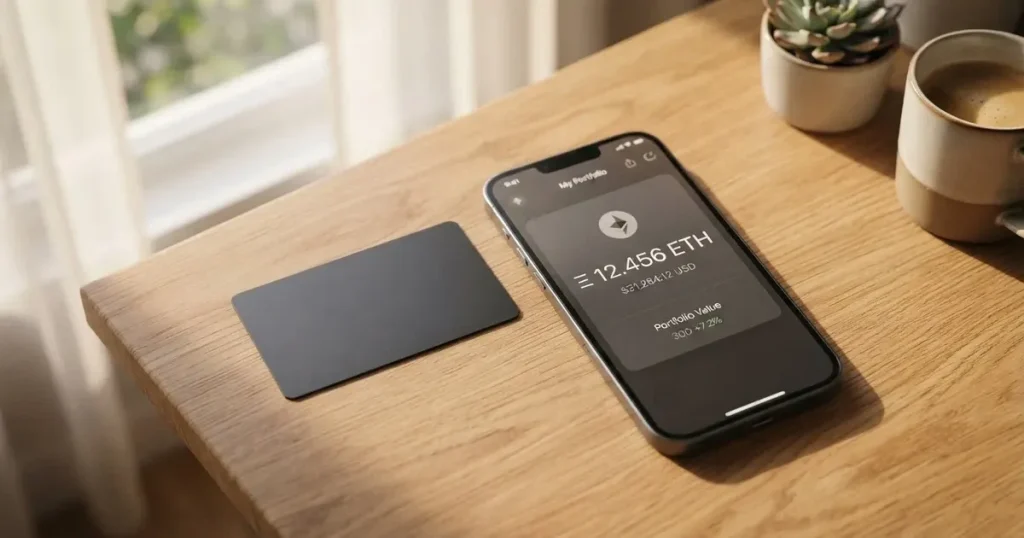
The Zoomex card is a virtual Mastercard with a dedicated IBAN, funded by transferring USDC from a Zoomex exchange account into a UR account and spending it like an ordinary debit card, including in Apple Pay, Google Pay and Samsung Pay. There is no card issuance fee and no annual fee, and converting crypto to fiat costs 1%. What catches my attention is everything the card’s own public material does not say: no country list in the press release, no identity-check details, no ATM information, no disclosure of which networks the USDC travels on, and no named issuing bank for the card itself. I scored it 6.8 out of 10.
*Conditions described are current as of October 28, 2026.*
Verdict: 6.8 out of 10, and the gaps are as important as the features
My overall mark is 6.8 out of 10. That is not a hostile score and not a generous one — it is roughly what I get for a young card, launched recently, that does the basics at a fair price while leaving the reader to guess at several practical questions.
Who this suits: you already hold crypto on Zoomex, you want a virtual card with an IBAN in your own name for subscriptions and online payments, you are comfortable sending USDC on a network you verify yourself, and you treat the balance as spend money rather than savings. New cardholders are moved from Basic to UR Pro automatically at no cost, which raises limits and gives better withdrawal fees, so the “membership tier” question mostly answers itself.
Who it does not suit: anyone who needs a physical plastic card, anyone who plans to use ATMs, anyone who wants a bank account with deposit guarantee, and anyone who needs predictable country-by-country availability written down somewhere. The card’s public pages do not name the issuing institution, and the currency list is USD, EUR, CHF, SGD, HKD, JPY “and more” — which is a phrase that answers nothing when a specific merchant asks for a specific currency.
| Criterion | Mark | Why |
|---|---|---|
| Who can get it | 8 / 10 | Press release gives no country list; an earlier check showed the world minus USA, Russia, Iran, North Korea |
| Cost | 8 / 10 | No issuance fee, no annual fee; 1% crypto-to-fiat conversion, Mastercard real-time rates between currencies |
| Top-up options | 5 / 10 | USDC deposit, USDC transfer from a Zoomex exchange account; networks not named |
| Reliability and complaints | 5 / 10 | Zoomex (Seychelles); claims Canada MSB, U.S. MSB, NFA, AUSTRAC; card on UR infrastructure, issuer unnamed; Gridinsoft 1.9 of 5 from 81 reviews about the exchange |
| Everyday use | 7 / 10 | Virtual Mastercard with a dedicated IBAN, Apple Pay, Google Pay, Samsung Pay; no plastic, ATM situation undisclosed |
| Total | 6.8 / 10 |
The timing matters for reading anything about this card. Late December 2025 saw early registration open with rollout expected in early 2026; the card itself launched on 9 March 2026. That is a matter of months of live operation, not years, and it shapes how much weight I can put on anything the card says about itself.
Will they give you the card
Short answer: the card does not publish a country list, so I cannot tell you from official sources where it is available, and I would not want you to guess.
What the card’s press release gives is no country list at all. An earlier check I ran showed it as global with exclusions for USA, Russia, Iran, North Korea and some US territories. That is unofficial and not confirmed by the card, and the US exclusions are worth noticing on their own: if your plan involved using a Zoomex card from inside the United States, the earlier picture was already a no.
The other missing piece is citizenship versus residence. The card does not say whether eligibility follows the country you live in or the country on your passport. That distinction is not a technicality in this industry — sanctions screening and issuer risk policy routinely apply to citizenship and country of birth as well as to your address, which is why a legitimate resident with a passport from a screened country can hit a wall that the marketing page never mentions.
So the practical question before you spend an evening setting things up is whether your country of residence and your citizenship both clear whatever policy sits behind the card. Nobody has published that policy. Ask support, and if you cannot get a straight answer, that answer is itself the answer.
How to get it
Short answer: it is a virtual Mastercard with a dedicated IBAN, obtainable through a UR account, and the identity-check steps are not stated anywhere I could find.
Here is the shape of the thing. The card is virtual — a Mastercard you add to your phone’s wallet rather than a piece of plastic in the post. A physical card is not mentioned, and since delivery only applies to physical cards, that question simply does not apply. Money settles in USD, EUR, CHF, SGD, HKD, JPY “and more”, and you get a dedicated IBAN, which is the part that matters most for the many people who pay online with a card number that has an IBAN attached for verification.
On membership, only two levels are stated: Basic and UR Pro. Verification tiers are not stated — there is no published ladder of document checks to aim at. New cardholders are moved up from Basic to UR Pro at no cost, and UR Pro brings higher limits and “better withdrawal fees”, though the exact improvement in withdrawal fees is not given as a figure.
Identity verification is not stated in the release, and the card arrives through a UR account rather than through a Zoomex-branded sign-up. That is a real structural detail. It means the onboarding, and possibly the checks you will face, sit with UR — an entity whose country and licences the card also does not state. The card describes itself as backed by UR’s licensed financial infrastructure, and UR is not explicitly named as the issuer.
If you are wondering whether you can pass the checks at all, then the honest answer is that the card publishes nothing on that, and you will find out by trying. One thing you can control: identity checks generally apply to adults, and prepaid and debit cards are generally available to people aged 18 and over, with some issuers setting higher limits.
Fees and other costs: what a payment really costs
Short answer: there is no issuance fee and no annual fee, cross-currency spending uses Mastercard’s real-time rates, and the one fee you will meet constantly is 1% to turn crypto into spendable fiat.

| Fee or limit | What the card states |
|---|---|
| Issuance fee | None |
| Annual fee | None |
| Crypto-to-fiat conversion | 1% |
| Cross-currency | Mastercard’s real-time exchange rates |
| ATM | Not stated |
| Limits | Upgraded UR Pro members: monthly limit up to 100,000 CHF; other limits not stated |
Now the part people actually care about: what does it cost to buy a coffee, and what does it cost to buy a plane ticket. Let us walk through three ordinary payments.
A coffee in your own city, in the currency you hold. You hold, say, EUR in the card and buy a coffee in EUR. There is no cross-currency conversion at all, so no exchange rate enters the picture. If you funded that balance from crypto, the 1% crypto-to-fiat conversion is the fee you are paying — and it is the one you cannot avoid while the balance is crypto-backed.
A subscription billed in USD while you hold EUR. This is where cross-currency spending bites, and here the card is actually competitive: the conversion uses Mastercard’s real-time exchange rates, with no separate FX fee layered on by the card. Compared with typical cards, which add a foreign-transaction markup on top of the rate, that is the strongest part of the cost picture and the reason I scored cost at 8 out of 10.
A larger purchase on a stablecoin balance. Same 1% conversion, no different. What I would check before you do it is the limit line, because that is where the cost section and the practical section meet: UR Pro members get a monthly limit up to 100,000 CHF, and no other limits are stated. If you are buying anything expensive — a hotel stay, a vehicle deposit, equipment for work — you want to know the per-transaction ceiling, and the card does not tell you what it is.
One more cost that is easy to miss: when you load the card, the money travels on a blockchain. Network fees for the deposit are charged by that blockchain, not by the card company. That is a small number compared with 1%, but it is real, and it is the reason a top-up should never be so small that it is worth skipping.
Top up: moving USDC in, and the question the card does not answer
Short answer: you fund it with USDC, either deposited directly or transferred from your Zoomex exchange account into a UR account, instantly — and which networks are supported is not stated.
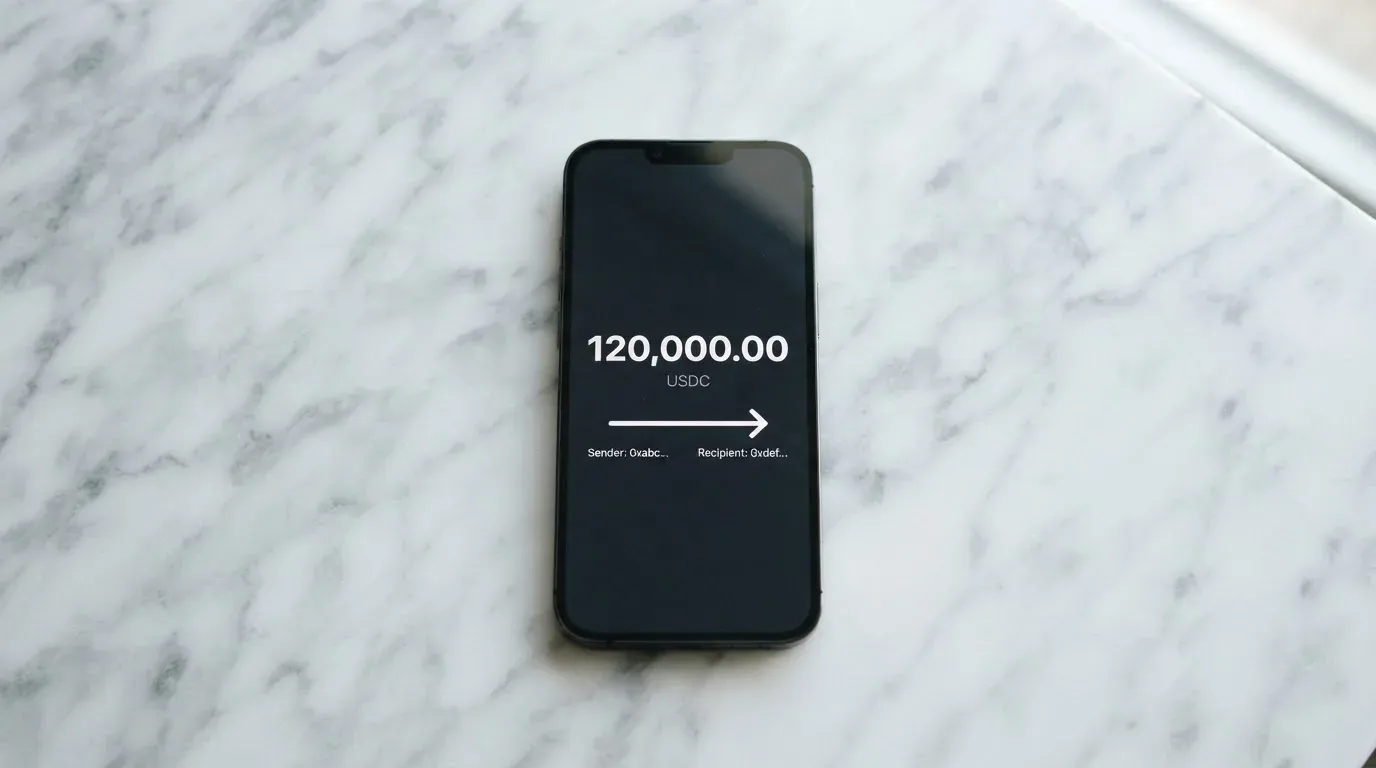
The two routes the card describes are a USDC deposit and a USDC transfer from a Zoomex exchange account to a UR account. Both are USDC. Only USDC is mentioned; no other coin appears in the funding description. Fees for topping up and the minimum deposit are not stated.
That last omission is the one to slow down for, because it is the classic place where crypto card money goes missing. Blockchain transfers are irreversible. If you send on a network the card provider does not support, or to an address belonging to a different network, the funds can be lost or need manual recovery with no guarantee of success. Since the card names no networks, the network is the one thing you must verify yourself before pressing send — from the deposit screen in your own account, not from a blog post or a support reply from six months ago.
Two pieces of background that bear directly on this. USDC is a US-dollar-pegged stablecoin, and Circle describes it as redeemable 1:1 for USD and fully backed by cash and cash equivalents, mostly in a government money market fund registered with the SEC, with monthly reserve attestations. It is natively supported on 38 networks as of 16 September 2026, including Ethereum, Solana, Base, Polygon PoS, Avalanche, Arbitrum and Stellar. Circle stopped supporting USDC on Tron in February 2024, so the popular shortcut of USDC over TRC20 is not a native option here — a detail that catches people out because TRC20 USDC still circulates in the wider market through other routes.
And “stablecoin” is not a promise. Stablecoins can lose their peg: TerraUSD collapsed in May 2022, and USDC temporarily lost its peg in March 2023 during the US banking crisis. Whatever stability you assume about the balance you are about to spend, check it yourself at that moment.
On the way back out: there is no fee for fiat withdrawals, and UR Pro members get better withdrawal fees — again without a figure. What happens to a remaining balance if you close the account is not stated.
Paying with it every day
Short answer: it works with Apple Pay, Google Pay and Samsung Pay from a virtual Mastercard with its own IBAN, which is a solid everyday setup for online payments and subscriptions — with no plastic card and no published information about blocked merchant categories.
The everyday story is good. A virtual card with a dedicated IBAN added to your phone wallet covers most of what people actually need: recurring subscriptions, app store purchases, travel bookings, anything that wants a card number and a supporting IBAN. Adding it to Apple Pay is straightforward in principle — Apple replaces the card number with a device-specific number stored in the Secure Element, not on Apple’s servers, and each payment uses a one-time dynamic security code, so the underlying Zoomex card number is not what sits on your phone.
What you give up by having no plastic: the card cannot be handed to someone else, cannot be used where a physical card is required, and does not help you if your phone is dead at the till. Where you can use it in person, the virtual card still works at contactless terminals, but the practical experience is untested territory as far as public information goes.
The gaps worth naming:
- Blocked categories are not stated. Merchant category codes are the four-digit codes that classify a business, and some — gambling is the classic one, category 7995 — are blocked by policy rather than law, with the list differing by issuer. You cannot tell from public sources whether this card declines gambling, adult content, fuel, or travel.
- ATM use is not stated at all, in either direction. Whether you can withdraw cash, at what fee, in which countries, is unknown from the card’s own material.
- The app is not described. It is a UR app; I did not read ratings, and I would not want to quote numbers I have not seen.
- Disputes and chargebacks are not stated. Nobody has published how you challenge a payment you did not make, or how long it takes. In this category that is normal but unpleasant — a chargeback is a refund ordered by the issuer, and prepaid-card coverage varies and should not be assumed.
Promotions are worth checking for what they are worth. Through 30 April 2026 23:59 UTC, compliant purchases earn 1% cashback credited in real time, and new users get a $10 reward for a $5+ purchase within 30 days of activation. The rate after the promotion is not stated. So the incentive is real but time-boxed, and I would not build a spending habit around a cashback that has a printed end date.
What can go wrong
Short answer: the main risks are not fraud reports about the card — I found none — but the concentration of undocumented things around it, and the fact that the exchange beneath it draws poor marks from at least one aggregator.
Let me be precise about what I searched and did not find. I found no official incidents involving the Zoomex card, and no Trustpilot or Reddit card reviews — there appears to be no dedicated card review page. That absence is not reassurance; with a card launched in March 2026, it simply means there is not yet a public complaint history to read. The one related score I did find is from a news aggregator: Gridinsoft rates zoomex.com — the exchange, not the card — at 1.9 out of 5 from 81 reviews. I would not treat that as a verdict on the card, but I also would not treat the absence of card complaints as a clean bill of health for the exchange that sits underneath it.
The company details are worth reading twice. Zoomex is in Victoria, Seychelles, which is where it announced its office, and it was founded in 2021. It claims registration as a Canada MSB, a U.S. MSB, a U.S. NFA registrant and an Australian AUSTRAC registrant. Claims are claims — I did not verify them against the registries — and the card does not name which of those registrations, if any, covers the card. It says only that the card is backed by UR’s licensed financial infrastructure, and UR is not explicitly named as the issuer, with UR’s country and licences not stated either. If you are about to hold money on this card, that is the single most important unknown in this review: who is actually liable for your balance, and under whose licence.
Security for the card specifically is not stated. The exchange says it passed a Hacken audit — a company claim about the exchange, not about the card. Support arrangements are not stated.
And the category carries risks that are structural rather than specific to Zoomex. Card programmes do close. Visa terminated its global agreements with FTX on 13 November 2022 and the FTX US debit card was wound down; WaveCrest, a Visa issuer that supplied crypto card brands, was suspended by Visa in Europe in 2018, closing all WaveCrest-issued programmes. Visa and Mastercard do not issue crypto cards to consumers themselves — they license issuers and can suspend a programme. When that happens, the usual sequence is a notice period, then spending and loading stop, then you are asked to withdraw what is left. A closure reported by a single secondary source in 2026 ended new loads on 8 July 2026 and stopped spending on 8 August 2026; I have not confirmed that independently, and I include it only to show the shape of the sequence rather than as a fact about this card.
One more category hazard that applies to prepaid-style cards like this one: some shops decline prepaid or foreign-issued cards, because the merchant can look up the card’s first six or eight digits and see the issuer institution and country, then apply extra scrutiny when the issuer country differs from the billing address. Address verification on online checkouts is mainly offered in the US, Canada and the UK and is generally unavailable for foreign-issued cards, which can cause declines. A declined payment is not only an inconvenience: a declined authorisation may leave a hold on your funds that stays for several days, typically up to seven.
What I would actually do about all this is keep only the spending balance on the card, treat the IBAN as a convenience for merchants rather than as an account you keep money in, and not hold a large idle balance in a card that is months old.
What to take instead
Short answer: if you need a card today and your country is served, the Coinbase Card is the more mature option; if you are in Europe and want cashback tiers, OKX is the one with the published reward table; Young Card is the weakest of the three on what its own pages disclose.
| Alternative | Score | Card | Cost and rewards |
|---|---|---|---|
| Zoomex | 6.8 / 10 | Virtual Mastercard, dedicated IBAN, multi-currency | No issuance or annual fee, 1% conversion; 1% cashback promo to 30 April 2026 |
| Coinbase Card | 6.4 / 10 | Visa prepaid debit, virtual or physical | Zero spending fees, no annual fees; variable crypto rewards, US card users only |
| OKX | 6.2 / 10 | Euro-denominated virtual Mastercard linked to OKX Pay | No card fee; conversion spread quoted as 0.1% and 0.4% in different places |
| Young Card | 5.7 / 10 | Not stated officially | Not stated; cashback in YNG tokens by club tier |
Coinbase Card is the one to look at first if your problem is “I have no ordinary bank card”. It is a Visa prepaid debit card, virtual or physical, available in all US states except Hawaii, and account opening follows the U.S. PATRIOT Act identity rules — name, address, date of birth, ID — with no other countries listed. Spending works with cash or crypto, and all crypto is converted to US dollars for purchases and ATM withdrawals, which is a clearer statement than anything on the Zoomex side. On fees: zero spending fees and no annual fees, with all fees disclosed in the Cardholder Agreement and User Agreement. The trade-off is the spread when Coinbase buys, sells or trades crypto, and that optional crypto rewards apply to US card users only, with a variable rate shown in the app.
OKX is the European comparison. It covers the EU plus Norway, launched 28 January 2026, with Iceland and Liechtenstein excluded; one explainer’s conclusion says “entire EEA”, which is inconsistent with that, and the rule follows the EEA user of OKX Europe Ltd., the MiCAR-licensed entity. The card is a euro-denominated virtual Mastercard linked to OKX Pay, issued via an unnamed European licensed payment provider — which is the same unnamed-issuer pattern I criticised above, so it is not automatically better on that axis. Funding is USDC or USDG held in OKX Pay, with no auto top-up and payment declined if the balance is insufficient. Its published reward table is the most detailed of any card here, and also the most contradictory: cashback only on USDG purchases with USDC earning none, monthly caps in EUR from Regular at 2% capped at 10 up to VIP4+ at 10% capped at 1,000, with the text saying 2–5% while the table says 10%. On the conversion spread, an explainer in May 2026 says 0.1% while the launch press release says a 0.4% market spread — the explainer is newer, and I would plan on the worse of the two until the card itself says.
Young Card scores 5.7 / 10 and, on the information available, simply cannot be compared properly: card type, cost, fees, funding and eligibility are all not stated officially. Its one concrete feature is that cashback is paid in YNG tokens, at a rate set by club tier — Essential 0.1%, Gold 1.8%, Platinum 3.6%, with Bronze and Silver not stated. Being paid in a platform token rather than cash is a category of risk all by itself, because you now hold something you may not be able to sell at the value shown.
Who I would recommend it to
I would recommend this card to a specific person: you already use Zoomex as an exchange, you are comfortable holding and moving USDC, and your payment problem is “I need a card number and an IBAN in my own name for online payments and subscriptions, and I do not have a bank willing to give me one.” For that person the combination is genuinely useful — no issuance fee, no annual fee, a 1% conversion, Mastercard’s real-time rates on cross-currency spending, and a real IBAN rather than a payment-processor workaround.
I would not recommend it if any of these are true:
- You need a physical card, in hand, for a shop that insists.
- You plan to use ATMs; the card says nothing about them, and silence here is not permission.
- You want your money to sit somewhere with deposit protection. A card balance is not a bank deposit, and e-money safeguarding arrangements are not the same thing as a deposit guarantee scheme.
- You cannot tell me which network to send USDC on for your account right now, and would rather rely on someone’s answer than check the deposit screen.
- You are in the United States, Russia, Iran or North Korea, or hold a passport from one of those countries, on the strength of an unofficial country picture I could not confirm.
- You plan to keep a large idle balance on the card for a long time, on a programme that is a few months old with no named issuer.
The honest summary is that this card is cheap, modern and structurally simple, and that the simplicity is where the risk hides. What the card publishes about its costs is good. What it publishes about its own availability, its identity checks, its ATM use, its networks and its issuer is thin to the point of absence. Judge it on what it has actually told you, and keep only what you can afford to lose on it.
Frequently asked questions
What is the Zoomex card?
The Zoomex card is a virtual Mastercard with a dedicated IBAN that spends a balance funded by crypto. You load USDC, and the card converts it to fiat so you can pay as if it were an ordinary debit card. It settles in USD, EUR, CHF, SGD, HKD, JPY “and more”, and works with Apple Pay, Google Pay and Samsung Pay. There is no physical version mentioned. The card launched on 9 March 2026.
Is Zoomex a bank?
No — not on the evidence available. Zoomex is a company in Victoria, Seychelles, founded in 2021, which claims registration as a Canada MSB, a U.S. MSB, a U.S. NFA registrant and an AUSTRAC registrant. Those are claims by the company, not things I verified. The card does not name an issuing bank at all; it says only that it sits on UR’s licensed financial infrastructure, without naming UR as issuer or stating UR’s country and licences.
Which countries can get the Zoomex card?
The card’s press release gives no country list, which is unhelpful if you are outside the obvious markets. An earlier check I ran showed it as global except USA, Russia, Iran, North Korea and some US territories — unofficial, and not confirmed by the card. The card also does not say whether eligibility follows your residence or your citizenship, and both can be screened.
How much does the Zoomex card cost to open and keep?
Nothing to open and nothing to keep: no card issuance fee and no annual fee. The costs that apply once you start spending are a 1% crypto-to-fiat conversion, and Mastercard’s real-time exchange rates when you spend in a currency other than the one you hold. Blockchain network fees also apply to the deposit, charged by the network rather than by the card.
How do I top up the Zoomex card?
With USDC, by one of two routes the card describes: a direct USDC deposit, or a transfer of USDC from your Zoomex exchange account to a UR account, described as instant. Only USDC is mentioned. The card does not state the supported networks, the top-up fee or the minimum deposit — and because blockchain transfers are irreversible, check the deposit screen in your own account before sending.
Does the Zoomex card require KYC?
Identity verification is not stated in the card’s release. The card arrives through a UR account, and only two membership levels — Basic and UR Pro — are described, with no verification tiers published. New cardholders are upgraded from Basic to UR Pro at no cost. In practice, expect the standard identity checks any regulated provider runs, but confirm the details with support before you start.
Can I use the Zoomex card in Apple Pay?
Apple Pay is one of the three wallets the card supports, alongside Google Pay and Samsung Pay, and it is the most natural way to use a virtual card day to day. Apple replaces the card number with a device-specific number stored in the Secure Element on your device, never on Apple’s servers, and every payment uses a one-time dynamic code. You still need sufficient card balance before a payment goes through.
Is the Zoomex card safe to use?
I found no official incidents and no Trustpilot or Reddit card reviews — but that is because the card launched in March 2026, not because it is proven. One aggregator rates the Zoomex exchange at 1.9 out of 5 from 81 reviews. Keep only spend money on the card, and remember that card programmes can close: Visa ended FTX’s agreements in 2022 and suspended WaveCrest in Europe in 2018.
What are the Zoomex card’s limits?
Upgraded UR Pro members get a monthly limit of up to 100,000 CHF, and that is the only limit the card publishes. No per-transaction ceiling, no daily limit and no ATM terms are stated. If you are planning a large purchase, ask support first rather than discovering the ceiling at the checkout.
Is the Zoomex card worth it?
For someone already on Zoomex who needs a card number and IBAN for online payments, the economics are good: no issuance fee, no annual fee, 1% conversion and real-time cross-currency rates. Beyond that it depends on your country clearing their unpublished eligibility rules and whether you can verify the deposit network yourself. If cashback is what draws you, note the 1% promo ends 30 April 2026 23:59 UTC and no later rate is stated.
Top exchange cards by score – cryptocardtop
Content created by the «cryptocardtop» team