
Holding dollars in USDC, spending them through a virtual Visa
 Available in US
ZAR is a crypto card aimed at one specific situation: you want to hold dollars in USDC, and you want to spend them through a Visa card number, because an ordinary bank card is not available to you. That is the whole pitch. It is not a travel card, not a rewards card, and not an everyday bank replacement — it is a virtual Visa sitting on a crypto balance, and how useful that is depends almost entirely on whether a virtual Visa solves your problem.
I checked the card’s own site, its app store listing, and its terms, and I scored it 7.3 out of 10 overall. The strong parts are eligibility (it opens in more countries than almost anything in this category) and cost (opening the account and the virtual card are free, with no foreign fees claimed). The weak parts are funding (right now the only native route is USDC on Solana) and everyday use (no plastic yet, and Google Pay is not mentioned).
If you are choosing between cards, keep those two axes in view before anything else: who will let you in, and how you get money onto it. Everything else follows.
The conditions described here are current as of October 28, 2026.
Verdict and Score
| Criterion | Mark | Why |
|---|---|---|
| Who can get it | 8 / 10 | Site says “100+ countries”, App Store says 110+ countries, no list; Russia, Belarus, Iran, Iraq, China, Japan, Vietnam, Venezuela named as refused |
| Cost | 9 / 10 | Account opening and virtual cards free, “No foreign fees”; physical card costs vary by country; monthly fee not disclosed |
| Top-up options | 5 / 10 | Currently only USDC on Solana; other stablecoins get converted to USDC; bank transfer also listed |
| Reliability and complaints | 7 / 10 | Golden Age Dev Lab Pte Ltd (Singapore), dollars from Circle, banking by SSB (Member FDIC); card issuer not named; no complaints found; App Store 3.9/5 from 44 ratings |
| Everyday use | 6 / 10 | Virtual Visa in USD, Apple Pay supported, ATM withdrawals claimed; plastic “coming soon”, Google Pay not disclosed |
| Total | 7.3 / 10 | Strong on access and fees, thin on funding routes and card maturity |
Who this suits, and who it does not
It suits you if you are in a country where an ordinary bank card is refused to you, you already hold USDC or can get it, and your main need is a card number that works at online merchants in dollars. It also suits you if you want no monthly fee and no foreign transaction fee, because both are stated plainly.
It does not suit you if you are paid in a local currency and want a normal everyday spending card with a physical piece of plastic, because the physical card is “coming soon” and the balance is USD. It also does not suit you if you hold USDT on another network and expect to spend it directly, because the current native route is USDC on Solana and other stablecoins are converted.
Will they give you the card?
Yes, for a very wide range of countries — the widest eligibility language I saw on any card in this category. ZAR’s site claims “100+ countries” and its App Store listing says 110+ countries, with no list published. The terms, however, say ZAR may refuse service in certain locations, and Russia and Belarus are named explicitly alongside Iran, Iraq, China, Japan, Vietnam and Venezuela, described as a non-exhaustive list. On top of that, the terms require users to be 18+ and not subject to sanctions.
Two things you should notice here, because they are exactly the details that decide whether you can actually sign up. First, the card does not say whether eligibility follows citizenship or residence. If you are a citizen of one of the excluded countries but live somewhere else, the public pages do not tell you which rule applies, and that is a real question to ask support before you send any documents. Second, the exclusion list is described as non-exhaustive, so a country not named may still be refused. Treat the country list as “probably open, not confirmed open”.
The company behind it is Golden Age Dev Lab Pte Ltd, incorporated under Singapore law, and its terms point to Singapore courts. Its terms also describe it as a fintech company and not a bank, and state that it is “not a money services business”, with no licence numbers given on the pages I read. The USDC itself is issued by Circle, and the banking relationship is with SSB, a Member FDIC. The card issuer is not named. I will come back to what that means in the risk section.
Practically: the odds are good. If you are in a large, ordinary country that is not on that list, this is one of the more open cards you can find. If you are in one of the named countries, or in a country you suspect is on the unlisted remainder, do not plan around it.
How to get it
The process is ordinary KYC with one identification provider. Verification is required for bank connectivity and for the card services themselves, and Plaid handles the identity check. Passports and driver’s licences are both accepted, there is PEP screening, and the minimum age is 18. Proof of address is not stated on the public pages, so I cannot tell you whether you will need it — I can only tell you it is not published.
The card you get is a virtual Visa or a physical one. The physical card is “coming soon”, so what you can actually use today is the virtual card, denominated in USD. There is only one KYC level described: no tiers, no separate limits for higher verification, and no stated processing time. That absence matters more than it sounds — with a single level, there is no published path from a small limit to a larger one.
Your account can be suspended. The terms list fraud, legal requirements and breach of the terms as grounds, which is normal, but it does mean the relationship can end without a stated appeal process on the pages I read.
There is one detail I would not skip: check whether your identity document and your country of residence pass before you wire anything anywhere. Since the exclusion list is not published and the citizenship-versus-residence basis is not stated, a five-minute support email costs nothing and can save you a rejected application.
Fees and what a payment really costs
This is the strongest part of the card. Opening an account is free, virtual cards are free, and the company states “No foreign fees”. What you cannot get from the public pages is a full price list: the physical card fee depends on the country and is not a fixed figure, no monthly fee is disclosed, the conversion fee is not stated, and the ATM fee and allowance are not stated.
| Fee or limit | What ZAR states |
|---|---|
| Account opening | Free |
| Virtual card issuance | Free |
| Physical card | Paid; fee depends on country |
| Monthly fee | Not stated |
| Foreign currency | “No foreign fees” |
| Conversion fee | Not stated |
| ATM withdrawal | “Withdraw dollars as local currency from ATMs worldwide”; fee and allowance not stated |
| Card currency | USD — “Spend and save in USD” |
| Daily transaction limits | Set at registration, depending on currency, payment method and the KYC/AML assessment; no amounts published |
| Tiers | Not stated |
Two behaviours are worth noting because they are positive signals. The fees are shown before you confirm a transaction, so you see the amount before committing, and any fee change is announced one week ahead rather than applied silently. That is better disclosure behaviour than most cards in this category manage.
Now let me walk through three ordinary payments, because “no foreign fees” is the phrase people quote, and the phrase does not mean what half of them assume.
Paying for an online subscription in dollars. You are spending USD from a USD balance, and the card is a USD Visa. This is the clean case: no conversion is involved at all, and the only thing between your balance and the merchant is the card network’s own pricing. There is no disclosed conversion fee because there is no conversion.
Paying for a subscription in euros. The merchant charges euros, so a conversion happens somewhere between the card network and ZAR. ZAR says there are no foreign fees; it does not say what rate is used or what the conversion fee is, because the conversion fee is not stated. Practically, you are relying on the Visa rate plus whatever ZAR does with it, and you cannot verify that from the public pages. Check the amount on the confirmation screen — that is where the fee is meant to be visible to you — before you authorise.
Withdrawing dollars from an ATM. The app store listing says you can withdraw dollars as local currency from ATMs worldwide. Neither the fee nor the allowance is published, so this is the single least predictable cost on the card, and the one where the “no foreign fees” line covers you least clearly. If cash matters to you, ask support for the ATM fee and the daily withdrawal allowance in writing before you rely on it.
The daily limits are set at registration and depend on the currency, the payment method and the outcome of the KYC/AML assessment, with no amounts published. So the limit you get is not something you can plan around in advance. That is why the card scored 6 on everyday use rather than higher: not because it is bad, but because it is not fully specified yet.
Top up: one good route and two others
The current native route is narrow. The terms say that only USDC on Solana is accepted right now. Other stablecoins such as USDT may be accepted but get converted to USDC, and the terms warn plainly that sending on the wrong chain may lose funds. The site additionally lists bank transfer and cash at a merchant.
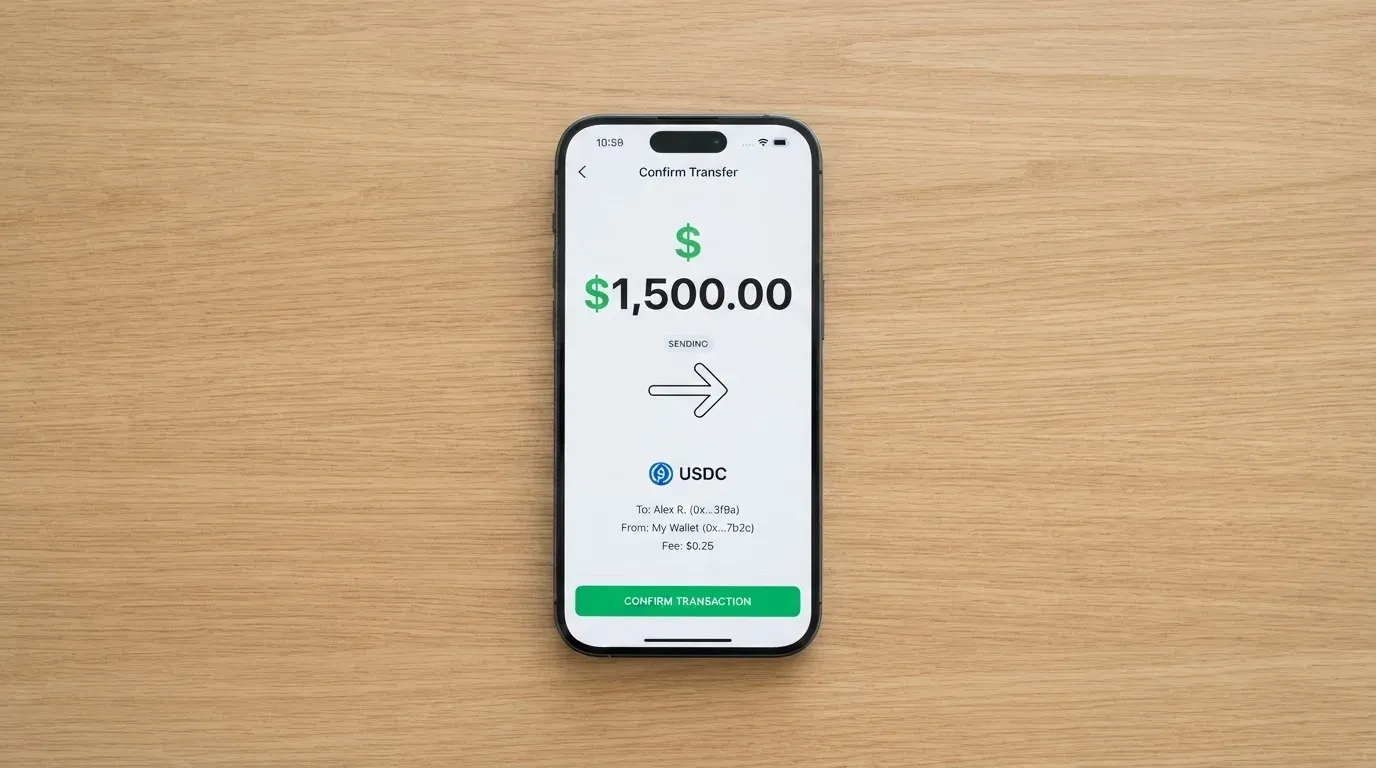
Understand what “only USDC on Solana” means for you. If you hold USDC on Ethereum, you cannot send it straight across; you would have to move it to Solana first, and network fees on the sending network are charged by that network, not by ZAR. If you hold USDT, you can send it but it will not arrive as USDT — it arrives as USDC. That is not necessarily bad; it is just a conversion at an undisclosed rate, on a schedule you did not set.
The warnings are not decorative. Blockchain transfers are irreversible. A deposit sent to an address on a network the provider does not support can be lost outright, or need manual support recovery with no guarantee of success. Stablecoins can also depeg: TerraUSD collapsed in May 2022, and USDC itself temporarily lost its peg in March 2023 during the US banking crisis. “Dollar-pegged” is a description of intent, not a guarantee.
On bank transfers, the fees vary by method and, again, you see the fee before you confirm. On stablecoin deposits, the minimum and the network fee are not stated. For USDC specifically, Circle says it is redeemable 1:1 for USD and fully backed by cash and cash equivalents, mostly in an SEC-registered government money market fund, with monthly reserve attestations; the BIS put roughly 90% of stablecoin market capitalisation in USDC and USDT in July 2025. Circle listed USDC as natively supported on 38 networks as of 16 September 2026, including Solana — the one ZAR wants.
Two further facts about the balance itself. You can close the account at any time, but all funds must be withdrawn first, and the fees for that withdrawal are not stated. And if the card’s stablecoin support is ever withdrawn, a programme closure typically follows a pattern: a notice period, then loading and spending stop, then users are asked to withdraw what is left. Plan where your balance sits accordingly.
For most people the practical sequence is simple: get USDC onto Solana, send it to the address the app shows you, confirm the network twice, and check the fee on the confirmation screen. If you already hold another stablecoin, read the conversion line before you send.
Paying with it every day
The day-to-day experience is fine for a virtual card and unfinished for everything else. Apple Pay tap-to-pay is supported, and the site lists Tap to Pay as enabled. Both iOS and Android apps exist. Google Pay is not disclosed, so do not plan a Google Pixel wallet setup around this card. A virtual Visa in USD is what you spend from, which is convenient for subscriptions and for anyone who wants to hold dollars rather than a local currency.
Two things you should know about how card payments behave in general, because they explain a lot of declines that have nothing to do with ZAR. A card number begins with an issuer identification number of six or eight digits that tells merchants which institution and country issued it, and some merchants apply extra scrutiny when the issuer country differs from the billing address — that alone can make a card look foreign at a shop. Address verification compares the numeric parts of the billing address the buyer typed with the issuer’s records, and it is generally unavailable for foreign-issued cards, which causes declines. Some merchants also decline prepaid cards outright because the lookup reveals the card type. None of that is a defect in your account; it is the category working as designed.
The app’s own rating gives a small signal: 3.9 out of 5 from 44 ratings on the UK App Store, read on 2026-10-21. That is a decent score on a small sample. The Google Play rating I did not read.
What is missing on everyday use: a physical card, Google Pay, any rewards or cashback, the list of blocked merchant categories, the ATM fee and allowance, and the published daily limits. No perks are stated at all, which is worth saying plainly in a category where several alternatives do offer them.
Disputes are handled in an unusual way, and you should read this before you ever need it. Disputes about the smart contract, the oracle, the API, the backend and account access go to an automated in-app resolution process, and for those the terms say litigation and arbitration are waived. Other matters go to the courts of Singapore. The chargeback process for a card payment is not stated. In ordinary card terms a chargeback is a refund ordered by the issuer to settle a dispute, with reason codes such as fraud, duplicate billing or goods not received; prepaid-card coverage varies by scheme and should not be assumed. If a large purchase goes wrong, you will not find a published route for it on these pages.
Support is reached at [email protected] and [email protected].
What can go wrong
I found no official incidents and no ZAR reviews at all. A search for ZAR app reviews and complaints across Trustpilot and Reddit returned nothing, and no Trustpilot page was found. That is genuinely good news and genuinely thin evidence at the same time: a young card with no reviews has not been reviewed, not been absolved. Treat it as an absence of signal rather than a clean record.
The structural risks are clearer than the incident history.
Custody. The terms describe self-custodial wallet software and say “We do not custody or control your funds”. The footer says customer funds are held at SSB in custodial accounts, FDIC-insured up to $250,000 per depositor — and that this does not protect against ZAR’s failure. Read those two statements together: the crypto side is self-custodied, and the fiat side sits in a bank account. Deposit insurance protects you against the bank’s failure, not against the card company’s.
The unnamed issuer. The card issuer is not named on the public pages. Visa and Mastercard do not issue crypto cards to consumers themselves; they license issuers, and in November 2022 Visa said it had terminated its global agreements with FTX, with the FTX US debit card programme wound down by its issuer. WaveCrest, a Visa issuer that supplied crypto card brands, was suspended by Visa in Europe in 2018, closing all WaveCrest-issued Visa programmes. Those are the two reference points that matter here: the network can end a programme, and the company that licensed the brand is not always the company that issued the card.
Declines and holds. A declined authorisation may leave a hold that stays for several days, typically up to seven. Address verification failing on a foreign-issued card is the most common boring cause.
Wrong network, irreversible. Covered above, and it is the most likely way a real user loses real money on this card: a transfer on an unsupported network can be gone.
Price risk on the balance. If you top up with USDT and it is converted, you take the conversion at the provider’s rate. And if USDC drifts from a dollar, your spending power drifts with it — the card’s balance follows the token, not the dollar.
Counterparty risk on the stablecoin. Tether says it disables tokens in wallets on the OFAC sanctions list and has frozen funds tied to illicit activity, so stablecoins are not censorship-proof in either direction.
No news and no published numbers. The pages I read carry no newsroom, no licence numbers and no issuer name. If you are making a decision with real money on it, ask for those three things in writing.
On regulation, the general frame is worth a sentence so you know which hat ZAR is wearing. In the EU, MiCA took legal effect in June 2023, its stablecoin rules applied from 30 June 2024 and the remaining provider rules from 30 December 2024; e-money tokens may be issued only by a credit institution or an electronic money institution, and the transitional period for existing providers runs until 1 July 2026 or until authorisation is granted or refused. A card, though, is regulated separately as a payment service — so a crypto card often depends on two licences, one on the crypto side and one on the card side. ZAR’s terms place it outside the US money-services-business framing and show no licence numbers, so you are not reading a regulated-entity record here. In the US, FinCEN guidance treats administrators and exchangers of convertible virtual currency as money transmitters, while people simply buying goods and services are not. This is background, not a view on whether the card is sound.
One more category habit worth knowing: a declined authorisation can leave a hold for days, and a merchant category code classifies a business — MCC 7995 is gambling, and many issuers block it by policy rather than by law. ZAR does not publish a blocked-category list, so you will find out by trying.
What to take instead
Three alternatives, so you can see where the trade-offs actually sit. Scores are my own on the same basis, not ZAR’s.
| Card | Score | Card | Cost | Foreign currency | Top-up |
|---|---|---|---|---|---|
| ZAR | 7.3 / 10 | Virtual and physical Visa; physical “coming soon”; USD | Account and virtual card free; physical fee varies by country; monthly fee not stated | “No foreign fees” | USDC on Solana only, plus bank transfer and cash at a merchant |
| Morse | 7.5 / 10 | Fully virtual Visa prepaid debit; spends from Morse Balance in any currency | Issuance and monthly fee not stated; card page says fees may apply | “Zero foreign exchange fees or markups”, real-time Visa rate | Debit card, stablecoin transfer, bank details; USDC, USDG and EURC via Solana free, other tokens fee |
| International Visa Card | 6.7 / 10 | U.S.-issued Platinum Visa, virtual; pays in USD; physical “coming soon” | $5 one-time virtual card, no maintenance fee; Classic free, Pro $9.00/month, Max $19.00/month | “Visa exchange rate + 2% FX fee” | USDC or USDT into the USD account free; also USD, EUR, SEPA, SWIFT, FedNow |
| UNi Card | 6.1 / 10 | Multicurrency Mastercard spending from the UNi.Global balance | No annual fee; issuance fee not stated | “No annual fee or foreign transaction fee”; live OTC rates, “no hidden exchange fees” | Not stated |
Morse scores highest of the four at 7.5, and its funding breadth is the reason: USDC, USDG and EURC over Solana are free, other tokens and blockchains carry a fee, and Bitcoin, USDT and Ethereum can also be deposited. Its zero-markup claim is stronger on paper than ZAR’s, which is silent on the conversion fee. Its limits are on eligibility rather than cost: it works by residence, not citizenship, is available in over 140 countries for the peer-to-peer side, and there is a closed beta needing an invite code in a list that includes Australia, Hong Kong SAR China, Japan, New Zealand, Singapore, Switzerland, Türkiye and the United Kingdom. The card is “available only in certain countries” and the list is not published — check the app. Like ZAR, its Visa is fully virtual for now, and its withdrawal and add/withdraw coverage runs through over 70 countries locally. For you specifically: if you are in one of those beta countries and already hold USDT or ETH, Morse may serve you better than ZAR.
The International Visa Card is the honest alternative if you want a traditional funding menu. It is a U.S.-issued Platinum Visa, virtual only for now, with $5 one-time issuance and no maintenance fee, plus free Classic, $9.00/month Pro and $19.00/month Max plans. You can fund it with USDC or USDT into the USD account free, and also by USD, SEPA, SWIFT or FedNow, which is the part ZAR cannot match. But it charges “Visa exchange rate + 2% FX fee” on foreign currency, it blocks residents of a long list including India, Israel, Nepal, Nicaragua, Turkey and Ukraine, and it blocks purchases in North Korea, Cuba, Iran, Russia, Syria, Ukraine and Venezuela. No cashback is stated. If you spend mostly in dollars and mostly online, the flat 2% simply does not bite.
UNi Card is the one with perks and the thinnest disclosure. It is a multicurrency Mastercard spending from the UNi.Global account balance, with no annual fee, no foreign transaction fee, live over-the-counter rates and “no hidden exchange fees”, plus spend-to-earn rewards up to 3%. But its eligibility is not stated, its funding routes are not stated, and whether it is physical or virtual is not stated. On the evidence available it is the least documented of the three.
My read across the four: ZAR wins on who gets in and on declared foreign fees, loses on how you fund it and on how much of the card is finished. Morse wins on funding. The International Visa Card wins on banking-rail convenience at a flat 2%. UNi wins on rewards and on paperwork, which is not the same as winning.
Who I would recommend it to
I would recommend ZAR to someone in a country where a bank card is genuinely hard to get, who already holds USDC, who is comfortable sending a transfer on a specific network and checking it twice, and who mainly buys things online in dollars. For that person it is a 8 or 9 out of 10 card, and the low monthly burden is the point.
I would not recommend it as a first card. If you are opening your first payment instrument, a virtual-only card with no published daily limits, no Google Pay, no rewards and an unnamed issuer asks you to accept several unknowns at once, and there are better-documented alternatives for that.
I would hold off if your balance is large relative to what you can afford to lose, because deposit insurance here covers the bank, not the card company, and because the chargeback route for a card payment is not stated. I would also hold off if your income is in a local currency, because the balance is USD and you will be exposed to the exchange rate on every top-up, on top of whatever conversion happens at the point of sale.
And I would not recommend it to anyone hoping to bypass identity checks or a sanctions list. The KYC is real — Plaid, passports and driving licences, PEP screening, 18+ — and the terms reserve the right to refuse service in certain locations. The way to use this card is to be eligible for it.
Before you send anything, four questions worth asking support, all of them things the public pages leave open: is my country of residence eligible given my citizenship, what is the ATM fee and allowance, what is the conversion fee and rate when I spend in a non-dollar currency, and who is the card issuer. If the answers to those are clear, the card is good. If they are not, that is your answer.
Frequently asked questions
What is ZAR card?
ZAR is a crypto payment card built around holding dollars in USDC rather than in a bank account. You get a virtual Visa card, denominated in USD, and spend from that balance. It is run by Golden Age Dev Lab Pte Ltd, a Singapore company, with USDC issued by Circle and banking through SSB, a Member FDIC. A physical card is described as coming soon. In short, it is a way to turn crypto into something a merchant terminal accepts.
How does ZAR card work?
You create an account, pass identity verification, top up with crypto, and spend the resulting balance through a Visa card number or Apple Pay. It behaves like a prepaid card rather than a debit card: the crypto is converted and loaded as a balance, and the card spends only that balance, so it cannot overdraw. You can also close the account at any time, though all funds must be withdrawn first and the fees for that withdrawal are not stated on the public pages.
Is ZAR a bank?
No, and the company says so. Its terms describe it as a fintech company, not a bank, and state that it is “not a money services business”, with no licence numbers given. What it does have is a banking relationship with SSB, a Member FDIC, where customer funds are held in custodial accounts and FDIC-insured up to $250,000 per depositor. That insurance covers the bank’s failure, not ZAR’s, which the footer itself points out.
Who owns ZAR?
The operator named in the terms is Golden Age Dev Lab Pte Ltd, registered under Singapore law, with disputes under Singapore courts. The dollars are Circle’s USDC, and the banking is SSB’s. One thing you will not find is the name of the card issuer, which is a licensed institution separate from the brand. That omission is worth chasing in support before you load significant funds.
Does ZAR card require KYC?
Yes, and it is a single flat level rather than a tiered system. Verification is required for bank connectivity and card services, Plaid handles the identity check, and passports and driving licences are accepted. There is PEP screening, and users must be 18+. Proof of address is not stated on the public pages, and no processing time is published. If you hold a politically exposed position, the screening step is where your application will be examined.
How do I top up ZAR card?
The native route right now is USDC on Solana, and that is the only one the terms call current. Other stablecoins such as USDT may be accepted but are converted to USDC, so check the rate before you send. The site also lists bank transfer and cash at a merchant, with fees varying by method and always shown before you confirm. On-chain network fees are charged by the blockchain, not by ZAR, and the minimum deposit is not stated.
Is ZAR card safe?
There is no published incident history and no reviews at all to judge, which is absence of evidence rather than a good track record. The card describes self-custodial wallet software and says it does not custody your funds, while fiat sits in an SSB account with FDIC insurance up to $250,000 that does not cover ZAR’s failure. Transfers are irreversible, so a wrong network can mean lost money. Treat any balance here as money you could lose in full.
What are ZAR card’s fees?
Opening the account and the virtual card are free, and there are no foreign fees, with fees displayed before you confirm and any change announced a week ahead. Not disclosed: the physical card fee, which varies by country, any monthly fee, the conversion fee, and the ATM fee and allowance. Daily transaction limits are set at registration based on currency, payment method and the KYC/AML assessment, with no amounts published. That last point is the one that will bite you in practice.
Is ZAR card available in my country?
Probably, but not certainly. The site claims “100+ countries” and the App Store listing says 110+, with no list published, and the terms reserve the right to refuse service in certain locations while naming Russia, Belarus, Iran, Iraq, China, Japan, Vietnam and Venezuela as a non-exhaustive set. The terms do not say whether the rule follows citizenship or residence, which is the specific question worth asking before you apply.
Why should I pick ZAR over Morse or another virtual Visa?
Pick ZAR if your priority is getting in at all, keeping costs at zero, and spending dollars online — it opens in the widest set of countries and declares no foreign fees. Pick Morse instead if you hold other tokens, since it accepts USDT, Bitcoin and Ethereum as well as USDC over Solana, and claims zero FX markup with the real-time Visa rate. Pick the U.S.-issued Platinum Visa option if you want to fund by SEPA, SWIFT or FedNow and can live with a flat 2% foreign currency fee.
Top app and neobank cards by score – cryptocardtop
Content created by the «cryptocardtop» team