
KeyOne card, a virtual Visa with a self-custody twist
 Available in US
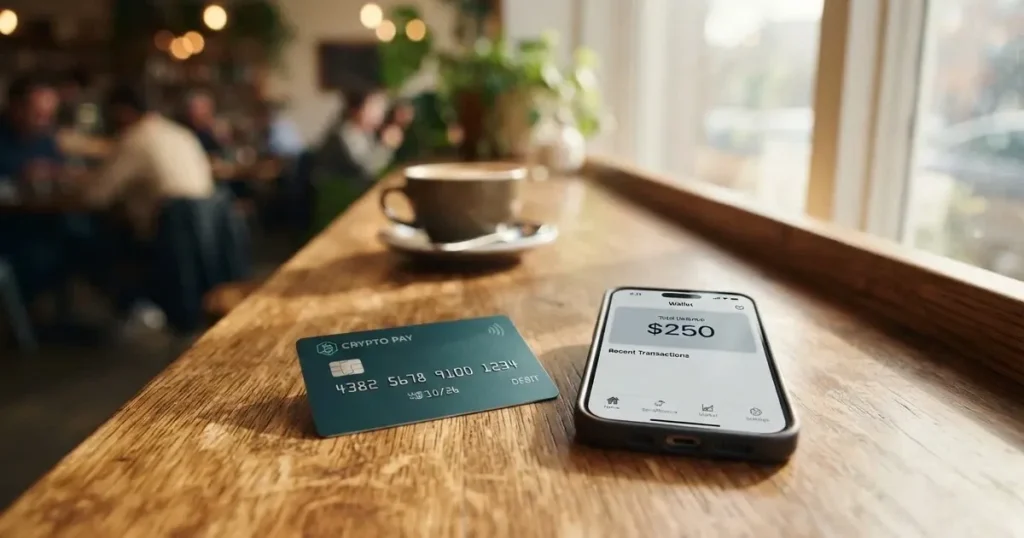
KeyOne is a virtual Visa payment card that spends from a euro balance you fund with USDC or USDT, or with a SEPA or ACH bank transfer. The card itself is free, the app is free, and the company behind it (KEYONE SOLUTION LTD, registered in Saint Christopher and Nevis) is upfront about not being a bank. Card issuance and the Visa programme actually run through Wirex, a long-established crypto-payments company that became a Visa principal member in Europe in December 2020. That mix, a young brand on top of a licensed issuer, is the heart of this card: the headline is simple (“free virtual card, pay with crypto”), the details live in the fees, the country list and the limits.
This review walks through who can actually get one, what it costs day to day, how to top it up, where it works smoothly, where it stumbles, and which alternatives exist if KeyOne is not quite the right fit.
The conditions described here are current as of October 28, 2026.
Verdict
KeyOne earns 6.8 out of 10 in this review. The card’s strengths are the free tier, the euro balance, the self-custody wallet that keeps your private keys on your device, and a country list that is genuinely broader than most competitors. The weaknesses are equally real: only a virtual card is offered, Google Pay support is not mentioned anywhere, ATM withdrawals are not addressed, and the app is so new that it has not yet accumulated ratings on the App Store or public reviews on Trustpilot or Reddit.
Score breakdown
| Criterion | Mark | Why it scored that way |
|---|---|---|
| Who can get it | 7 / 10 | 70 listed countries (Europe including Georgia, Moldova, Ukraine, Serbia, Azerbaijan; Asia including Kazakhstan, Uzbekistan, Japan, Thailand; UAE and Bahrain; Nigeria, Ghana, Kenya, South Africa, Uganda; Mexico, Brazil, Argentina; Australia). Russia and Belarus are not on the list. |
| Cost | 8 / 10 | Free tier at EUR 0: no issuance fee, no monthly fee. Payments in the balance currency are 0%; conversion is capped at 1%. Crypto top-ups cost 0.8% plus a network fee on the free plan. |
| Top-up options | 7 / 10 | USDC and USDT, SEPA, ACH and top-up from another Visa or Mastercard. Crypto withdrawals work only on the Base network. |
| Reliability and complaints | 7 / 10 | Wirex issues the card; KeyOne Solution Ltd runs the technology interface. No public complaints about KeyOne itself surfaced in research, but the absence of independent reviews is itself a signal. |
| Everyday use | 4 / 10 | Virtual Visa only. Apple Pay is supported with a one-tap add; Google Pay is not mentioned. ATM use is not stated. |
| Total | 6.8 / 10 |
The audience I would point KeyOne to is straightforward: residents of Georgia, Serbia or Kazakhstan who want a free euro-denominated card without a foreign-bank account, and who already hold stablecoins they want to spend online. It is less suitable for anyone who needs a physical card, plans to withdraw cash, or relies on Google Pay on Android.
Who can get the KeyOne card
KeyOne is a residence-based product. The card is available to residents of 70 listed countries, and the application page is explicit: for any unlisted country, “you can’t apply for a KeyOne card yet.” The list is unusually wide for a crypto card. It covers most of Europe (including Georgia, Moldova, Ukraine, Serbia and Azerbaijan, which are often excluded by competitors), large parts of Asia (Kazakhstan, Uzbekistan, Japan, Thailand), the Gulf (UAE, Bahrain), several African markets (Nigeria, Ghana, Kenya, South Africa, Uganda), Latin American countries (Mexico, Brazil, Argentina), and Australia. The two conspicuous absences are Russia and Belarus, but the card does not publish a separate excluded-citizens list, and the public pages do not say how citizenship is treated if it differs from country of residence.
If you are in one of the listed countries, the next gate is identity. KeyOne follows the standard crypto-card KYC pattern: a government-issued ID, a selfie, and, if asked, a proof of address. The accepted ID types depend on which country you apply from, but the page mentions passport, national ID card, driving licence and residence permit. The fine print is typical for this category: name and date of birth must appear on the document and match your application, the photo must match your selfie, and the document’s validity date must be in the future. You must be 18 or older, per the home page.
One thing the company is unusually clear about is what it is and what it is not. KEYONE SOLUTION LTD is incorporated in Saint Christopher and Nevis (company number C 63589) and states plainly that it is “not a bank.” The Terms are governed by the law of Saint Christopher and Nevis. The card is issued by Wirex under Wirex’s own regulatory permissions, and KeyOne Solution Ltd describes itself as the “technology interface.” That structure means the regulated part of the deal (the card, the payments, the safeguarding) sits with Wirex, while the app and the user experience sit with KeyOne.
How to sign up
The signup path is short enough to fit in a few steps: check your country is on the supported list, download the KeyOne app, submit a government-issued ID and a selfie, provide proof of address if asked, and wait for approval. Once approved, the card number, expiry date and CVV appear directly in the app. There is no physical card to wait for, and no delivery step at all, because only a virtual Visa is offered.
Processing time is described as variable (“support can check status”), and the company does not publish a guaranteed turnaround. The identity checks themselves are not tiered the way some competitors structure them: there is no Bronze/Silver/Gold ladder here, just the single flow above and a standing warning that “additional checks may be required” if the first pass raises questions.
The card balance is in euros, and fees in the agreement are quoted in euros, even though the home page also talks about “payments in balance currency.” That wording can be a little slippery if you are reading a quote from a non-euro merchant, but the substance is the same: when the merchant’s currency matches the balance, there is no conversion fee. The cardholder agreement repeats this: payments in the balance currency carry no fee, while payments in another currency carry a conversion fee of up to 1%.
The iOS app is published as “KeyOne: Crypto Card & Wallet,” requires iOS 17 or later and was at version 1.0.10 at the time of writing. The listed languages are English, Russian and Serbian. The App Store (Ireland) has not yet received enough ratings to display a score, which is more a function of the app’s age than of its quality. The Android listing (Google Play, package name com.keyonesolution.keyone) similarly has no rating retrieved at the time of research. The web app lives at app.keyonepay.com.
Fees: what it really costs
The headline on this card is the free tier. The Free plan costs EUR 0 to start, EUR 0 per month, and EUR 0 to issue. Payments in the balance currency are 0%. Currency conversion costs up to 1%. A Premium plan is available for EUR 149 per year (paid as a one-time 12-month fee from the card balance), and that higher tier raises a few limits and lowers the top-up and exchange fees, but is not necessary for most users.

Costs at a glance
| Fee or limit | Free plan (EUR 0) | Premium (EUR 149/year) |
|---|---|---|
| Card issuance | Free | Free |
| Monthly service fee | Free | Free (annual fee applies) |
| Payments in balance currency | 0% | 0% |
| Currency conversion (non-balance) | Up to 1% | Up to 1% |
| Crypto top-up (USDC / USDT) | 0.8% + network fee | 0.33% |
| SEPA / ACH in | 0.8% | 0.3% |
| Top-up from another Visa or Mastercard | About 4.5% | About 4.5% |
| In-app exchange, first slice of the month | 0.3% on first EUR 1,000 | 0.3% on first EUR 2,000 |
| In-app exchange after the first slice | 1.25% | 1.25% |
| Extra cards | Not available | EUR 10 each |
| Card spend per card per month | EUR 20,000 | EUR 30,000 |
| Single transaction limit | EUR 20,000 | EUR 30,000 |
| SEPA in / out per month | EUR 20,000 | EUR 20,000 |
| Number of virtual cards | 1 | 3 |
| Metal card | No | No |
Three everyday situations illustrate how those numbers land at the till:
Buying a EUR 30 subscription in a euro merchant. The charge is in the balance currency, the conversion fee is 0%, and the only cost is the underlying network fee that Wirex or the scheme may add on small transactions, which is not stated on the public pages. In practice, a EUR 30 subscription is a near-zero-fee transaction on this card.
Buying USD 50 of goods from a US merchant. The merchant charges in dollars, the card converts to euros, and the conversion fee is capped at 1% of the euro value, so the cost is at most about 0.45 euros on a 45-euro purchase. The exact rate the issuer uses is not published as a markup over the interbank rate, only the cap.
Topping up with USDT to fund the card. On the Free plan, the 0.8% KeyOne fee is added, and the network (gas) fee on whatever chain the USDC or USDT is sent on is charged separately. Premium lowers the KeyOne slice to 0.33% but the network fee is the same. There is no published minimum top-up.
One thing the public pages leave blank is the ATM story. There is no stated ATM fee or ATM limit, and KeyOne is a virtual card with no plastic, so cash access is not part of the offering. If cash access matters to you, KeyOne is not the card to plan around.
Top up: how to fund the card
The card balance is in euros, so every top-up path is a way to get euros onto the card. There are four main top-up paths: USDC or USDT, a SEPA or ACH bank transfer, a top-up from another Visa or Mastercard, and (in the other direction) a crypto withdrawal on the Base network.
USDC and USDT are the only cryptocurrencies listed for top-up. The company does not name which network(s) are supported for the deposit, and that omission is the single most important thing to verify before you send. Stablecoin networks matter because they change the gas fee, the speed of the deposit and, most importantly, the risk of sending on a chain the card provider does not support. Send on the wrong network and the funds are likely lost, because blockchain transfers are typically irreversible.
The fiat rails are clearer. SEPA is available across many EU countries and in the UK, ACH is US-domestic and Faster Payments handles UK pounds. The SEPA in and out limit is EUR 20,000 per month, which is generous for a personal card. SEPA in on the free plan costs 0.8%; on Premium it costs 0.3%. ACH in is priced the same as SEPA in.
Topping up from another Visa or Mastercard is the most expensive option at about 4.5%. It is the right tool for emergencies, not for routine funding, because the fee is several times the cost of a SEPA transfer. It is also the only top-up that does not require you to already hold euros or stablecoins.
If you want to move value off the card and back into your own crypto wallet, the only network offered is Base. There is no KeyOne fee on that withdrawal, and you still pay the Base network fee. Bank transfers out (SEPA or ACH) may carry a partner fee, shown to you before you confirm the transaction. Closing the card in the app does not affect the balance; you can withdraw first and close afterwards. Deleting the account is a separate flow: request it in the app under Profile > Support or by email, withdraw remaining balances first, and the card and accounts are closed within 30 days. KYC and transaction records are kept for five years, which is standard for regulated payments.
Paying with KeyOne day to day
Once the card is approved, the day-to-day picture is short. KeyOne is a virtual Visa, you add it to a mobile wallet for in-store tap-to-pay, and you use the card number for online purchases. Apple Pay is the supported wallet, with a one-tap add from the app. Google Pay is not mentioned on the public pages, which is a real gap for Android users in the markets where KeyOne is strongest.
The cardholder agreement and the app behave like a typical prepaid card: you can only spend what is on the balance, so there is no overdraft and no credit. 3-D Secure handles the risk checks for online payments; you approve or decline the prompt in the app. The card can be blocked in the app if it is compromised, and the issuer can suspend or close a card in cases of suspected fraud or unsupported country. There is no cashback, rewards or staking yield mentioned in the terms or app, and the cardholder agreement is silent on them. The home page also says “some countries, merchant categories and transactions are restricted,” but does not list them, which is a small transparency gap.
There are a few sharp edges worth knowing about for everyday use. First, prepaid and foreign-issued card numbers are sometimes treated with extra caution by merchants, especially in the US, where Address Verification Service is common and can decline cards that do not pass a US-style address check. Second, a declined authorisation can leave a hold on the balance for several days, typically up to a week. Third, refunds from merchants are credited to the KeyOne balance, not necessarily in the currency of the original charge (the agreement says they “may arrive in a different currency”), so a dollar refund may show up in euros. The agreement uses the word “support” to describe the dispute process, not the word “chargeback,” and gives no timeframes, so if something goes wrong with a merchant, you file through support and the issuer helps pursue it.
For the question of where the card actually works, the short answer is “anywhere Visa is accepted online, and any contactless terminal that takes Apple Pay.” That is a wide footprint, but it is not the same as a guarantee that every merchant will accept it. Some merchant categories (gambling is a common example) are blocked by issuer policy, and some merchants decline prepaid or foreign-issued cards outright.
What can go wrong
This is a young product, so the risk picture is more about what is not yet known than about documented failures. Public complaints about KeyOne itself are scarce on Trustpilot, Reddit or in news coverage: searches for “KeyOne” return a lot of unrelated results (OnePay, KeyOneClick) but nothing material about the card. The App Store listing has not yet received enough ratings to display a score. The Google Play listing exists but a rating could not be retrieved at the time of research. Cardholder Agreement and Terms were both last updated on 12 October 2026, which is recent.
The structural risks are the ones to weigh.
Company and licensing. KEYONE SOLUTION LTD is registered in Saint Christopher and Nevis, an offshore jurisdiction that does not carry the consumer-protection weight of, say, a UK or EU financial regulator. The card itself is issued by Wirex under Wirex’s own permissions, which is the part of the deal that provides the actual regulatory cover. KeyOne Solution Ltd does not name a banking or e-money licence of its own. If you have a dispute about the card, your contractual relationship for card services runs with the issuer, not with KeyOne’s technology layer.
Self-custody. KeyOne’s selling point is a self-custody wallet, where the private keys are created and stored on your device through an embedded wallet provider. That is good for sovereignty and bad for key loss. The home page FAQ is explicit: losing your device or your PIN can mean permanent loss of funds, and KeyOne cannot move crypto without your signature. The trade-off is real, and a reader who is not comfortable being their own custodian should treat that as a reason to look at a custodial alternative.
Stablecoins are not guaranteed stable. The two accepted top-up assets are USDT and USDC. Both are US-dollar pegged, both have large market share, and both have depegged in the past: USDC briefly lost its peg in March 2023 during the US banking turmoil, and Tether’s reserves have been the subject of long-running scrutiny. Cardholder funds held as stablecoins are exposed to that volatility for as long as they sit on the card, which is why most users convert to the euro balance quickly.
Program risk. Card programmes can be wound down. In 2018 Visa suspended WaveCrest, which had been supplying several crypto card brands, and all WaveCrest-issued programmes were closed. In November 2022 Visa terminated its global agreements with FTX and the FTX US debit card was wound down by its issuer. The pattern is not unique to crypto: when the issuer or scheme changes course, the card stops working, and users get a notice period, a stop on new loads, and instructions for withdrawing balances. KeyOne is built on Wirex, which has been a Visa principal member in Europe since December 2020, so the issuer side is established. The technology layer above it is newer.
Chargebacks and disputes. The agreement does not use the word “chargeback” and does not set timeframes, which is unusual compared to a typical EU or UK cardholder agreement. The process is “contact support, support helps you file a dispute with the issuer.” For a reader who is used to a regulated bank card’s clearer dispute language, this is a softer promise.
Support. KeyOne runs a Telegram support bot at @keyone_supportbot (described as the fastest route), an email channel (the address on the site is obfuscated), an X account at @keyoneapp for status, and an in-app chat under Profile > Support. The company says it “usually respond within a few hours, and always within 24.” Hours of operation are not stated. The website’s language selector shows English only, but the iOS app is localised into English, Russian and Serbian, which suggests where the company’s early user base actually lives.
What to take instead
If KeyOne is not a fit, the three alternatives below cover the most common reasons people look elsewhere: a card aimed at a specific national market, a prepaid card with broad geographic reach, and a metal-tier option with cashback. None of these is “the same card with a different logo,” and the information below reflects what is on the public pages as of October 2026.
Alternatives at a glance
| Card | Score | Card type | Best for | Trade-off vs KeyOne |
|---|---|---|---|---|
| CardFlow | 4.9 / 10 | Virtual USD Mastercard | Nigerians and global users, fast virtual card creation | No country list, fees not stated, smaller review base |
| HyperCard | 4.7 / 10 | Prepaid card, balance in USD or EUR | Broad geographic acceptance | No country eligibility list, fees and limits not stated on public pages |
| Card.fi | 6.6 / 10 | Virtual and physical, including metal, with cashback | Users who want cashback and a metal option | Higher upfront cost (Virtual Classic from $49, Virtual Premium $249), more expensive top-up fees |
CardFlow (4.9 / 10) is positioned as “Nigeria’s smartest fintech card platform” and is also aimed at “Nigerians and global users.” It offers a virtual USD Mastercard, reportedly created in three minutes. Creating a virtual card is “completely free” per its FAQ, but a monthly fee is not stated and the public pages do not list top-up fees or country eligibility. Top-up is in Bitcoin, USDT, ETH or Naira bank transfer, with networks not stated. If you are in Nigeria, it is worth a closer look; if you are not, the public information is thin.
HyperCard (4.7 / 10) is a prepaid card with a balance in USD or EUR, which mirrors KeyOne’s euro balance plus the option of dollars. The official pages do not publish a country eligibility list; the App Store says the card works in “more than 176 countries,” which is a statement about acceptance, not eligibility, so it should not be read as a promise that the card can be applied for from all of them. The card network is not stated on the App Store page, the App Store listing does not list fees, and the public pages did not surface fee or limit data at the time of research. Top-up is in USDT, BTC and ETH, with networks not stated. It is a “broad footprint, thin disclosure” alternative.
Card.fi (6.6 / 10) is the closest functional competitor. Cards ship to “200+ countries” per its banner, and the terms bar residents of, or orders from, “a country subject to sanctions that would prohibit the service,” with no separate citizenship rule. It offers Virtual Classic ($49 one-time), Virtual Premium ($249), physical Classic and Premium, and a metal (stainless steel) tier, with every physical order including a virtual card. The cards are issued “under licence from the relevant card schemes” (Visa or Mastercard are not named). Top-up supports 32 coins across 5 networks (Ethereum, Base, BNB Chain, Solana, Kaanch), with USDT, USDC, ETH, BNB, SOL and KAANCH among them, and the deposit address is per card. Top-up fees are 1.5% plus $1.00 (Classic) or 1% (Premium), FX is 3.5% (Classic) or 2.5% (Premium), and the conversion fee is shown before each top-up. Cashback on card spending is 0.8% (Classic, cap 10 USDT/month), 1% (Premium), or 1.2% (Metal, cap 100 USDT/month, 5,000 USDT lifetime) or 2% (Metal, cap 250 USDT/month, 20,000 USDT lifetime). The headline 10% at coffee shops is capped at 10 USDT/month. Metal holders can also earn “up to 18%” on balances, variable. The trade-off versus KeyOne is the upfront cost: where KeyOne is free, Card.fi is paid for at issue.
Who I would recommend KeyOne to
KeyOne is a fit for a specific kind of reader. If you live in Georgia, Serbia, Kazakhstan or another country on the 70-country list, do not have an easy path to a euro bank account or a Visa card, and already hold USDC or USDT, KeyOne is one of the more straightforward ways to turn that stablecoin balance into a euro-denominated card. The free tier is genuinely free, the self-custody wallet means you keep your own keys, and Apple Pay support lets you leave the physical card at home.
KeyOne is a worse fit if you need a physical card, rely on Google Pay, plan to withdraw cash, expect a cashback or rewards programme, or live somewhere outside the 70-country list. It is also a poor fit if you are not comfortable being your own custodian: the self-custody wallet’s “lose your device, lose your funds” warning is not theoretical, and KeyOne cannot recover a lost key. The lack of published dispute timeframes and the offshore incorporation of the technology company are reasons to size any balance on the card to what you can afford to have tied up, and to move value off the card when you are not actively spending it.
The card’s score of 6.8 out of 10 reflects a real product with a real issuer behind it, doing a specific job well for a specific audience. It is not a one-size-fits-all card, and the marketing-free description above is meant to help you decide whether you are in that audience.
Frequently asked questions
What is the KeyOne card?
KeyOne is a virtual Visa debit card linked to a euro balance inside the KeyOne app. You fund the balance with USDC, USDT, a SEPA or ACH bank transfer, or a top-up from another Visa or Mastercard, and you spend the euros anywhere Visa is accepted online or through Apple Pay. The card is issued by Wirex under Wirex’s own regulatory permissions; KeyOne Solution Ltd provides the technology interface.
How does the KeyOne card work?
You download the app, pass an ID and selfie check, and a virtual card is issued. You top up the card’s euro balance with stablecoins, a bank transfer, or a card top-up. At payment, the card draws on the euro balance; if the merchant charges in a currency other than euros, KeyOne adds a conversion fee of up to 1%. Crypto remains in your own self-custody wallet until you move it to the card balance.
Is KeyOne a bank?
No. KeyOne Solution Ltd states on its home page that it is “not a bank.” The card is issued by Wirex, a regulated payments company. Crypto balances are not covered by deposit-guarantee or investor-compensation schemes.
Who owns KeyOne?
KeyOne is operated by KEYONE SOLUTION LTD, a company registered in Saint Christopher and Nevis under company number C 63589. The Visa card programme is run by Wirex, and the Terms are governed by the law of Saint Christopher and Nevis.
Is KeyOne available in my country?
KeyOne publishes a list of 70 supported countries, covering most of Europe (including Georgia, Moldova, Ukraine, Serbia, Azerbaijan), parts of Asia (Kazakhstan, Uzbekistan, Japan, Thailand), the Gulf (UAE, Bahrain), several African markets (Nigeria, Ghana, Kenya, South Africa, Uganda), parts of Latin America (Mexico, Brazil, Argentina) and Australia. If your country is not on the list, the application page says you cannot apply yet. Russia and Belarus are not on the list, and the public pages do not say how non-resident citizens are treated.
How do I get a KeyOne card?
You download the KeyOne app, check that your country is on the supported list, and complete the in-app KYC: a government-issued ID (passport, ID card, driving licence or residence permit depending on country) and a selfie, plus proof of address if asked. Once approved, the virtual card number, expiry and CVV appear in the app. There is no physical card.
How do I top up my KeyOne card?
The four top-up paths are USDC or USDT (network not stated, so confirm in the app before sending), SEPA in many EU countries and the UK, ACH for US dollars, and a top-up from another Visa or Mastercard. Crypto withdrawals off the card are only supported on the Base network. SEPA in and out are limited to EUR 20,000 per month.
How do I add KeyOne to Apple Wallet?
Open the KeyOne app after your card is issued and tap the option to add the card to Apple Pay. The card is tokenised, meaning the number stored in Apple Wallet is a device-specific number and not the card number on the front of the virtual card. Google Pay is not mentioned on the public pages.
Is KeyOne card safe?
The regulated part of the deal is sound: Wirex issues the card under its own Visa permissions, and 3-D Secure applies to online payments. The trade-off is self-custody, which means you hold the keys and bear the loss if your device or PIN is compromised, and the offshore incorporation of the technology company. Card funds and crypto balances are not covered by deposit-guarantee schemes.
How do I delete my KeyOne account?
Request account deletion in the app under Profile > Support, or by email. Withdraw your remaining balances first, because the card and accounts are closed within 30 days and KYC and transaction records are kept for five years. Closing the card alone is separate and does not affect the balance.
Top virtual cards by score – cryptocardtop
Content created by the «cryptocardtop» team