
A Visa Infinite card aimed at the very wealthy, with almost nothing published about how it works
 Available in US
If you have been searching for a card that turns your crypto into ordinary spending money, the Digital Treasures Card is probably on your list, and probably because of what it promises rather than what it tells you. It is a Visa Infinite card, presented by a Singapore-registered company, converted from stablecoins to fiat in real time inside an app called dtcpay Wallet. It sounds like a premium everyday card. Here is the problem I ran into within minutes of looking: almost every practical question a person actually has — which countries can apply, what the fees are, what the daily limits are, what happens when something goes wrong — is not answered in the card’s own readable public material.
That is not a small gap. A crypto card is not a savings account; it sits between an app that holds your money, a company you have never heard of, and a payment network that can switch a programme off without asking you. When the price of a coffee, your eligibility, or your right to a refund is invisible before you commit, you are being asked to take the risk on faith. I scored this card 4.7 out of 10. Not because it is obviously a scam — I found no official incident — but because the transparency needed to justify holding real money here is simply absent.
The conditions described on this page are current as of October 28, 2026.
Verdict: 4.7 out of 10
The card suits one specific person: a high-net-worth holder who already holds stablecoins, already has an account, and wants a premium Visa Infinite card to convert them into fiat at the point of spend. If that is you, the pitch is coherent. If you are anyone trying to open an ordinary bank card and having trouble, or you simply want to know what a coffee will cost you before you buy it, this card will frustrate you — not because it is bad, but because it will not tell you.
| Criterion | Mark | Why |
|---|---|---|
| Who can get it | 4 / 10 | Countries are not officially disclosed. Unofficial sources say the card targets ultra-high-net-worth clients, is issued from Singapore, and excludes the United States. |
| Cost | 5 / 10 | Issuance, monthly fee and ATM costs are not disclosed. The only published claim is “competitive exchange rates”, with no figures. |
| Top-up options | 6 / 10 | Stablecoins convert to fiat in real time through the dtcpay Wallet app. Starting data lists USDT, USDC, BTC and ETH, but networks are not named. |
| Reliability and complaints | 4 / 10 | The operator is Digital Treasures Center Pte Ltd, Singapore, licensed as a Major Payment Institution by the Monetary Authority of Singapore; the issuing bank is not named. Trustpilot shows 2.6 out of 5 from 4 reviews, with account blocks and unreturned funds. |
| Everyday use | 5 / 10 | Visa Infinite, offered virtual or physical, with Apple Pay and Google Pay. ATM terms are not disclosed. |
| Total | 4.7 / 10 | Transparent enough for everyday money would require public fees, limits and country rules. None of those are published. |
Look again at the two lowest rows. Reliability and everyday use score badly not because the card fails, but because you cannot check it. An unnamed issuing bank means you do not know who is legally responsible for your balance. A TrustScore of 2.6 from four reviews is a tiny sample and proves nothing on its own — but four one-star reviews across two and a half years, all saying the same things (accounts blocked, money not returned), with no company reply, is a signal worth weighing rather than ignoring.
Who this card suits, and who it does not
It suits a high-net-worth holder converting stablecoins to fiat on a Visa card, who treats the card as one tool among several and is already inside the dtcpay ecosystem. The audience the card appears designed for is people for whom the conversion rate matters more than the cost of the coffee.
It does not suit anyone who needs to know their exact fee before a transaction, anyone in a country whose eligibility is unclear, anyone who wants to withdraw cash and needs a published ATM policy, or anyone who treats a card as an ordinary bank card with ordinary consumer protections. If you fall into any of those groups, this is the wrong card and the information to make that decision does not exist here.
Will they give you the card?
Short answer: I could not confirm that they would, because the card’s own public pages do not say. The card’s readable sources do not disclose which countries qualify, whether eligibility follows citizenship or residence, or what minimum balance or status is required. That is not stated.
What circulates around the card is unofficial and should be treated as a starting point, not as confirmed policy. Fintech News Singapore reported in February 2025 that the card targets ultra-high-net-worth individuals. Starting data in our own research says the card is Singapore-issued and that the United States is excluded under issuer terms — but that exclusion is not confirmed by a readable official source, so do not rely on it, and equally do not assume you are eligible because you are outside the US.
The distinction between citizenship and residence matters more than it sounds. A card can screen on the country of your passport, the country of your birth, and the country of your address, and those are not the same test. Nationality is recorded and screened separately from residence precisely because sanctions rules and issuer risk policy are often applied to citizenship and country of birth as well as address. So “I live in a supported country” is not the same as “I am eligible.” When eligibility is unpublished, you cannot answer that question from the outside — you can only ask the company.
There are other gates that are simply not described: what identity checks are performed, how many tiers of verification exist, and how long review takes. None of that is stated. For a reader who has been turned away by ordinary banks, an unknown, unpublished onboarding process is not a reassuring sign; it is an opaque one.
How to get it
The card is applied for and funded inside the dtcpay Wallet app. That much is clear. Everything around the application is not. How long it takes, what documents you need, what the identity check involves, whether there are tiers of verification, and how the card is delivered — all not stated. There is no published walkthrough I could read.
Here is what I can tell you about the card itself, because it is the one part that is well defined. It is a Visa Infinite, called the Digital Treasures Card, launched in February 2025 after dtcpay announced a Singapore card launch with Visa in September 2024. It is available as a virtual or a physical card. The card currency is not stated. When it launched, the company said it would be accepted at over 150 million Visa locations; an earlier release had said 130 million across more than 200 countries. Those are Visa-network acceptance figures, which tell you where a card could in principle be swiped, not where you are allowed to hold one.
The Visa Infinite part is worth a moment. It is a premium tier: normally it comes with metal, lounge and travel benefits. Whether this card carries any of those benefits, and whether they work for a card issued out of one country and used in another, is not stated. Assume nothing about airport lounge access until you see it in writing.
My practical advice is deliberately modest: before you send any money, ask the company, in writing, the questions this page could not answer — which countries are eligible, what the total cost of a purchase is, what your limits are, and who the issuing bank is. If the answers are vague, that vagueness is the answer.
Fees: what it really costs
This is the section I found hardest to write honestly, because the honest answer is that the numbers are not there. Issuance cost is not stated. The monthly fee is not stated. ATM withdrawal fees are not stated. Daily and monthly spending limits are not stated. There is no tier structure — it is a single Visa Infinite card. The only published pricing statement of any kind is that conversion happens at “competitive exchange rates”, with no figures attached to that word anywhere in the readable sources.
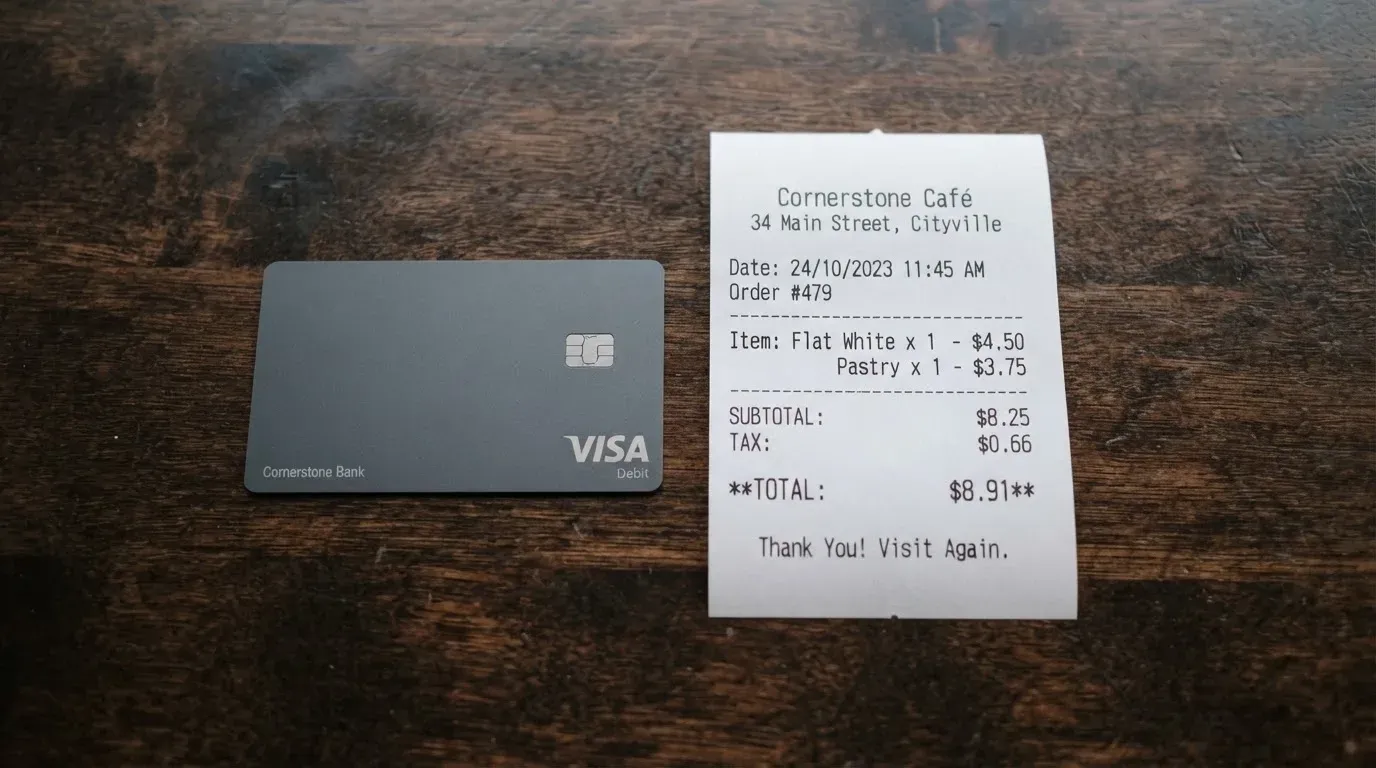
“Competitive” is not a price. It is a promise that the rate will not embarrass them. You cannot budget against it, and neither can I.
| Fee or limit | What is published |
|---|---|
| Issuance fee | Not stated |
| Monthly fee | Not stated |
| Conversion (stablecoin to fiat) | “Competitive exchange rates”; no figures published |
| Foreign exchange / non-home currency | Not stated |
| ATM withdrawal | Not stated |
| Daily spending limit | Not stated |
| Monthly spending limit | Not stated |
Here is how the missing fees land on three ordinary payments, so you can feel the shape of what you do not know.
A coffee in your own currency, if the card currency matches, depends on the conversion rate at the moment of spend plus any undisclosed conversion fee. If it does not match, a foreign exchange fee applies — and you cannot see what it is.
A subscription bought online in dollars on a card denominated elsewhere combines the conversion rate, any FX fee, and the risk that a foreign-issued card is declined outright. Address verification, which compares the numeric parts of your billing address against issuer records, is mainly offered in the US, Canada and the UK and is generally unavailable for foreign-issued cards, which can cause declines. This is the category reality that hits hardest when the issuing country is not disclosed.
An ATM withdrawal adds whatever the ATM operator charges to a fee the card does not publish, in a currency that may not be yours, at a limit nobody has stated.
Two category facts sharpen the last one. Declined authorisations can leave a hold on funds that stays for several days, typically up to seven. And merchants can decline prepaid or foreign card numbers because the issuer country is visible in the card’s identifying digits, and some apply extra scrutiny when it differs from your billing address. A card issued from an undisclosed country is, to a merchant’s risk system, a foreign card.
None of this means the card is expensive. It means you cannot tell. The single most useful thing you can do before using this card for anything recurring is ask the operator for the full fee schedule, and get it in a form you can keep.
How to Top up the card
Funding works by converting stablecoins to fiat in real time through the dtcpay Wallet app. Starting data adds USDT, USDC, BTC and ETH to the list of what is convertible. Networks are not stated. That last omission is the one to dwell on, because it is the one that can cost you the whole amount.
A stablecoin exists on many blockchains, and the same token has different versions on each. USDT, for example, has been issued on networks including Ethereum, Tron, Solana, Polygon and Avalanche. USDC is natively supported on 38 networks, and Circle stopped supporting USDC on Tron in February 2024, so the version of USDC you might assume exists on a given network may not. Blockchain transfers are irreversible. If you send funds on a network the provider does not support, or to an address belonging to another network, that money can be lost, or need manual recovery with no guarantee of outcome. This is the single largest practical hazard of topping up any crypto card, and it is entirely avoidable — but only if you know the supported networks in advance, which this card does not publish.
You also need to know what to do when you want your money back. Withdrawal terms are not stated. What balance you can take out, to which addresses, on which networks, at what cost — none of it is public. That matters beyond convenience: a card you can load but not reliably unload is not the same as a bank account.
There is one fee that is not the provider’s, and it is worth separating clearly. The blockchain charges its own network fee for your deposit — gas on Ethereum, paid only in ETH, or bandwidth and energy on Tron, often by burning TRX. If you hold USDT and no ETH, a transaction can simply be unsendable. This is a cost of the network, not a charge by the card company, and it exists regardless of which card you use.
Paying with it every day
Day to day, the promise is a premium card you load with crypto and spend as ordinary money. The mechanics of that are standard for the category, and it is worth knowing how they work even here.
A payment card number begins with six or eight digits identifying the issuing institution. Merchants can look that up and see which institution and which country issued the card. When a card is topped up from crypto and converted into a stored balance, it behaves like a prepaid card: it spends a balance you have loaded, and cannot overdraw it. That is a genuine comfort — you cannot be surprised by an overdraft, because the model does not allow one. It is also why some merchants treat it more cautiously, and why a foreign-issued prepaid can be declined.
For phone payments, the mechanics are reassuring. When you add the card to Apple Pay, the card number is replaced with a device-specific number stored on the device’s secure hardware, never on the company’s servers, and each payment carries a one-time code. Google Pay works on a similar principle. So even if the app company is opaque, the phone-payment layer is one of the better-protected parts of the setup. Whether your particular card can be added to each wallet is not stated, so treat it as likely rather than confirmed.
Three everyday features are not stated: whether the card connects to any self-custody wallet, what rewards or cashback exist if any, and how a disputed transaction is handled. On that last one, the category baseline is that a chargeback is a refund ordered by the card issuer, and prepaid-card coverage varies by country and should not be assumed. If the money behind your card started as crypto converted to a balance, the question of whether you have the same dispute rights as a credit-card holder is worth asking before you rely on one.
For a card billed as Visa Infinite, used by someone with substantial balances, the absence of any published rewards information is unusual. It is also, again, simply an absence.
What can go wrong
The company behind the card is dtcpay, a brand of Digital Treasures Center Pte Ltd, registered in Singapore, describing itself as a Major Payment Institution licensed by the Monetary Authority of Singapore. The Visa partnership was announced in September 2024. The issuing bank is not named.
I found no official incident involving the card. That is worth saying plainly, because it is genuinely better than the alternative. But the absence of a recorded incident on a young card is weak evidence, and it should not be weighed as reassurance on its own.
The complaint record is real, if small. On Trustpilot, the dtcpay company listing — company-wide, not card-specific — shows a TrustScore of 2.6 out of 5 from just four reviews, all one star, dated between January 2024 and July 2026. The themes in those reviews, as user reports, are accounts blocked or inaccessible, delayed or unreturned funds, allegations of fraud, and slow support. The company has not replied to them. Four reviews is a sample too small to conclude anything about the business, and I am not concluding anything. What I am saying is that the specific pattern people report — money in, account frozen, funds not returned — is the exact pattern that matters most to someone about to load real value.
There is a category context behind that pattern that you should hold in mind. Anti-money-laundering due diligence requires institutions to verify customers, screen sanctions lists, establish the purpose of the relationship, and monitor transactions for suspicious activity. When due diligence cannot be completed, rules require the institution to refrain from the transaction, and where necessary to end the relationship. That is why accounts get closed or frozen pending documents — it is the system working, and it applies to any regulated provider, including honest ones. It also means the quality of your paperwork and the speed of your responses decide whether your money stays available.
Four more things this card does not tell you: what security measures protect the app, where support is located and how fast it answers, and whether there is any segregated safeguarding of your balance. That last one is a meaningful omission. Electronic money institutions must safeguard customer funds, by segregating them in dedicated accounts or insuring them — but such funds are not the same as bank deposits and are not necessarily covered by a deposit guarantee scheme. Because the issuer here is an electronic money structure rather than a named bank, you should assume your balance sits outside deposit-guarantee protection unless the company tells you otherwise in writing.
One further industry point worth knowing, because it shows the card network itself can end a programme. Visa and Mastercard do not issue crypto cards to consumers; they licence issuers and can suspend a programme. In November 2022 Visa said it had terminated its global agreements with FTX, and the FTX US debit card programme was wound down. In 2018 Visa suspended WaveCrest in Europe, closing all WaveCrest-issued Visa programmes. Programme closures typically run in a predictable order: a notice period, then spending and loading stop, then users are asked to withdraw remaining balances. A card that works well for years can still end. The difference between a smooth ending and a painful one is almost entirely down to what the provider told you in advance.
What to take instead
If the Digital Treasures Card’s opacity is the deciding factor for you, these three scored higher, and they publish more. Here is how they compare, with the caveats that matter.
CardFlow scored 4.9 out of 10. It aims at Nigeria and at Nigerians and global users, though it states no country list or exclusions. It is a virtual USD Mastercard, created in minutes, and the site FAQ says creating a virtual card is completely free. You can fund it with Bitcoin, USDT, ETH or a Naira bank transfer, though networks are not stated. Monthly fees, other fees and rewards are not stated.
HyperCard also scored 4.7 — level with this card. Official pages state no country list, though the App Store says the card works in more than 176 countries, which is a statement about acceptance rather than eligibility, and those are different things. It is a prepaid card, with the network not stated on the App Store page and the balance in USD or EUR. The App Store page lists no fees. You deposit crypto such as USDT, BTC or ETH in the app and it is converted to USD or EUR on the card; networks not stated.
Card.fi scored 6.6 out of 10, and it is the most transparent of the three by a distance. Its banner says cards ship to more than 200 countries, and its terms bar residents of, or orders from, a country subject to sanctions that would prohibit the service. It offers Virtual Classic and Virtual Premium, physical Classic and Premium, and a metal stainless steel version, with every physical order including a virtual card; cards are issued under licence from the relevant card schemes, though Visa and Mastercard are not named, and the card currency is not stated.
| Card.fi | CardFlow | HyperCard | |
|---|---|---|---|
| Score | 6.6 / 10 | 4.9 / 10 | 4.7 / 10 |
| Card | Virtual and physical Classic, Premium, metal | Virtual USD Mastercard | Prepaid, network not stated |
| One-time cost | Virtual Classic $49, Virtual Premium $249 | Free to create | Not stated; App Store lists no fees |
| Monthly fee | None, and no annual, inactivity or minimum-balance fee | Not stated | Not stated |
| Top-up fee | Classic 1.5% + $1.00; Premium 1% | Not stated | Not stated |
| FX fee | Classic 3.5%; Premium 2.5% | Not stated | Not stated |
| Coins and networks | 32 coins across 5 networks; market rate on arrival | Bitcoin, USDT, ETH, Naira bank transfer | USDT, BTC, ETH |
| Rewards | Cashback on spend only: 0.8% Classic, 1% Premium, up to 1.2–2% Metal, with caps | Not stated | Not stated |
Card.fi’s numbers are the ones you can actually plan around: real fees, shown before each top-up, and a rewards structure with caps stated. Its trade-offs are real too. A wrong-chain deposit risks permanent loss — a warning in its own terms, and the same hazard that applies here. And a headline 10% at coffee shops capped at 10 USDT a month is a marketing number, not an income stream; the honest rate is the cashback on ordinary spending.
The pattern across all four cards is the same, and it is the most useful thing in this comparison. Every one of them withholds the same core facts in different degrees: which networks to send on, whether a fee applies, what the country eligibility is. Card.fi’s advantage is not that it is safer; it is that it tells you. Given that you will be moving real value through whichever you choose, being told is worth a great deal.
Who I would recommend it to
I would recommend the Digital Treasures Card to one person, and warn everyone else. If you are a high-net-worth holder who already keeps stablecoins, already uses dtcpay, and want a premium Visa card that converts to fiat as you spend, this is a coherent product for a coherent purpose, and the Visa Infinite framing fits that purpose.
I would not recommend it as your first card, your only card, or your everyday card. I would not recommend it to anyone who cannot answer the question “what does this cost me” from published material, because the answer is not published. I would not recommend it to anyone who needs to know with certainty that their funds are reachable, because withdrawal terms are not stated. And I would treat any statement you have read — including unofficial ones about where it is issued and who it is for — as a starting point for a question to the company, not as a fact on which to act.
If you are in the position of having been declined by ordinary banks, and this card is on your list as a way forward, my honest advice is to let the lack of published answers do its work for you. Ask first. If the company answers clearly — eligibility, full fee schedule, limits, named issuer, withdrawal terms — then you have something to weigh. If the answers are vague, you have learned the most important thing about the card without loading it.
Frequently asked questions
What is the Digital Treasures card?
The Digital Treasures Card is a Visa Infinite payment card offered by dtcpay, a Singapore brand of Digital Treasures Center Pte Ltd. It launched in February 2025 and is available as a virtual or physical card. Its defining feature is that stablecoins such as USDT and USDC are converted to fiat in real time inside the dtcpay Wallet app, and the card then spends that balance like an ordinary payment card. It is aimed at high-net-worth holders, not at everyday users.
How does the Digital Treasures card work?
You hold crypto, you convert it to a fiat balance through the dtcpay Wallet app, and the Visa card spends that balance. Because the balance is loaded rather than drawn on demand, the card works like a prepaid card and cannot overdraw. The card’s identifying digits reveal its issuer and country to merchants, so it may be treated as a foreign card, and which networks are supported for deposits is not published.
Who owns Digital Treasures?
dtcpay is a brand of Digital Treasures Center Pte Ltd, a company registered in Singapore. It describes itself as a Major Payment Institution licensed by the Monetary Authority of Singapore, and it announced a card partnership with Visa in September 2024. The bank that actually issues the card is not named in the company’s readable public material, which is why the card’s regulatory protections are hard for a customer to pin down.
Is the Digital Treasures card available in my country?
The card’s official readable sources do not publish an eligibility list, so I cannot tell you whether you qualify. Unofficial sources suggest it is issued from Singapore, targets ultra-high-net-worth individuals, and excludes United States applicants under issuer terms, though that exclusion is not confirmed by a readable official source. Eligibility may also turn on citizenship rather than residence, so ask the company directly rather than assuming.
Does the Digital Treasures card require KYC?
The card’s public material does not describe its identity checks, so the requirement is not stated. You should expect them regardless. Any regulated provider must verify customers and screen sanctions lists as part of anti-money-laundering law, and customers of US or EU-regulated providers routinely supply name, address, date of birth, nationality and identity documentation. Accounts get frozen or closed when documentation is incomplete, so have your documents ready and answer questions promptly.
How do I top up the Digital Treasures card?
You convert stablecoins to fiat in real time through the dtcpay Wallet app. Starting data lists USDT, USDC, BTC and ETH as convertible, but the supported networks are not published, and that is the detail that matters most. Sending a token on an unsupported network, or to an address belonging to a different network, can lose the funds permanently, because blockchain transfers cannot be reversed. Confirm the supported network in the app before you send anything.
What does it cost to use the Digital Treasures card?
The card’s public sources do not state an issuance fee, a monthly fee, ATM fees, or daily and monthly limits. The only published pricing claim is “competitive exchange rates” for real-time stablecoin-to-fiat conversion, with no figures. You therefore cannot budget a coffee from the published information. Ask for the full fee schedule in writing before relying on the card, especially for any recurring or subscription payment where a hidden FX or conversion fee would accumulate quietly.
Is the Digital Treasures card safe?
I found no official incident involving the card, but there is little published about how it protects you. Security measures, support quality, and whether your balance is safeguarded are all not stated, and because the issuer is an electronic money structure rather than a named bank, you should assume the balance is not covered by deposit guarantee. Trustpilot shows a 2.6 out of 5 TrustScore for dtcpay from four one-star reviews, all reporting blocked accounts, unreturned funds, fraud allegations or slow support, with no company reply. The sample is small, but the pattern is the one that would hurt you most.
Can I use the Digital Treasures card in my country?
Where it can be spent and where you can hold it are different questions. The card runs on Visa and the company said at launch it would be accepted at over 150 million Visa locations, an earlier release having said 130 million across more than 200 countries. That describes network acceptance, not your right to hold the card. Expect some friction abroad: foreign-issued cards can be declined at unfamiliar merchants, and address verification is generally unavailable for foreign-issued cards, which causes declines on online purchases.
Is the Digital Treasures card worth it?
For someone already holding stablecoins who wants a premium card to convert them at the point of spend, the concept holds together. For everyone else, the deciding factor is transparency rather than price: no published fees, no published limits, no named issuing bank, no stated withdrawal terms. A card with fewer features but published numbers, such as Card.fi’s clear top-up and FX fees, may suit you better. Judge this one on what it tells you, and right now it tells you very little.
Top virtual cards by score – cryptocardtop
Content created by the «cryptocardtop» team