
Swiss IBAN, USDC money, honest gaps — the M2 card, read closely
 Available in US
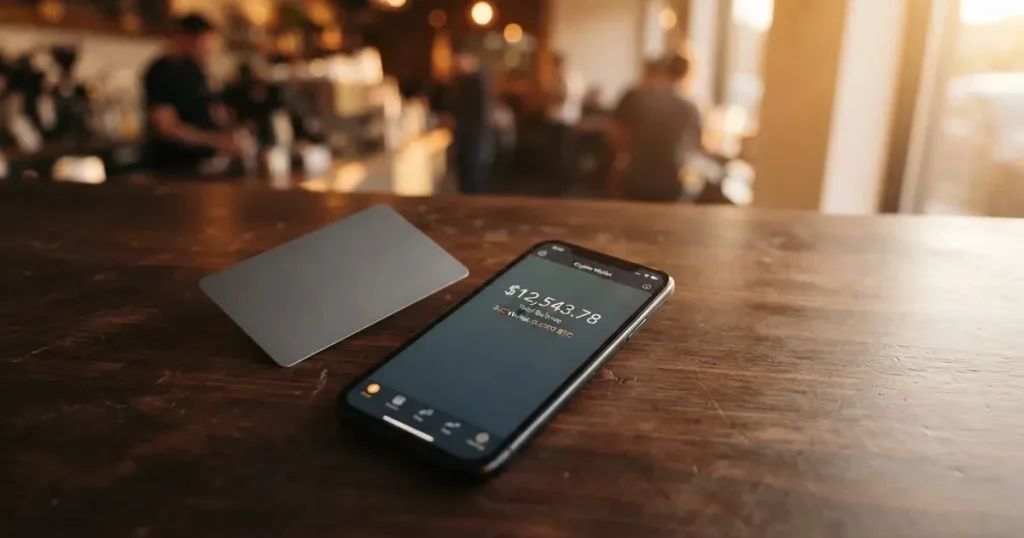
There is a particular kind of card that keeps surfacing these days: not a bank card from your local bank, but a card attached to a crypto balance, sold as a way to spend what you hold on-chain. The M2 card is one of them, and it is more interesting than most — because it pairs a Swiss IBAN account with a Mastercard debit card you fund in USDC. That combination is genuinely unusual, and it is also the whole pitch. If you have been reading about crypto cards and wondering which ones are built on something real rather than a promise, the Swiss IBAN is what makes M2 worth a proper look.
This review is written for you if you are somewhere in the world and ordinary banking has been awkward — because of where you live, how you are paid, or what documents you can get hold of. You will find out who the card is willing to issue to, what a year of it actually costs, how the money moves in and out, and where the published information simply runs out. I have read the card’s own materials and compared them against how this category behaves in general. Where something is not published, I say so rather than guessing.
The conditions described here are current as of October 28, 2026.
Verdict: a strong Swiss-IBAN card with gaps in the fine print
The M2 card scores 6.9 out of 10. That is not a “stay away” number and it is not a “sign up tonight” number. It is the score of a card that does something genuinely useful — it gives you a Swiss IBAN account and a Mastercard you can load with USDC — but that does not yet publish enough of the details you would want as a serious everyday account. The everyday-use experience is the strongest part; the cost structure is the weakest, because the conversion figure is not disclosed and you cannot build a real budget from what is on the page.
Here is how the card scored on each criterion I checked, and why.
| Criterion | Score | Why |
|---|---|---|
| Who can get it | 8 / 10 | Open across “over 150 jurisdictions” — most of the EU, the UK, Switzerland, much of Asia-Pacific, Latin America, Africa and the Middle East; not the United States or sanctioned regions |
| Cost | 5 / 10 | Subscription from 10 USDT a month (or 25.5 quarterly, 84 yearly), half that if paid in token; “no hidden FX spreads” is promised but the conversion fee itself is not disclosed |
| Top-up options | 6 / 10 | Deposit USDC on BNB Smart Chain and Mantle, Ethereum “soon”; balances convert into seven fiat currencies |
| Reliability and complaints | 7 / 10 | Funds sit in a Swiss IBAN account at regulated institutions with 1:1 reserves; the issuer and licence are not named, and no complaints surfaced |
| Everyday use | 9 / 10 | Instant virtual Mastercard, physical card optional, plus Apple Pay, Google Pay, Alipay and WeChat Pay |
| Total | 6.9 / 10 | A well-built everyday card with real financial substance, held back by undisclosed numbers |
Who is this card for? It is for someone who wants a Swiss IBAN account alongside a card that spends a crypto balance, and who is comfortable with the small print being incomplete. If that is you — if you already hold USDC on BNB Smart Chain or Mantle, if you travel or buy from merchants who push back on foreign cards, if the idea of a euro or dollar account held at a regulated Swiss institution appeals — then M2 is a serious candidate and I would not talk you out of it.
Who is it not for? If your priority is a card you can forecast to the last cent, look elsewhere until the conversion fee is published. If you need a card issued in your own country because your merchant refuses foreign-issued cards, a Swiss BIN works against you there, not for you. And if you are in the United States or a sanctioned region, this is simply not available to you.
Will They Give You the Card?
Coverage is the strongest thing about M2. The card says “over 150 jurisdictions”, and the detail is genuinely wide: most EU countries, plus the United Kingdom and Switzerland; an Asia-Pacific reach that includes mainland China, Hong Kong, Taiwan, Japan, Singapore and Korea, as well as the UAE; Latin America including Brazil, Argentina, Mexico and Chile; Africa including Nigeria, Kenya, Rwanda and Ghana; and the Middle East with the UAE, Qatar and Saudi Arabia. The United States is not supported, and neither are sanctioned regions.
Two things to draw out of that list. First, mainland China is inside the supported area, but Chinese mainland users need a passport to apply. Second, and more generally, what the card checks is the country you are in, not the passport you hold — though in practice the verification pass may look at both, and how a name is spelled on your documents has to line up with how it is spelled on the card.
This is the standard shape for a card in this category, and it is worth understanding why it is shaped that way. Every one of these cards is issued under a licence from a national regulator, and that regulator’s appetite is set by its own rules and by sanctions policy — not by where you would like the card. So a wide jurisdiction list is really a list of places whose regulators are comfortable with the arrangement. If you are outside it, no amount of goodwill on the support desk changes the answer.
Eligibility is also age-gated: prepaid and debit cards of this kind are generally available to adults of 18 and over, and some issuers set higher limits on top of that.
How to Get It
Applying is short, and the identity check is the part that deserves your attention. You sign up, you verify through MatchID, you pick a subscription plan, you deposit. That is the whole sequence.
Verification is a passport or a valid ID plus a selfie, run through the MatchID system. This is an automated check, and while it is designed to be fast, the time taken can vary if a review flags a mismatch. There is a single KYC level here, not a tiered system, and full access to the account is unlocked once a subscription has been paid. That last point is worth sitting with: the card is not free to hold, and the free part of the experience is deliberately thin.
You get a Mastercard debit card attached to a Swiss IBAN account. The virtual card is instant; the physical card is optional and ships after activation. How long it takes to arrive is not stated anywhere on the public pages, so if you are planning around having plastic in your wallet, do not assume — the virtual card and the mobile wallets are the reliable path in the meantime.
One thing I want to be plain about, because it comes up in almost every question about this card: you will be asked to complete an identity check, and there is no way around that. It is not a limitation to be engineered past — it is the legal requirement that makes the account possible in the first place. Anyone offering to get you a card without it is offering you something other than this card.
Fees: What It Really Costs
The honest summary is this: the subscription is clear, the promise about exchange rates is reassuring, and the number you would most want — the conversion fee — is missing. Here is everything the card publishes.
| Fee or limit | What the card says |
|---|---|
| Subscription (paid in USDT) | 10 USDT monthly, 25.5 USDT quarterly, 84 USDT yearly |
| Subscription (paid in token) | 5 USDT monthly, 15 USDT quarterly, 60 USDT yearly — a 50% discount |
| What the subscription covers | Banking infrastructure, compliance, custody, card issuance and rewards |
| Conversion fee | Not stated |
| FX spread | “No hidden FX spreads” |
| Exchange between 7 fiat currencies | “With competitive rates” |
| ATM fees | Not stated |
| Daily and monthly limits | Not stated |
There is a single card, not a stack of tiers, and the subscription is simply billed monthly, quarterly or yearly. Paying in token rather than USDT halves every price — that is the one genuine discount the card offers, and it is worth comparing against what you would pay converting that token at the card’s own rate.
The card insists that “all fees are transparent and shown before confirmation” and that there are “no hidden FX spreads”, and that exchange between its seven fiat currencies happens “with competitive rates”. Those are good words. They are not the same as a number. Because the conversion fee is not published, you cannot compute what a payment will cost you in your own currency before you make it — you can only find out after. For a card you use daily, that is not a small gap; it is the difference between budgeting and guessing.
Balances can be held in EUR, CHF, USD, CNH, JPY, SGD and HKD. An earlier version of the page listed RMB rather than CNH — the same currency under its other name, but it is a small illustration of why you should read the current page rather than a cached one.
Two or three everyday payments, and what applies
Take a Saturday coffee bought with the virtual card in Zurich. The subscription has already been paid. What remains is the conversion: whatever the card takes when it loads or converts your balance, plus the rate at which your funding currency becomes Swiss francs. The card promises no hidden spread, but it does not publish the conversion fee, so the exact figure is unknown until you see it.
Now the same coffee paid while you are in Tokyo. Now the card converts between two of its own currencies, and again the rate is “competitive” rather than stated. This is the payment where the missing number hurts most, because it is the one you will repeat every time you travel.
And a subscription you pay online, from a merchant outside your own country. This is where a foreign-issued card can meet friction it did not cause: the merchant’s bank looks up the card’s issuing country, sees Switzerland where the billing address says something else, and may decline or ask for extra verification. That is not a fault in your card, but it is a real cost in convenience, and it is worth factoring into how you use it.
What I could not find, and would want before committing: ATM fees, daily limits, monthly limits, and the conversion fee itself. Card delivery timing is also not stated.
Top up: Getting Money In
This is the part of the card that is most clearly designed for crypto users, and the most likely to trip you up if you skim.
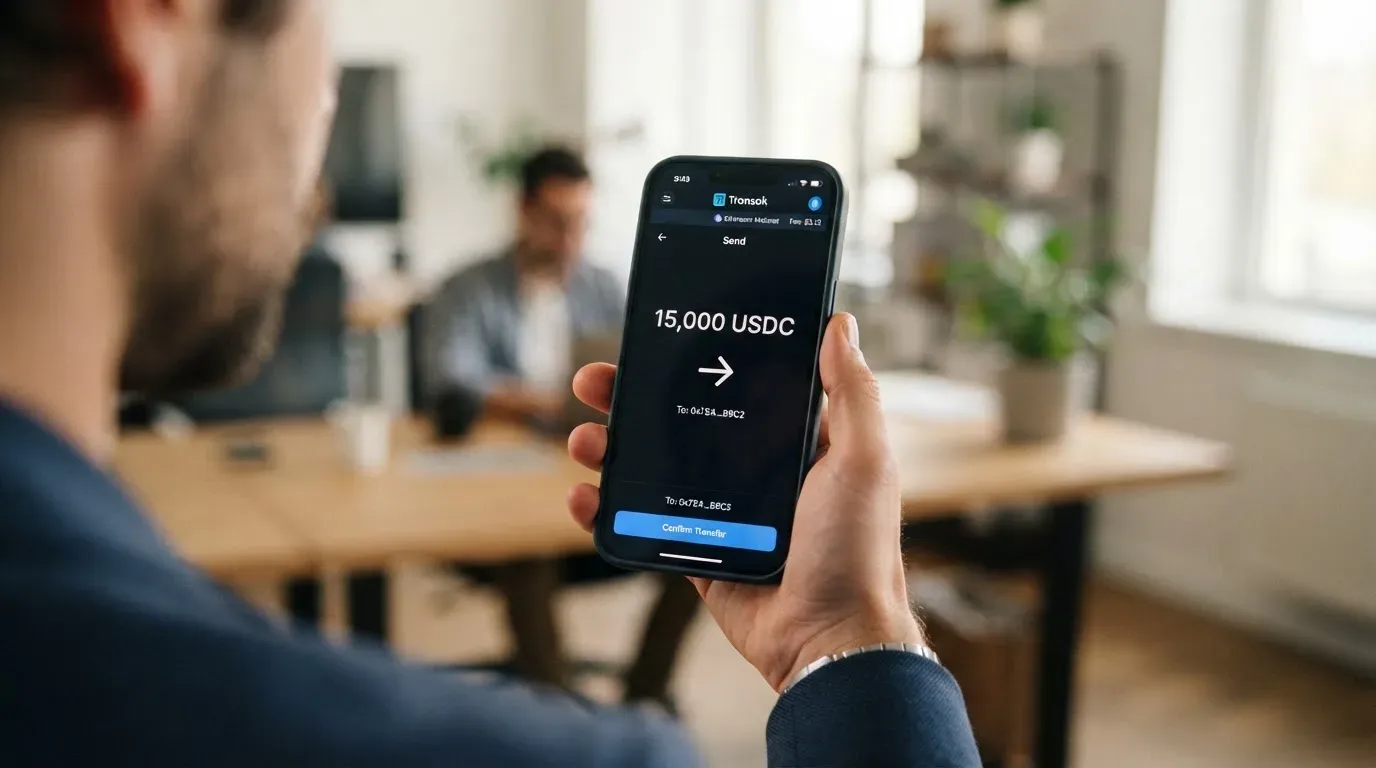
You deposit USDC on the BNB Smart Chain and Mantle networks. Ethereum is described as “soon”. Your deposit is converted into your balance currency — EUR, CHF, USD, CNH, JPY, SGD or HKD. Fees and minimums for top-ups are not stated.
Those two words, “BNB Smart Chain” and “Mantle”, are the whole instruction. Send USDC to the wrong network and the money does not arrive, does not bounce back politely, and does not refund itself — blockchain transfers are irreversible by design. This is not a M2 quirk; it is how every blockchain works. But with a card that names only two networks today, it is the single most likely way to lose your deposit, so read the network name as carefully as you read the amount.
USDC is a dollar-pegged stablecoin issued by Circle, which says it is redeemable 1:1 for USD and fully backed by cash and cash equivalents, mostly held in a government money market fund, with monthly reserve attestations. Stablecoins are not guaranteed to hold their peg: USDC briefly lost it during the US banking crisis in March 2023, and TerraUSD collapsed outright in May 2022. A stable balance is the expectation, not a promise.
If you hold USDT rather than USDC, note that Tether describes USDT as a token issued across multiple blockchains with reserves intended to back it 1:1 — but the card takes USDC. Converting USDT into USDC first means a second step, another exchange, and another set of fees.
On the way out: “your balance is yours, held in your IBAN account, and can be withdrawn according to banking rules.” Withdrawal fees are not stated. That phrase — according to banking rules — is doing real work, and it is the honest core of the account’s appeal: this is meant to be ordinary banking, with the crypto part on the way in.
Paying With It Every Day
Day to day, the M2 card is at its best. You get a virtual Mastercard immediately, and a physical card if you want one. You can push the card into Apple Pay, Google Pay, Alipay and WeChat Pay. Spend online, in shops, or contactless, in most of the world the card networks reach.
Apple Pay is worth a special word because it quietly solves a problem most cards have. When you add a card to Apple Pay, the device stores a device-specific number in its secure hardware rather than your actual card number, and every payment generates a fresh one-time code. A merchant who sees your card number never sees the number that comes from the wallet, so the ordinary card-number-fraud exposure largely disappears. The issuer can still restrict the wallet version — blocking it on magnetic-stripe or website payments, say — but for everyday spending it is the safer way to hold a card that lives partly in a crypto account.
Alipay and WeChat Pay on the same virtual card is an unusual inclusion and genuinely useful if you travel in Asia.
There are two gaps worth naming. First, blocked spending categories are not stated, so you cannot tell in advance whether gambling, adult content, or certain high-risk merchant categories will be declined. Merchant category codes are what determine these blocks, and the blocked list is a policy choice of the issuer rather than a legal fixed point — it varies from one issuer to the next, and this one is not published. Second, if a payment is declined, a hold can sit on your balance for several days, typically up to seven, which is standard card behaviour and a useful thing to know before you retry the purchase elsewhere.
On rewards: the card pays 0.1% “consumption rewards” from spending inside your own referral network, with the depth widening as you bring people in — one invite opens three generations, three invites open five, five opens ten. There is also referral cashback and “Partner Cashback” for projects. Read this as a modest nudge toward inviting others rather than as a meaningful rebate on your spending.
What is not stated: what the app itself offers beyond the card, and how disputes work — whether you can formally contest a charge through the card, and what happens if a merchant takes your money and delivers nothing. Chargeback rights are a real thing, but they are set by the issuer and, for prepaid cards, vary considerably. Do not assume they apply here.
What Can Go Wrong
Let me take the reassuring parts seriously first, because on this card they are unusually well evidenced. Funds are held in your own Swiss IBAN account at regulated institutions, backed 1:1. The card’s words: “even if Matchain stops operating, your funds remain accessible through the regulated bank.” The infrastructure runs on Matchain, described as live on mainnet. So the crypto layer failing and your money failing are, by design, two different failures.
That said, honest caveats belong here too. Deposit insurance “depends on jurisdiction and account structure” — which means the protection you may or may not have is not a single, uniform thing, and you should ask about it rather than assume it. And safeguarded customer funds are not the same as bank deposits: an electronic money institution must set them aside in dedicated accounts or insure them, and that money may sit outside any deposit guarantee scheme. The M2 card also does not name its issuer or its licence. It describes itself as a “Swiss-regulated debit card and IBAN account”, which is a claim about the setup rather than a licence number you can look up. For a card that asks you to hold real balances, that is a detail I would want answered.
The category’s history is relevant here, not as scare-mongering but as context. Custodial platforms have failed repeatedly — Mt. Gox with roughly US$350 million reported stolen, Coincheck around US$400 million, Ronin Network US$625 million — and blockchain transfers have no built-in recovery path. Card programmes themselves can be shut down: Visa terminated its global agreements with FTX in November 2022 and the FTX US debit card was wound down; WaveCrest, a supplier of crypto card brands, was suspended by Visa in Europe in 2018 and all its Visa programmes closed. Closures follow a pattern — a notice period, then loading and spending stop, then you are asked to withdraw what remains. One 2026 closure reported by a secondary source ended new loads on 8 July and spending on 8 August; that is a single unconfirmed source, but the pattern is the part worth noticing.
On M2 specifically, I found no complaints. That is genuinely good news, and it is also thin evidence: a young product with a small user base can be complaint-free simply because complaints have not had time to accumulate. Treat it as a signal, not a proof.
Support is by email at [email protected], a “Get Help” form, and X at @m2card_io. Hours and languages are not stated, which matters if something goes wrong at an awkward hour — and with a card that touches two systems, your banking hours and their support hours may not be the same hours.
What is not stated anywhere I could find: delivery times, ATM fees and limits, blocked merchant categories, dispute handling, app features, and the issuer’s name and licence.
What to Take Instead
If M2’s missing numbers are the problem, the alternatives are worth measuring on the same axes. Here is how the closest options compare, on the same score out of ten and the same criteria where I have the facts.
| Card | Score | Cost and fees | Top-up | Notes |
|---|---|---|---|---|
| M2 | 6.9 / 10 | 10 USDT monthly, 25.5 quarterly, 84 yearly; no hidden FX spreads promised, conversion fee not stated | USDC on BNB Smart Chain and Mantle | Swiss IBAN; virtual Mastercard instantly, physical optional |
| Morse | 7.5 / 10 | “Zero foreign exchange fees or markups”; paying online and contactless is free | Debit card, stablecoin transfer, or account details; USDC, USDG and EURC via Solana are free | Visa prepaid, fully virtual; self-custodial wallet; real exchange rate |
| International Visa Card | 6.7 / 10 | Virtual issuance $5 once, no maintenance; Classic free, Pro $9/month, Max $19/month | USDC or USDT into the USD account free, plus USD, EUR, SEPA, SWIFT, FedNow | US-issued Platinum Visa, virtual only; 2% FX fee on foreign currency |
| UNi Card | 6.1 / 10 | No annual fee, no foreign transaction fee | Not stated | Mastercard, multicurrency; converts at live OTC rates; up to 3% spend-to-Earn |
Read across that table and a few things stand out. Morse scores highest and is the one to look at if fees are your deciding factor: zero foreign exchange fees or markups, real-time Visa exchange rate, and free payment both online and contactless, with a self-custodial wallet so the custody question takes a different shape. Its catch is access — eligibility is by residence rather than citizenship, the app is available in over 140 countries, local add and withdraw in over 70, but a list of closed-beta countries needs an invite code, including Australia, Hong Kong SAR China, Japan, New Zealand, Singapore, Switzerland, the United Kingdom and others, and the card is available only in certain countries with the list not published. It also cannot serve customers subject to US, UK, EU or UN sanctions.
The International Visa Card is the one to consider if you want plainest possible pricing: a one-time $5 for the virtual card, no maintenance, a free tier, and a stated 2% foreign currency fee on top of the Visa rate, which is at least a number you can do arithmetic with. Against it: it excludes residents and legal registrants of a long list including mainland China, India, Israel, Russia, Türkiye, Ukraine, Vietnam and others, with purchases blocked in North Korea, Cuba, Iran, Russia, Syria, Ukraine and Venezuela; the physical card is “coming soon”; and there is no cashback.
UNi Card is the simplest of the four on paper — no annual fee, no foreign transaction fee, live OTC rates with “no hidden exchange fees”, and up to 3% spend-to-Earn, which is the best rewards figure in the group. But two of the things I would check first are not stated at all: who can get one, and how you fund it. A card that publishes neither has not told you enough yet.
And M2’s distinctive advantage stands: among these, it is the one that pairs the card with a Swiss IBAN account. If that specific thing is what you are after, the alternatives do not really compete — none of them offers it.
Who I Would Recommend It To
I would recommend the M2 card to someone who already holds USDC, knows which network it is sitting on, and wants a Swiss IBAN and a Mastercard to spend it through. I would recommend it to someone whose ordinary banking has been difficult — who cannot easily open a local account, or whose income arrives in ways conventional cards do not handle well. And I would recommend it to someone who reads: who will open the fee page before committing, who will ask support what the conversion fee actually is, and who understands that a card with a Swiss BIN will occasionally look foreign to a shop somewhere else.
I would not recommend it, yet, to someone who needs to predict the cost of a payment to the cent, because the conversion fee is not published and that makes precise budgeting impossible. I would not recommend it to anyone in the United States or a sanctioned region, because it is not available there. And I would hesitate for someone who plans to hold a large balance for a long time without asking first what the deposit protection actually is, because “depends on jurisdiction and account structure” is not an answer, it is an admission that the answer varies.
The M2 card is a 6.9. That is a card with real substance — a Swiss account, a proper network, broad availability, everyday wallets that work — doing less paperwork than it probably should. Give it the year it is in, keep an eye on whether that conversion fee ever appears, and if it does, this becomes an easy recommendation.
Frequently asked questions
What is the M2 card?
The M2 card is a crypto-linked payment card: a Mastercard debit card attached to a Swiss IBAN account, funded with USDC stablecoin rather than drawn from a conventional bank balance. You deposit crypto, it converts into a fiat balance in one of seven currencies, and you spend that balance like an ordinary debit card. The Swiss IBAN account is the part that distinguishes it from most cards in this category.
How does the M2 card work day to day?
You deposit USDC on the BNB Smart Chain or Mantle network, it converts into your balance currency, and you spend from that balance with the virtual Mastercard. Apple Pay, Google Pay, Alipay and WeChat Pay all work with the virtual card, and a physical card is optional. Balances can be held in EUR, CHF, USD, CNH, JPY, SGD or HKD.
Is M2 a bank?
No — it presents itself as a “Swiss-regulated debit card and IBAN account” rather than a bank, and the card does not name the issuer or the licence behind that claim. What it does say is that your balance is held in your own Swiss IBAN account at regulated institutions with 1:1 reserve backing, and that funds stay accessible through the regulated bank even if Matchain, the infrastructure it runs on, stops operating. Ask support which institution holds the account.
Who can get the M2 card?
The card covers “over 150 jurisdictions”: most EU countries, the UK, Switzerland, much of Asia-Pacific including mainland China, Hong Kong, Taiwan, Japan, Singapore and Korea, Latin America including Brazil, Argentina, Mexico and Chile, Africa including Nigeria, Kenya, Rwanda and Ghana, and the Middle East. Not supported: the United States and sanctioned regions. Mainland China applicants need a passport.
How do I apply for the M2 card?
The sequence is short: sign up, complete the MatchID identity check with a passport or valid ID plus a selfie, choose a subscription plan, then deposit. Verification is an automated check that is designed to be fast, though it can take longer if the system flags a mismatch. There is a single KYC level, and paying a subscription is what unlocks full access — so the free version of the experience is deliberately limited.
Is the M2 card free?
No. The subscription is 10 USDT monthly, 25.5 USDT quarterly or 84 USDT yearly if you pay in USDT; paying in token halves those to 5, 15 and 60 USDT. The subscription covers banking infrastructure, compliance, custody, card issuance and rewards. On top of that, the card promises no hidden FX spreads but does not publish its conversion fee.
How do I top up the M2 card?
Send USDC to the card’s deposit address on the BNB Smart Chain or Mantle network — Ethereum is described as “soon”. Your balance is then converted into EUR, CHF, USD, CNH, JPY, SGD or HKD. Getting the network wrong means the deposit does not arrive, because blockchain transfers cannot be reversed. Top-up fees and minimums are not stated, so check the app at the time.
Can I withdraw money from the M2 card?
The card states that your balance is yours, held in your IBAN account, and can be withdrawn according to banking rules. That framing matters — it means withdrawals follow ordinary bank processes rather than crypto transfers. Withdrawal fees are not stated on the public pages, so the practical cost of getting money out is something you would need to confirm.
Is the M2 card safe to use?
Reasonable, with gaps to know about. Funds sit in your own Swiss IBAN account at regulated institutions with 1:1 backing, the crypto layer runs separately from the bank, and Apple Pay protects the card number by replacing it with a device-specific token. But deposit insurance “depends on jurisdiction and account structure”, safeguarded funds are not the same as bank deposits, and the issuer’s licence is not named. I found no complaints, though that is thin evidence from a young product.
Is the M2 card worth it for daily spending?
For everyday use, yes — that is where it scores highest, with an instant virtual Mastercard, optional physical card, and four mobile wallets including Alipay and WeChat Pay. The friction to plan for is that a Swiss-issued card can look foreign to some merchants, a declined payment can hold funds for several days, and blocked spending categories are not published. If fees being predictable matters more than the IBAN, a card with a stated foreign exchange fee may suit you better.
Top app and neobank cards by score – cryptocardtop
Content created by the «cryptocardtop» team