
A fee-free Gulf crypto card with too much left unsaid
 Available in US
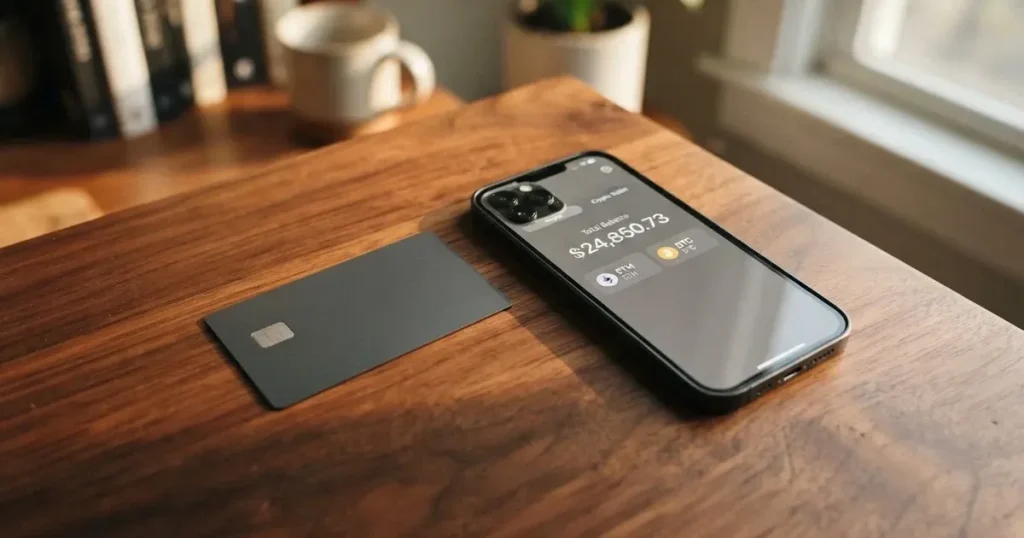
The Kem card is a Visa you load with Tether (USDT) and then spend like an ordinary payment card — in shops, online, and wherever Visa is taken. On paper it is one of the cheaper cards in this category: no issuance fee, no monthly fee, and “No FX fees” in the company’s own words. The catch is not the price list. It is how little the company publishes about limits, fees on conversion, which networks to send USDT on, and who is actually issuing the card. I gave it 5.8 out of 10.
Conditions are current as of October 28, 2026.
Who is this for? In the main, residents of Gulf countries who already hold USDT and want to spend it directly rather than through an exchange account. Who is it not for? Anyone who needs a card they can rely on for a rent payment, and anyone who cannot afford to have their balance frozen while a support team does not answer.
The conditions described below are current as of October 2026.
Verdict
Kem scores 5.8 out of 10. The reason is not that the card is expensive — on the published numbers it is the cheapest card in my comparison set — but that the details a shopper actually needs are missing, and the public record of complaints is poor. Let me walk you through the breakdown criterion by criterion, because each score tells you something different about the card.
| Criterion | Score | Why |
|---|---|---|
| Who can get it | 6 / 10 | Visa is accepted in 150+ countries, and it is marketed to residents of Kuwait, Bahrain, UAE and Qatar; a restricted-country list of 13 countries comes from the starting data only |
| Cost | 8 / 10 | No issuance fees, no monthly or annual fees, “No FX fees”; a 1% conversion figure appears in the starting data but is not confirmed on the page; unofficially, ATM use and top-up are free |
| Top-up options | 4 / 10 | Deposit USDT from any wallet or exchange, and swap gold or crypto to USDT in the app — but no networks are named |
| Reliability and complaints | 3 / 10 | The operator is KEM TECHNOLOGIES HOLDING in ADGM, with no issuer or licence named; Trustpilot shows 2.5 out of 5, with complaints about failed withdrawals and unanswered support, and KYC reportedly taking up to 4 weeks |
| Everyday use | 7 / 10 | A virtual card is immediate, a physical card comes on request; unofficially Apple Pay works and Google Pay is marked unsupported |
| Total | 5.8 / 10 | A cheap card that asks you to trust more than it explains |
Read that table as a shape rather than six separate verdicts. The two strong scores — cost and everyday use — are about the card being easy and cheap to hold. The weak ones — top-up options and reliability — are about the card being understood and dependable, and that is where your money can get stuck. Cost and everyday use can be checked in an afternoon. Reliability cannot, because the facts you would need are not published. That asymmetry is the whole review in miniature.
Will They Give You the Card?
Yes for a defined set of countries, no for a longer list. Here is the situation as the card describes it.
The card is a Visa, which means it works “wherever Visa is accepted” — the company’s wording is “150+ countries”. But being able to *use* a card and being able to *get* one are different questions, and the second has a much shorter answer. Kem markets the card to residents of Kuwait, Bahrain, UAE and Qatar. If you live in one of those four, you are in the intended audience.
Then there is the restricted list. Thirteen countries appear on it: Belarus, China, Cuba, India, Iran, Iraq, Israel, Russia, Syria, Turkey, Ukraine, Venezuela, Vietnam. One thing to be careful about: this list comes from the starting data I worked from, and the company’s own blog page does not state it. So treat it as a strong indication of direction rather than a published rule you can cite. Before you spend an evening on the application, the practical step is to read the eligibility terms inside the app itself, because that is the version that will be enforced.
There is also a wrinkle worth flagging, because it catches people out in this category. Some restricted-country rules follow *residence*, others follow *citizenship*. If you are a citizen of one of the listed countries but live legally somewhere else, you are in genuinely unclear territory, and no amount of reading the marketing page will settle it for you. Ask the company directly and keep the answer.
One reassuring note from the background on how these cards work: because a Kem card is Visa, its acceptance footprint is not the company’s invention. It rides the Visa network, which routes the payment and sets the rules. That is also the network’s risk — Visa can suspend a programme, as it did with FTX in November 2022. More on that in the risks section.
How to Get It
The application is in the app, and it goes through KYC. That is the short version, and the details underneath it are where people get stuck.
- Download the app — it exists for iOS and Android.
- Sign up in the app.
- “Provide your identity documents for KYC verification.”
- Virtual card: immediate.
- Physical card: available upon request.
What the official pages do *not* tell you matters here. Which documents are accepted: not stated. Whether you need proof of address: not stated. Minimum age: not stated. What KYC tier you will end up at: not stated. How long delivery takes, how much it costs, how many countries it ships to, and what a replacement card costs: all not stated.
Third-party reviewers fill some of that gap, and I am flagging it as unofficial because the card’s own pages do not confirm it. Per cryptocards.so in 2026, verification asks for email, phone, ID, proof of address and a selfie, and setup is claimed to take under 3 minutes — but the same reviewers report delays of up to 4 weeks. That gap between the promise and the reported experience is worth keeping in your head before you plan anything time-sensitive around the card. Three minutes or four weeks is a very wide range, and nobody has publicly explained which end you will land on.
The physical card question is also where the silence is most costly. If you need a card for a recurring payment that a wallet cannot cover — a gym membership, a subscription, a landlord who wants plastic — then “available upon request” with no stated delivery time and no stated cost is not enough to plan around.
Fees: What It Really Costs
Here is the card’s cost story, which is its strongest feature. And I will say the uncomfortable part in the same breath: most of the numbers below come from third-party listings, because the card’s own pages publish very little fee detail — the page itself notes that public fee information is limited.
The card states plainly: “No issuance fees” and “no monthly or annual fees”. The blog intro says “No FX fees”. That last one is the one that would matter most to a Gulf resident, and it is stated as a marketing line rather than a fee table, so I would treat it as a claim to test with one small purchase rather than a guarantee to plan around.
| Fee or limit | What the card says |
|---|---|
| Issuance | “No issuance fees” |
| Monthly or annual fee | “no monthly or annual fees” |
| FX | “No FX fees” (blog intro) |
| Conversion on purchases | 1% per the starting data — not confirmed on the page |
| ATM | Not stated; unofficially free, withdrawals unlimited (cryptocards.so, 2026) |
| Top-up | Not stated; unofficially free (cryptocards.so, 2026) |
| Declines | Not stated; unofficially free (cryptocards.so, 2026) |
| Daily spend limit | Not stated; unofficially “Unlimited” (cryptocards.so, 2026) |
| Monthly spend limit | Not stated; unofficially “Unlimited” (cryptocards.so, 2026) |
That “not stated” column is long enough to be the real story of this card. Unofficially, cryptocards.so in 2026 lists monthly, issuance, ATM, FX, top-up and decline fees all as free, and daily, monthly and ATM limits all as “Unlimited”. If that is accurate, this is an unusually generous card. If it is not accurate, you are finding out at the till rather than in advance, and no page will tell you which is the case.
There is no tier structure to speak of: a single card is named, the “Kem Infinity Card”. No higher plan, no paid upgrade, nothing to compare. That cuts both ways — nothing to upsell you, but also nothing documented to grow into.
Two or three everyday payments, line by line
Let me make the abstract fees concrete with the three payments most people actually make, so you can see which fee line hits and which does not.
- A coffee in the local currency. If your balance is in USDT and you pay in, say, AED, the transaction involves a conversion of your crypto balance into the local currency. This is where a 1% conversion fee, if the starting-data figure is accurate, would apply. The “No FX fees” line suggests the currency-side fee is zero, but conversion of the crypto side may be counted separately — and the card’s pages never draw that line. This is the single most important fee question to ask the company before you rely on the card.
- An online subscription in USD. Same mechanics, but you also meet 3-D Secure. Visa’s version is called Visa Secure, and the issuer either approves the payment without friction or challenges you with a one-time code or a biometric check. That is a normal part of paying online with any Visa card, not a Kem-specific trap.
- A cash withdrawal at an ATM. Unofficially free and unlimited, and the card publishes nothing at all on it. Note also that a declined authorisation can leave a hold on your funds that stays for days — typically up to 7 — which is a Visa-network behaviour, not something Kem chose, but something that can surprise you if you try a big withdrawal after a small one has been declined.
The habit I would suggest, given how much of this is unconfirmed: make one small purchase, read the receipt, and work out what the percentage actually was. Then you are quoting a fact, not a hope.
How to Top Up
The top-up story is short on the card’s side and long on the gaps. The card’s own words: “Deposit Tether from any wallet or exchange to your Kem balance”, and you can swap gold or crypto to USDT in-app before spending. The App Store listing mentions swaps between crypto and Gold, KWD, SAR and AED; unofficially, cryptocards.so in 2026 lists support for KWD, SAR and AED.
That is genuinely convenient on its face — USDT from any wallet or exchange, plus a gold-to-USDT swap inside the app, is more choice than many cards in this category offer. But here is the problem: the networks are not stated.
That single missing detail can cost you your deposit. Blockchain transfers are irreversible. If you send USDT on a network the provider does not support, or to an address belonging to a different network, the funds can be lost outright, or need manual support recovery with no guarantee of success. The networks USDT actually exists on include Ethereum, Tron, Solana, Polygon, Avalanche and others — and there is no way to tell from Kem’s public pages which of those to use, or whether more than one is accepted. You are being asked to make an irreversible transfer into an address whose correct network is not published.
Two more things are unstated here too: fees on deposit, and the minimum. Who pays the on-chain network fee for your deposit is also not stated — that cost belongs to the blockchain, not to the card provider, but whether Kem passes it on is exactly what nobody has published. Third-party FAQ material quoted elsewhere mentions variable network and administrative fees for external withdrawals.
Two details from the app listing that bear directly on this: the balance is custodial — the provider holds it, not you — and the App Store says transfers and withdrawals “may be subject to review or network delays”. Add to that the background fact that Tether disables tokens in wallets on the OFAC sanctions list and has frozen funds tied to illicit activity. Stablecoins are not censorship-proof, and the issuer of your balance is not a neutral party. None of this means trouble is coming; it means the rails have edges.
So the practical sequence, for anyone who decides to proceed: confirm the supported network in the app before you send anything, send a small test amount first, and keep the transaction hash. And understand that “any wallet or exchange” describes where the USDT comes *from*, not which chain you must use.
Paying With It Every Day
Here the card looks good. A virtual card you can hold in a phone wallet immediately, a physical card on request, tap-to-pay, and a Visa acceptance footprint of “150+ countries”.
The wallet picture needs a caveat, because the official blog says nothing about Apple Pay or Google Pay. Unofficially, cryptocards.so in 2026 marks Apple Pay as supported and Google Pay as unsupported, while one user reports that Google Wallet works. Since Google Play listing details were not read for this review, treat both lines as leads rather than facts. The reason this matters: adding a card to a phone wallet replaces the card number with a device-specific number stored in the phone’s secure hardware, and each payment carries a one-time dynamic security code. That is meaningfully safer than typing your card number into sites. If the wallet route works for you, it is the one worth using.
Which merchants you can buy from is also unstated — the card publishes no list of blocked categories. That matters more than it sounds. Merchants are classified by a four-digit merchant category code, and many issuers block specific codes by policy rather than by law, with the blocked list varying by issuer. Gambling is the classic example. With no published list, you find out at the till.
The app itself is thin evidence either way: 4.2 out of 5 from 31 ratings on the App Store, read 2026-10-21, and the Google Play listing was not read. Thirty-one ratings is a small base, and a small base can move a lot on a handful of reviews.
Rewards: the official page says nothing. Unofficially, cryptocards.so in 2026 reports no cashback and no welcome or referral bonus, with staking at 5.5% APR. If you were hoping for a reward to offset the conversion fee, that hope is misplaced on this evidence.
One more thing you will want to know and cannot: dispute handling is not stated. A chargeback is a refund ordered by the card issuer to settle a dispute, with reason codes for fraud, duplicate billing or goods not received. Consumer reversal rights vary by country, and prepaid-card coverage varies and should not be assumed. If you are spending meaningful sums, the absence of a published dispute process is a gap to weigh, not a detail to skip.
What Can Go Wrong
This is where the card scores 3 out of 10, and the reason is not a scandal but a pattern. Let me take the pieces in order of how much they should worry you.
Failed withdrawals and stuck funds. User reports collected from Google Play and review aggregators in 2026 describe failed withdrawals and stuck funds, and deductions on failed transactions — being charged for a payment that did not go through. A Trustpilot read on 2026-10-21 shows 2.5 out of 5 from 5 reviews, all 1-star. The complaint timeline recorded in those reports runs from failed withdrawals and unanswered support in October–November 2025, through scam allegations from October 2025 to April 2026, to a slow card application in December 2025. Five reviews is a tiny sample and cannot establish a pattern on its own; but the specific, repeated shape of the complaints — withdrawals that do not arrive, money deducted for nothing, support that does not reply — is the set of complaints that matters most, because they all point at the same thing: your balance being controlled by someone else’s systems.
No answer from support. Unanswered support appears repeatedly in the same reports. The official contact route is the page at the Kem website; languages and opening hours are not stated. If your money is stuck and nobody replies, a contact page with no published hours is a thin margin.
KYC that takes four weeks. Reported, not official, but it interlocks with the complaints above: while verification sits unfinished, you have no working card and no answer. If verification also triggers a source-of-funds review — which is what anti-money-laundering rules contemplate when due diligence cannot be completed — EU rules require the institution to refrain from the transaction or relationship and, where necessary, end the relationship. That is precisely why accounts get closed or frozen pending documents.
Nobody will tell you who is liable. The operator is KEM TECHNOLOGIES HOLDING Ltd, registered in the Abu Dhabi Global Market, company number 000008598. The App Store seller is KEM Company for Electronic Payment and Settlement Services, and the developer is KEM LLC. A Czech entity, Kemfinity s.r.o., appears in the starting data and third-party sources only. The app says plainly: “Kem is a crypto financial platform, not a bank”. And the decisive gap: the card issuer and its licences are not stated.
That last point deserves a moment, because it is structural rather than cosmetic. A payment card is a programme that needs an issuer licensed by Visa or Mastercard to issue it — the networks license issuers and can suspend a programme, and they do not issue these cards to consumers themselves. The crypto brand is often only the programme manager or front end that markets it. So the entity whose name is on your payment is not on Kem’s public pages. If something goes wrong, knowing which institution stands behind the card, under which licence, in which jurisdiction, is the first thing you would want and the thing you cannot get. It also means the usual consumer protections you would assume from a bank are not obviously in place.
On the licensing side there is a legitimate, separate point you should check rather than assume. In the EU, MiCA — the markets-in-crypto-assets regulation — took legal effect in June 2023, with its stablecoin rules applying from 30 June 2024 and the crypto-asset service provider rules from 30 December 2024. ESMA maintains an interim public register of authorised providers, white papers and non-compliant entities, and it is worth a search before you deposit. Under MiCA, e-money tokens may be issued only by a credit institution or an electronic money institution. None of this tells you whether Kem holds anything; it tells you there is a register, and that a card of this kind often rests on two licences rather than one.
Programme closure is a real category risk. It is not hypothetical. Visa terminated its global agreements with FTX on 13 November 2022 and the FTX US debit card was wound down. WaveCrest, a Visa card issuer that supplied crypto card brands, was suspended by Visa in Europe in 2018, closing all WaveCrest-issued Visa programmes. The pattern in these closures is consistent: a notice period, then spending and loading stop, then users are asked to withdraw remaining balances. One 2026 closure reported by a secondary source had new loads ending 8 July 2026 and spending stopping 8 August 2026 — single source, unconfirmed, and offered only to show the shape of a timeline. Whatever your balance, plan for it to be inaccessible for a period rather than assuming instant access.
Where your crypto sits. The balance is custodial, so the provider holds the credentials and you must trust it completely. That carries counterparty and hack risk, and the sector has a record: Mt. Gox (about US$350 million reported stolen, 2011–2014), Coincheck (about US$400 million, 2018), Ronin Network (US$625 million, 2022). Kem does display a PCI DSS compliance badge assessed by ControlCase, which is a genuine positive and speaks to card-data handling. But two-factor authentication, instant freeze and fund safeguarding are not stated — and those are exactly the controls that would change my assessment. If you cannot find them documented, assume nothing.
What is not a Kem problem but will feel like one. Some merchants decline prepaid or foreign-issued cards because the BIN lookup reveals the card type and issuer country. Address verification is mainly offered in the US, Canada and the UK and is generally unavailable for foreign-issued cards, which can cause declines at online checkout. A card issued in one country can look “foreign” to a shop in another. None of that is Kem’s fault; all of it will look like it when your payment is declined.
Finally, a category habit worth forming: check the app for anything you have not read, because this card publishes so little. Draw a line between “not stated on the public pages” and “does not exist” — the first is what I can verify about Kem; the second I cannot.
What to Take Instead
Two of the four alternatives below have published restrictions or narrower funding paths, so read the comparison as trade-offs rather than a ranking. My own scores for the alternatives are shown where I have them; they are my ratings, not the cards’ claims.
| Card | Score | Card and network | Stated cost | Funding | Key caveat |
|---|---|---|---|---|---|
| Kem | 5.8 / 10 | Visa; virtual immediate, physical on request | No issuance, monthly or annual fees; “No FX fees”; 1% conversion unconfirmed | USDT from any wallet or exchange; networks not stated | Issuer and licences not stated; 2.5/5 Trustpilot |
| International Visa Card | 6.7 / 10 | U.S.-issued Platinum Visa, virtual only — physical “Coming soon” | $5 one-time issuance; no maintenance; plans Classic free, Pro $9.00/month, Max $19.00/month | USDC or USDT 1:1 free; also USD, EUR, SEPA, SWIFT, FedNow | Long restricted list by residence or registration |
| UNi Card | 6.1 / 10 | Multicurrency, Mastercard network, spends from UNi.Global balance | “No annual fee”; issuance fee not stated | Not stated | Eligibility not stated; “Spend-to-Earn” up to 3% |
| Morse | 7.5 / 10 | Visa prepaid debit, fully virtual, spends from Morse Balance in any currency | Issuance and monthly fee not stated; card says “Fees may apply. See Cardholder Agreement” | Debit card, stablecoin transfer, account details; USDC, USDG and EURC via Solana free | Eligibility by residence, not citizenship; self-custodial wallet |
Morse is the one I would look at first if your priority is getting a card whose costs are actually written down. It states “Zero foreign exchange fees or markups” with the real-time Visa exchange rate, conversions on Morse use the real rate “with no markup”, and paying with the card online and contactless is free. Its funding path is the widest here: deposits by debit card, stablecoin transfer, or account details, with USDC, USDG and EURC via Solana free, while other tokens and blockchains carry a fee. Bitcoin, USDT, Ethereum and other tokens can be deposited. Two things to weigh: the Morse Wallet is self-custodial, which changes the trust equation entirely compared with Kem’s custodial balance; and eligibility is by residence, not citizenship — users must be at least 18 and resident in a supported country, the app is in over 140 countries for P2P, with local add/withdraw in over 70. It cannot serve customers subject to US sanctions (also UK, EU, UN), and a set of countries including the UK, Australia, Japan, Singapore, Switzerland, Serbia, Thailand, Türkiye and Hong Kong SAR are in closed beta needing an invite code. Card availability is limited to certain countries and the list is not published — you check the app.
International Visa Card is the plainest option if you want a virtual dollar card and nothing more. It is U.S.-issued Platinum Visa, virtual, pays in USD, and card use in USD is free on all plans. The cost is clearer than Kem’s: $5 one-time issuance, no maintenance fee, and the FX line is stated as “Visa exchange rate + 2% FX fee” — a higher headline FX cost than Kem claims, but a published one. The catch is its restricted list, which is long and follows residence or legal registration, not citizenship: Belarus, mainland China, North Korea, Cuba, India, Iraq, Iran, Israel, Myanmar, Nepal, Nicaragua, Russia, Syria, Turkey, Ukraine, Venezuela, Vietnam, with FATF grey-list countries reviewed case by case. Purchases are blocked in North Korea, Cuba, Iran, Russia, Syria, Ukraine and Venezuela. It also offers more funding rails — USD, EUR, SEPA, SWIFT, FedNow — which matters if you would rather not depend on a crypto network at all. Its physical card is “Coming soon”.
UNi Card is the multicurrency option on the Mastercard network, spending from the UNi.Global account balance. It states “No annual fee or foreign transaction fee”, converts assets at live OTC rates with “No hidden exchange fees”, and offers “Spend-to-Earn rewards” up to 3%. Two silences to weigh: who can get it is not stated, and how you fund it is not stated. Physical versus virtual is also unstated.
My own comparison in one line: Kem is the cheapest and the least documented; Morse is the best-documented and the most selective; the International Visa Card is the clearest on fees and the longest on restrictions; UNi sits in between with a rewards offer and two notable blanks. If the question is “can I spend USDT cheaply”, Kem is competitive. If it is “can I tell what I am paying and who stands behind it”, Morse or the International Visa Card are easier to answer.
Who I Would Recommend It To
After all of that, here is who I would actually hand this card to.
A resident of Kuwait, Bahrain, UAE or Qatar who already holds USDT, spends most of it locally, and treats the balance as spending money rather than savings. If that is you, the pitch works: no issuance fee, no monthly fee, no stated FX fee, a virtual card in your phone immediately, a gold-to-USDT swap in the app, and acceptance wherever Visa goes. Just top up in small amounts, test one small payment to see the real conversion rate, and keep the balance at a level whose absence for two weeks would inconvenience you rather than stop you.
I would not recommend it as your only card. Not because the price is wrong, but because of the combination of three things: an unnamed issuer and unnamed licences, a custodial balance, and a public complaint record centred on failed withdrawals and unanswered support. Anyone whose rent, salary or family depends on one card hitting the till should keep a second card they fully control, whatever it is.
I would rule it out entirely if you need a physical card quickly, if you depend on Google Pay specifically, if you are in one of the 13 restricted countries, if you need published dispute handling before spending real sums, or if you are the sort of person who would rather hold your own keys. The last point is not a small preference. With a custodial balance you trust the provider completely, and a seed phrase — typically 12 to 24 words — is an unencrypted key that anyone who obtains it can use to spend your funds, with no built-in recovery.
Two final checks I would make before depositing anything, both in the app rather than on a website: whether the provider appears on the relevant public register of authorised entities, and whether two-factor authentication, an instant freeze and a safeguarding policy are documented. If those exist, this card is a reasonable cheap tool. If they cannot be found, that is your answer.
Frequently asked questions
What is the Kem card?
The Kem card is a Visa payment card you fund with Tether (USDT). You deposit USDT from a crypto wallet or exchange into a balance inside the app, then spend it like an ordinary card in shops and online wherever Visa is accepted. You can also swap gold or crypto into USDT inside the app before spending. The company describes itself as a crypto financial platform, not a bank.
How does the Kem card work?
It works closer to a prepaid card than a bank card. You top up a balance first, and the card spends only that balance, so it cannot overdraw. When you pay in a local currency, your crypto balance is converted at that moment, which is where a conversion fee may apply. The card’s own pages state “No FX fees” but do not publish a conversion fee table, so check the rate on a small purchase before relying on it.
Is Kem a bank?
No. The app states plainly that “Kem is a crypto financial platform, not a bank”. The operator is KEM TECHNOLOGIES HOLDING Ltd in the Abu Dhabi Global Market, company number 000008598, and the card issuer and its licences are not stated on the public pages. That is the single most important thing to ask the company before you deposit anything.
Who can get the Kem card?
It is marketed to residents of Kuwait, Bahrain, UAE and Qatar, and a Visa card works in 150+ countries. A restricted list of 13 countries — Belarus, China, Cuba, India, Iran, Iraq, Israel, Russia, Syria, Turkey, Ukraine, Venezuela and Vietnam — comes from the starting data rather than the card’s own page. Check the eligibility terms in the app, since that is the version enforced.
Does the Kem card require KYC?
Yes. You sign up in the app and provide identity documents for KYC verification. The official pages do not state which documents are accepted, whether proof of address is required, or your minimum age. Third-party reviewers say email, phone, ID, proof of address and a selfie are needed, but also report waits of up to four weeks.
Is the Kem card free?
There are no issuance fees, no monthly fees and no annual fees. A 1% conversion figure on purchases appears in the starting data but is not confirmed on the page, and third-party listings describe ATM, top-up and decline fees as free along with unlimited daily, monthly and ATM limits. The card’s own pages note that public fee information is limited, so confirm before a large purchase.
How do I top up the Kem card?
You deposit USDT from any wallet or exchange to your Kem balance, and you can swap gold or crypto into USDT in the app first. Deposits of USDT, Bitcoin and other assets are supported in the app’s swap screens. The networks to use are not stated publicly, which matters because blockchain transfers cannot be reversed — confirm the network in the app and send a small test amount first.
Can I add the Kem card to Apple Wallet?
Third-party listings say Apple Pay is supported and Google Pay is marked unsupported, though one user reports Google Wallet working. The card’s own blog page says nothing either way, so treat this as unconfirmed. If it works, using a phone wallet is the safer route because the card number is replaced by a device-specific number and each payment uses a one-time code.
Is the Kem card safe?
It carries a PCI DSS compliance badge assessed by ControlCase, which speaks to card-data handling. But the balance is custodial, the card issuer and licences are not named, and two-factor authentication, instant freeze and fund safeguarding are not stated. Trustpilot shows 2.5 out of 5 from 5 reviews, all 1-star, with complaints about failed withdrawals and unanswered support. Use small balances.
Is the Kem card worth it?
Worth it if you are a resident of Kuwait, Bahrain, UAE or Qatar who already holds USDT and wants to spend it without an exchange account, since the stated fees are low. Not worth it if you need one dependable card, a physical card quickly, Google Pay, or published dispute handling. Weigh the low cost against an unnamed issuer and a thin public record before you deposit.
Where can I use the Kem card?
Anywhere Visa is accepted, which the company puts at 150+ countries. Two practical limits are worth knowing: some merchants decline prepaid or foreign-issued cards, and address verification is largely unavailable for foreign-issued cards, so online checkouts can be declined. The card publishes no list of blocked merchant categories, so you find out at the till.
How do I withdraw money from Kem?
The official pages do not describe the withdrawal process. Third-party FAQ material mentions variable network and administrative fees for external withdrawals, and the App Store says transfers and withdrawals “may be subject to review or network delays”. User reports through 2026 describe failed withdrawals and stuck funds, so test a small withdrawal early rather than waiting until you need the money.
Top app and neobank cards by score – cryptocardtop
Content created by the «cryptocardtop» team