
A Hong Kong Visa card that spends USDT and USDC, with almost none of its fee schedule published
 Available in US
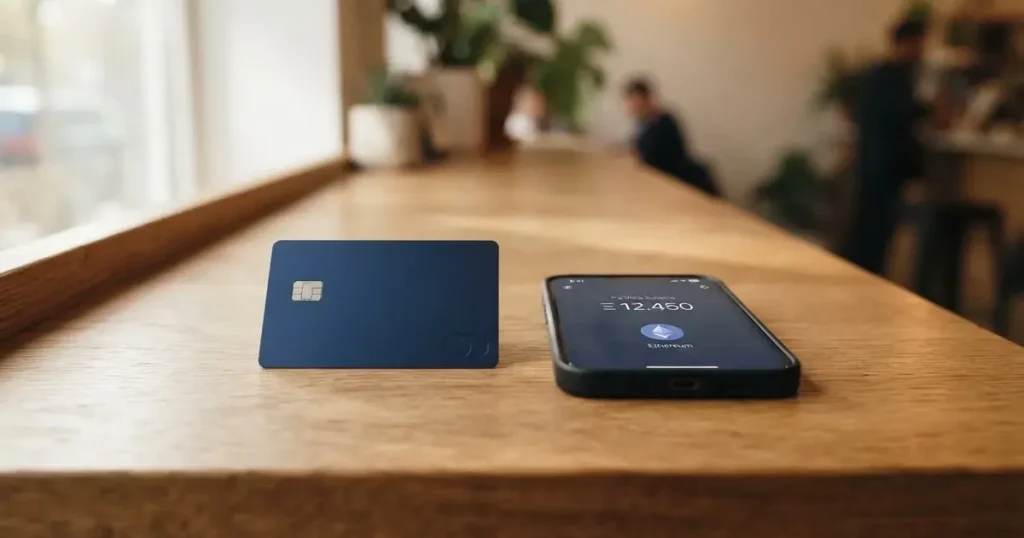
WebitPay is a Visa payment card you fund with USDT or USDC instead of a bank account, issued through a Hong Kong programme manager and an issuer called Reap Technologies. On the surface it does what most people in this category want: a physical card, a virtual card you can push into Apple Pay or Google Pay, cash withdrawals, and no obvious monthly charge. Underneath, the card’s public pages leave out almost every number a person would need to decide whether it is worth using — the fee schedule, the country list, the deposit minimum, the spending and withdrawal limits. That gap, not the product, is what decides my score.
The conditions described here are current as of October 28, 2026.
Who should look at this card: someone who already holds USDT or USDC, wants a plain Visa number to spend at ordinary shops, and is comfortable reading the app for the details the website leaves out. Who should not: anyone who needs a published fee schedule before signing up, anyone who needs a card in a specific country with a written guarantee, or anyone whose priority is a bank that answers to a deposit guarantee scheme. That audience note is worth repeating because it is the whole proposition: this is a card for users who want a Visa funded with USDT or USDC, not a mainstream bank account with crypto attached.
| Criterion | Mark | Why |
|---|---|---|
| Who can get it | 5 / 10 | The terms forbid sanctioned persons and the FAQ points to a list of barred countries and regions without ever showing it |
| Cost | 5 / 10 | The fee schedule is promised for the website; only the ATM conversion charge is given, at 1%, plus a separate ATM fee whose amount is not disclosed |
| Top-up options | 5 / 10 | USDT or USDC straight from a wallet, but no networks, no minimum and no top-up fee published |
| Reliability and complaints | 7 / 10 | Hong Kong company, issuer Reap Technologies with no licences named, 2FA via Google Authenticator, no incidents or user complaints found, App Store 5.0 from 2 ratings |
| Everyday use | 9 / 10 | Physical and virtual Visa cards, virtual card in Apple Pay and Google Pay, ATM on the physical card |
| Total | 6.0 / 10 | A well-shaped card with a very thin public document |
Will they give you the card
The honest answer is: the card’s own terms will not tell you. There is no published list of eligible countries on the public pages. What the terms do say is that users must not be subject to sanctions, and the FAQ refers to a list of prohibited countries and regions — but the list itself is not shown. So the two things you would most want to know, where you must live and what your nationality has to be, are both left for you to discover by applying.
That is not the same as “anyone can get it”. Sanctions screening is real screening, and it is applied by the compliance side of the business, not by the marketing page. It also means the answer to “is the card available in my country” cannot honestly be given from what the card publishes. My advice is the unglamorous one: if your country is not obviously on the permissive side of international compliance, do not build a plan around this card. And note the direction of travel — the population most likely to want a USDT-funded card is exactly the population most likely to sit in a jurisdiction a Hong Kong compliance team has to think carefully about.
One more thing that is not stated anywhere: the card does not publish KYC tiers. There is no basic tier and no higher tier with higher limits, which means you cannot ask “what does this level let me do?” and get an answer before you hand over documents.
How to get it
The card comes in two forms, physical and virtual, both Visa. The App Store description sells the network angle — “millions of Visa-supported merchants” — which is the ordinary Visa promise and not something unusual for a card in this category. The card’s own currency is not stated anywhere on the public pages, though the App Store advertises “multi-currency payments across international platforms”. Whether that means one card with a chosen currency, or conversion at the point of sale, is not explained.
Applying means identity verification, and there is no way around that part. KYC is required through an automated third-party provider, Shufti Pro, which uses facial recognition and matches your data against records. That process can escalate to manual review. What documents you need is not stated: no list of accepted IDs, no proof-of-address requirement, no minimum age published on the pages I checked. Refusing the KYC step can lead to suspension, which is worth knowing before you start a half-finished application and walk away from it.
Also not stated: how long delivery takes for the physical card, how long processing takes, and the specific reasons an application can be rejected. If you need a card working by a specific date, this is a card that gives you no basis for planning — you would be guessing.
Two further gaps. There are no published tiers to speak of, so “what do I get at the next level” has no answer. And if your application stalls, the support routes are concrete: an email address, a phone line, and hours.
Fees: what this card really costs you
This is the weakest part of the picture, and the reason the cost score is a 5. The card says its fee schedule “will be made available on our website”, and there is in fact a “WebitPay Card Service Fees” FAQ page — but its contents are not shown on the public pages. So the document that would answer “what does it cost” exists as a promise and as a page title, and I cannot read it. Neither can you, from what is published.
What is disclosed is narrow. ATM withdrawals carry a 1% currency conversion fee, and there is a separate ATM fee on top of it whose amount is not shown. Whether there is a free allowance before the fees apply is not stated. The crypto conversion fee — the one you pay when your USDT or USDC becomes spendable balance — is not stated. The general foreign exchange fee on ordinary purchases abroad is not stated. Issuance fee, monthly maintenance fee: not stated. Daily spending limit, monthly spending limit, daily withdrawal limit: not stated.
| Fee or limit | What the card publishes |
|---|---|
| Issuance | Not stated |
| Monthly fee | Not stated |
| Crypto conversion fee | Not stated |
| Foreign exchange fee on purchases | Not stated |
| ATM currency conversion | 1% |
| Separate ATM fee | Charged; amount not shown |
| Free ATM allowance | Not stated |
| Daily and monthly limits | Not stated |
| Card currency | Not stated |
| Top-up fee and minimum | Not stated |
Here is what that means in practice, because a missing fee is not a zero fee. Take three ordinary days and see what you cannot compute.
Paying for a coffee in a shop on the card’s own currency. If you hold USDT, something has to convert it into a balance the network can spend, and that step’s fee is not published — so you cannot tell what the coffee actually cost you. If you are abroad, the FX treatment is not published either. The number you would see at the till is knowable; the number you keep is not.
Withdrawing cash at an ATM abroad. This is the one case you can partly price: 1% currency conversion, plus an undisclosed ATM fee, on top of whatever the ATM operator charges. Two unknowns stacked. For a card whose most attractive feature is being used outside a normal banking setup, that is an uncomfortable gap.
Paying online in a foreign currency on a subscription you forgot about. Small recurring payments are exactly where an undisclosed FX fee hides best, because the amount is small enough that you do not check the rate and large enough that it accumulates.
My rule of thumb after reading fee pages like this: if the provider will not publish the number, treat the number as material and size your balance accordingly. Load small, spend small, and check the app’s own fee display after your first transaction rather than assuming it is zero.
How to top it up
Top up with stablecoins — USDT or USDC — sent directly from your wallet. That is the whole mechanism, and in one sentence it is the card’s reason to exist. It also means the card is unusable in the way an ordinary bank card is unusable: if you have no stablecoins, there is no path from your salary to this card. No bank transfer, no card funding, no direct deposit route is published.
What is not stated about funding is almost everything around the transfer. Which networks are supported — Ethereum, Tron, Solana, others — is not published, and this matters more than it looks: a transfer sent on a network the provider does not support, or to an address belonging to a different network, can be lost, or need a manual support recovery with no guarantee, because blockchain transfers are irreversible. There is no stated minimum top-up, no stated deposit fee, and no fiat option at all. Where the balance comes from is also constrained: the terms require top-ups to originate from legitimate sources, which is a compliance statement rather than an operational one.
Two stablecoins sit behind the card, and they are not interchangeable in practice. USDT and USDC are both dollar-pegged and between them they make up about 90% of stablecoin market capitalisation, per the BIS in July 2025 — but they are issued on different networks. USDC is natively supported on 38 networks, while USDT has been issued on Ethereum, Tron, Solana, Polygon, Avalanche and others. Notably, Circle stopped supporting USDC on Tron in February 2024, so “USDC over TRC20” is not a native option you can assume. Check what the app expects before you send anything, because the wrong guess is the expensive kind of mistake.
There is also no published withdrawal process. That matters for symmetry: you can pay in, but the card’s pages do not describe how you get money back out, and the terms say only that on closure remaining funds “may be returned under applicable law”. If your plan involves cashing back to a bank account, that plan is not supported by anything the card publishes.
Paying with it every day
Day-to-day use is where this card scores highest, at 9 out of 10, and it is easy to see why. There is a physical Visa card and a virtual Visa card. The virtual card works with Apple Pay and Google Pay, which is where most people will actually use it — you pay with your phone and never handle a piece of plastic. There is no extra Webit fee for Google Pay, though network charges, third-party charges and Reap’s own charges may still apply. The physical card works at ATMs.
The virtual-card-in-your-phone experience is genuinely the good version of this product. When you pay by phone, the card number is replaced by a device-specific number held in the phone’s secure hardware, and each payment uses a one-time code — so the raw card number is not floating around and is not exposed in the way an old card number does. The issuer can still restrict that tokenised number, for example blocking it on phone or online use, which is a feature rather than a flaw.
Two things are not stated that shape real usage. The card does not publish its list of blocked merchant categories, so you do not know in advance whether gambling, adult content, or similar categories will decline at the till. And the app is thin as a signal: 5.0 in the App Store from 2 ratings, version 1.4.5, iOS. Two ratings is not a user base. The Google Play rating was not checked. Two ratings is also not a complaint — I found no incidents and no user reports — but it means the app’s reputation is unmeasured rather than excellent.
Version history is more informative than the rating. Version 1.1.3 in December 2025 brought statement download and ATM improvements. Version 1.2.1 in January added WhatsApp OTP and an Anti-Phishing Code. Version 1.2.3 in March added balance alerts. Version 1.4.5 arrived in September. A product that ships an anti-phishing code and balance alerts in its first year is a team that reacts to problems; a product that ships nothing after launch would worry me more.
If a payment goes wrong, the route is defined: contact the merchant first, and if that does not resolve it, raise a claim with Webit, which then liaises with Reap and the card networks, subject to eligibility and timelines. A reversal is not guaranteed. That is the standard arrangement in this category — the brand mediates, the issuer decides — and it is worth knowing before you dispute anything.
What can go wrong
Let me split this into what could go wrong with the money and what could go wrong with the paperwork, because they are different risks.
The money risk is mostly the balance you have already loaded. The card is described as an electronic money account, and how that money is held is not stated — whether it is safeguarded, segregated or otherwise protected is not said. Funds of this kind are not the same as a bank deposit and should not be assumed to be covered by a deposit guarantee scheme. Keep the loaded balance at a level whose loss would not hurt you.
The industry context is not comforting here. Custodial platforms have a real history of failure: Mt. Gox with roughly US$350 million reported stolen between 2011 and 2014, Coincheck with about US$400 million in 2018, and Ronin Network with US$625 million in 2022. And card programmes themselves get switched off — Visa terminated its global agreements with FTX on 13 November 2022, and the FTX US debit card was wound down. Programme closures tend to follow a pattern: a notice period, spending stops, then users are asked to withdraw. One 2026 closure reported by a secondary source ended new loads on 8 July 2026 and spending on 8 August 2026 — single source, unconfirmed, but it shows the shape of what you would be exposed to. A company this young, with a Hong Kong office at Room 2706, 27/F, Everbright Centre, 108 Gloucester Road, Wan Chai, deserves the same scepticism you would apply to any counterparty holding your balance.
The paperwork risk is the bigger one for the person I am describing. Refusing KYC can lead to suspension. Terms can be changed. A user who needs their money on a particular day has no published withdrawal process to rely on. None of this means the card is unsafe; it means the card’s protections are largely unwritten, and unwritten protections are not protections you can cite when you need one.
There are two further limits on this card’s own record. The site says Webit Information Technology Limited holds “necessary financial licenses” but names none. The issuer, Reap Technologies Limited, has no licences named either. The terms are governed by Hong Kong law. In the EU, if you are reading this because you are there — a card governed by Hong Kong law is not an EU-authorised service, and the two-licence structure means a crypto card can be sound on the crypto side and unlicensed on the payment side. ESMA keeps a public register of authorised crypto-asset service providers; you can check any provider there, and I would encourage it before you load money.
Finally, the sanctions point is not academic. Tether says it disables tokens in wallets on the OFAC sanctions list and has frozen funds tied to illicit activity — stablecoins are not censorship-proof. If your situation involves any of this, the answer is a proper compliance conversation with the provider, not a workaround.
Support, if you do need it: an email address, a phone line, and hours Monday to Saturday, 08:00 to 18:00, with a Help Center on Zendesk. That is a real support operation, which is more than many cards in this category offer.
What to take instead
If the missing fee schedule is the dealbreaker for you, the alternatives below all publish more than WebitPay does about at least one thing. I am not ranking them for you — the right choice depends on whether you want a card issued in the United States, a multicurrency account, or a self-custody wallet with a virtual card on top.
| Score | Card and currency | Cost | Funding | Rewards | |
|---|---|---|---|---|---|
| International Visa Card | 6.7 / 10 | U.S.-issued Platinum Visa, virtual, pays in USD; physical “coming soon” | $5 one-time issuance, no maintenance fee; plans Classic free, Pro $9.00/month, Max $19.00/month | USDC or USDT into the USD account free at 1:1; also USD, EUR, SEPA, SWIFT, FedNow | No cashback stated |
| UNi Card | 6.1 / 10 | Multicurrency card on the Mastercard network, spends from the UNi.Global balance | No annual fee; issuance fee not stated | Not stated | Spend-to-Earn up to 3% |
| Morse | 7.5 / 10 | Fully virtual Visa prepaid debit, spends from Morse Balance in any currency | Issuance and monthly fee not stated (“fees may apply, see Cardholder Agreement”) | Debit card, stablecoin transfer or Account Details (USD, EUR, MXN, COP; BRL needs Brazilian CPF); USDC, USDG and EURC via Solana free, other tokens carry a fee | Not stated on card pages |
| WebitPay | 6.0 / 10 | Physical and virtual Visa; card currency not stated | Not stated; ATM conversion 1% plus a separate undisclosed ATM fee | USDT or USDC from wallet; networks not stated | Not stated |
On fees specifically, the International Visa Card is the most transparent of the four: card use in USD is free on all plans, and foreign currency is stated as “Visa exchange rate + 2% FX fee”. You know what you pay before you spend. Its catch is eligibility — it is not available to residents or legal registrants of a long list including Belarus, mainland China, North Korea, Cuba, India, Iraq, Iran, Israel, Myanmar, Nepal, Nicaragua, Russia, Syria, Turkey, Ukraine, Venezuela and Vietnam, FATF grey-list countries are reviewed case by case, and purchases are blocked in North Korea, Cuba, Iran, Russia, Syria, Ukraine and Venezuela. The rule is by residence or registration, not citizenship.
Morse is the strongest card here on paper — 7.5 out of 10 — because it is the one whose economics are stated clearly: zero foreign exchange fees or markups, the real-time Visa exchange rate, conversions at the real rate with no markup, and paying with the card online and contactless is free. It is also the most interesting structurally, because the wallet is self-custodial: the funds stay in your own wallet until the moment of payment. That means key loss, phishing and clipboard-hijacking malware are your problem rather than the provider’s — a different risk profile, not a smaller one. Eligibility is by residence, not citizenship: at least 18 and resident in a supported country, with the app available in over 140 countries. It needs an invite code in some places, including Hong Kong SAR China, Singapore, Japan, Australia, the United Kingdom, Switzerland, Serbia, Thailand, Türkiye, New Zealand and others, and it cannot serve customers subject to United States, UK, EU or UN sanctions. The card is “available only in certain countries” and the list is not on the page — you check the app.
UNi Card publishes the two numbers people most want — no annual fee and no foreign transaction fee, with assets converted at live over-the-counter rates and, in its words, no hidden exchange fees — and adds up to 3% Spend-to-Earn. What it does not publish is how you fund it. That is the same gap as WebitPay’s, in a different place.
Who I would recommend it to
I would recommend this card, with eyes open, to someone who already lives in stablecoins. Someone who keeps USDT or USDC, wants to spend it at ordinary shops, is comfortable holding a balance on a platform rather than in a self-custody wallet, and has accepted that the exchange rate and any conversion cost are whatever the app says on the day. For that person the card is a reasonable tool: Visa acceptance, a physical card for cash, a virtual card in the phone, ATM access, two-factor authentication, a freeze function for a lost card, and a support team with published hours.
I would not recommend it to someone who wants to know the cost before committing. The fee schedule is not published, the country list is not published, the limits are not published, and the licences are not named. If your decision to use a card depends on those four things, this card cannot give them to you, and a card that will not publish them has already answered a question about itself.
The middle case is the person who needs a Visa number for one specific thing — a subscription, a travel booking, a merchant that declines prepaid cards. Then the fit is fine, because you will load a small balance, use it, and the missing disclosures cost you very little. The larger your balance and the more you travel, the more the missing FX and conversion numbers start to matter.
One last thing I would tell any reader. Paying with a card funded from crypto can be a taxable event, depending on where you are — this is general background, not advice for your situation, and it is worth checking with someone qualified before you spend. If you are in the United States, the IRS treats digital assets as property, so exchanging them for goods or dollars generally produces a taxable gain or loss, measured at fair market value on the date of the transaction. That means each card payment funded from crypto may be treated as a separate disposal. Elsewhere the treatment differs, and I am not qualified to tell you yours.
Frequently asked questions
What is WebitPay?
It is a Visa payment card — physical and virtual — that you fund with USDT or USDC sent straight from a crypto wallet instead of drawing on a bank account. It is run by Webit Information Technology Limited, a Hong Kong company, with the card issued by Reap Technologies Limited. WebitPay acts as the programme provider rather than the issuer.
How does the WebitPay card work?
You top up with USDT or USDC, the balance sits on the card, and the Visa network spends it like any other card. The app advertises multi-currency payments across international platforms, but the card’s own currency is not stated on the public pages, and the crypto conversion fee is not published either.
Is WebitPay a bank?
No. The account is described as an electronic money account, and the issuer is Reap Technologies Limited. The site says WebitPay holds “necessary financial licenses” but names none, and how customer funds are safeguarded is not stated. Treat it as an e-money product, not a bank deposit.
Who owns WebitPay?
Webit Information Technology Limited, whose terms list an office at Room 2706, 27/F, Everbright Centre, 108 Gloucester Road, Wan Chai, Hong Kong. The terms are governed by Hong Kong law. I found no licensing or issuer news in the app’s version history to add to this picture.
Is the WebitPay card available in my country?
The public pages do not say. The terms say users must not be subject to sanctions, and the FAQ refers to a list of prohibited countries and regions without publishing it. There are no eligibility tiers either, so the honest answer is that you have to apply to find out — and if your jurisdiction is at all sensitive, get a clear answer from support first.
How do I get the WebitPay card?
Apply in the app and complete KYC through Shufti Pro, an automated third-party provider using facial recognition and data matching, with possible manual review. Delivery time for the physical card, processing time, accepted documents and rejection reasons are all not stated. Refusing the KYC step can lead to suspension.
Does WebitPay require KYC?
Yes. Identity verification is mandatory, and it is handled by an automated provider rather than by a person reading your documents, though a case can escalate to manual review. Required documents, proof of address and minimum age are not published. No KYC tiers exist on the public pages, so higher limits are not something you can ask about.
How do I top up the WebitPay card?
You send USDT or USDC from your own wallet, and the terms require top-ups to come from legitimate sources. Which networks are supported is not stated, and that is the detail to get right: a transfer on an unsupported network can be lost, since blockchain transfers are irreversible. No minimum, no top-up fee and no fiat funding option are published.
What are the WebitPay card’s fees?
Not published. The fee schedule is promised for the website and a “WebitPay Card Service Fees” FAQ page exists but its contents are not shown. The one figure given is a 1% currency conversion fee on ATM withdrawals, plus a separate ATM fee whose amount is not disclosed.
Is the WebitPay card safe, and who do I contact?
I found no official incidents and no user reports, and the app has 5.0 from 2 ratings — too few to mean anything. Security features include two-factor authentication via Google Authenticator, an Anti-Phishing Code, WhatsApp OTP, balance alerts and a card freeze. Support is at an email address and a phone line, Monday to Saturday, 08:00 to 18:00, with a Help Center on Zendesk.
Top app and neobank cards by score – cryptocardtop
Content created by the «cryptocardtop» team