
Kinesis Card Review: Gold Cashback or a Pre-Registration Gamble?
 Available in US
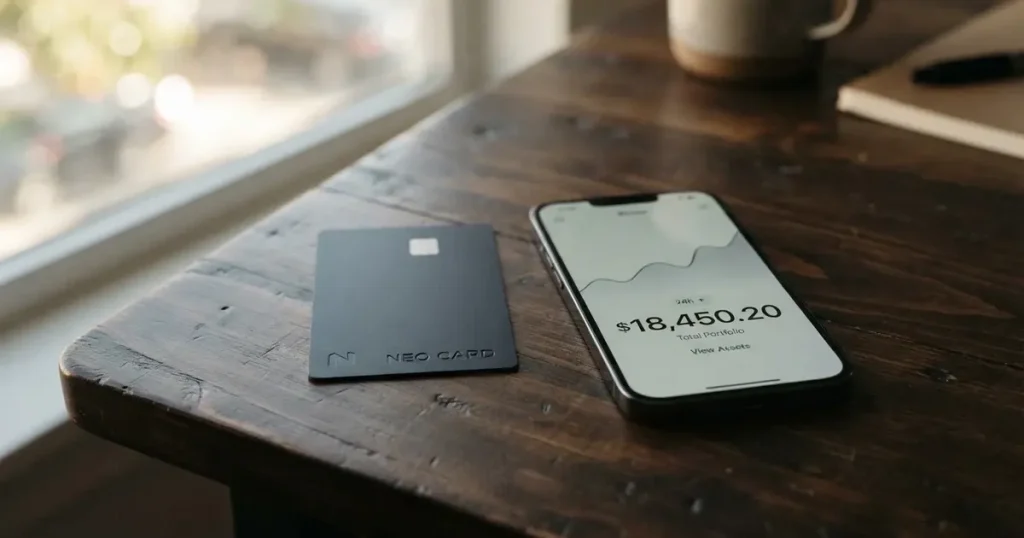
The Kinesis card is a virtual payment card tied to a Kinesis Money account that holds gold, silver, crypto and a dollar stablecoin, and it pays 2% cashback in gold. That premise is genuinely interesting — spending a crypto balance through a normal card, and getting rewarded in actual metal rather than points. But when I went through the card’s own pages and the public record around it, a pattern emerged: almost everything that matters to a cardholder — who can actually get one, what it costs, which networks it accepts, which limits apply — is either not stated or comes only from third-party sources. My score is 4.8 out of 10. This is not a scam accusation; it is a “too much is missing for me to recommend it” verdict. Read on if you are weighing it, and pay special attention to the cost and reliability sections, because those are where the risk sits.
The conditions described on this page are current as of October 28, 2026.
Verdict: 4.8 / 10 — interesting idea, too many gaps
Kinesis suits a very specific person: someone who already holds gold (KAU) or silver (KAG) on the platform and wants to earn 2% cashback paid in gold while spending. If that is you, and you are comfortable with a virtual-only card and a company whose card programme details are hard to pin down, there is something here. For everyone else — and especially for anyone trying to solve a problem like “I cannot get an ordinary bank card” — the missing information is disqualifying. A card is a trust instrument; you are handing over spending power and cashing out of an account at a company you may never have heard of. Where the terms are silent, you cannot evaluate the deal.
| Criterion | Mark | Why |
|---|---|---|
| Who can get it | 5 / 10 | Not named on the page; starting data points to the United States, Latin America and the Caribbean; overall availability unclear, the site shows pre-registration |
| Cost | 6 / 10 | Not disclosed officially; unofficial: no monthly or sign-up fee, 1.95% transaction fee on one page, 0.22% conversion and 0.45% transactions in another source |
| Top-up options | 5 / 10 | Instant conversion of gold (KAU), silver (KAG), crypto and C1USD from the Kinesis account; networks not named |
| Reliability and complaints | 4 / 10 | Card issuer and licences not named; Trustpilot for Kinesis Money 2.4 out of 750 reviews: withdrawal delays of about 40 days, complaints about fees and liquidity |
| Everyday use | 3 / 10 | Virtual only; Apple Pay and Google Pay not mentioned; no ATM |
Total: 4.8 / 10.
One more thing to weigh before you keep reading: this is a virtual card only, and virtual-only is the single biggest constraint for day-to-day life. No ATM, no physical card to tap, no mention of Apple Pay or Google Pay. If your mental picture of a card is a piece of plastic in your wallet, this is a different product.
Will they give you the card?
Honestly: the card’s own pages do not say. Eligibility is not stated on the page I read. What the starting data points to is the United States, Latin America and the Caribbean as the intended regions, but that is not the same as a published eligibility list, and the site is still showing pre-registration for the virtual card. Pre-registration means interest, not access. Many readers searching this are asking “is Kinesis available in my country” — and I cannot give you a yes or a no from the card’s own materials, because the card does not publish one. You would be applying on faith.
There is a related but distinct product that trips people up: the physical Visa card launched in the US in 2021, covered by Brave New Coin and Substack, is a separate offering from this virtual card. If you have seen a Kinesis-branded Visa card in the wild, that is not the thing under review here.
KYC is another silence. The card’s site links to a Kinesis verification guide, but the page does not state what KYC level this specific card requires. That matters if you are trying to understand what documents you would need. My advice to you is not to read this as an endorsement of any way to skip verification — no crypto card lets you legitimately skip KYC — but as a reason to assume identity checks are required and to plan for them.
How to get it
The path is a pre-registration. The card is offered as a virtual card through the Kinesis Money platform, and the site lets you register interest ahead of launch with a free six-month cashback plan “from launch”. Third-party coverage indicates the virtual card is live now, so the pre-registration page may be a leftover or an early stage for a wider rollout. Either way, the mechanics are simple: get a Kinesis account, complete whatever verification the platform requires, and sign up for the virtual card when it is offered to you. There is no branch, no paperwork, no phone call.
What you end up with is a card number in your account or app, not a piece of plastic. That is the whole product. Keep it in mind as you read the costs and daily-use sections — every point below assumes a virtual card.
Fees and what a payment really costs
Here is the honest state of the fee picture: the card’s own materials do not state the issuance fee, the monthly fee, the transaction fee, the conversion fee, the ATM fee, or any daily or monthly spending limits. The site links to a general fees page, but the specific card terms are not spelled out where I read them. That is a real gap and the reason the cost score is only 6.

What circulates officially-adjacent (but is still unofficial) is this: one promotional page indicates no monthly or sign-up fees, and one page gives a 1.95% transaction fee, while another source gives 0.22% conversion plus 0.45% per transaction. These two unofficial versions do not agree with each other. That is precisely the problem. I cannot tell you what you will actually be charged, only that different pages quote different numbers and none is a promise.
| Fee or limit | What the card says |
|---|---|
| Issuance fee | Not stated |
| Monthly fee | Not stated; unofficial sources say none |
| Transaction fee | Not stated; unofficial: 1.95% on one page, 0.45% on another |
| Conversion fee | Not stated; unofficial: 0.22% on one source |
| FX fee | Not stated |
| ATM fee | Not stated |
| Daily limit | Not stated; unofficial: up to $15,000 daily on one source, €15,000 daily on another |
| Monthly limit | Not stated; unofficial: over $400,000 monthly on one source |
Let me walk three everyday payments through what is known, so you can feel how the unknowns land.
Buying coffee (say $5) from a Kinesis balance held in crypto. Your card would convert your crypto to spendable balance at the point of sale. The conversion fee and the transaction fee both potentially apply, and both are the numbers that disagree between unofficial sources — somewhere between roughly $0.02 and $0.10 on a $5 purchase depending on which figure is real. Small in absolute terms, but it tells you nothing about the larger purchases.
An online subscription, say $30 monthly. Same two fees stack on every cycle. If the transaction fee is genuinely 1.95%, that is about $0.59 a month; if it is 0.45%, about $0.14. A recurring subscription quietly turning into a small monthly leak is a classic card complaint, and here you cannot even know your rate.
Spending abroad or on anything priced in a non-dollar currency. If there is a foreign-exchange fee, it is not stated. The virtual card’s currency is not stated either. These two unknowns together mean the worst-case cost of an overseas transaction is genuinely unknown to you before you make it. This is one of the reasons I am reluctant to recommend the card to anyone using it as their primary or travel card.
I would rather tell you the fees are unclear than invent a number. Check the card’s own fees page yourself before you commit, and treat every unofficial figure above as a starting point for a question, not an answer.
How to Top up
Topping up here is not really “depositing” in the bank sense — it is converting what you already hold on the platform into spendable balance. The card’s stated model is instant conversion of gold (KAU), silver (KAG), crypto and the C1USD stablecoin at the point of sale, from your Kinesis account. Spending draws down your account balance. That is the core mechanic, and it is the part of the design that actually makes sense to me: you are not depositing money and hoping the card works; you are converting metal and coins you hold into something spendable at the moment you spend.
The page also says you can buy gold and crypto with “your card or bank transfer”. So the on-ramp into the account itself is a card or a bank transfer, and from there everything is internal conversion.
Where the uncertainty sits:
- Networks not named. Which blockchains your crypto has to travel on to reach the platform is not stated. This is the practical trap for anyone sending stablecoins: send on the wrong network and the funds can be lost or need manual recovery. Blockchain transfers are irreversible.
- Card-specific top-up fee and minimum: not stated. You cannot compute the cost of getting money in.
- Withdrawal terms for the card: not stated. How you get value back out is a blank.
So: the top-up options score 5 because the *concept* is broad — gold, silver, crypto, stablecoin — but the practical details (networks, minimums, fees) are exactly the ones that decide whether a top-up works are missing. For a reader who already holds metals on Kinesis, this is a plus. For a newcomer, it is a locked door.
Paying with it every day
This is where the card is weakest in my assessment, and it is why Everyday use scored 3.
It is virtual only. There is no physical card. Apple Pay and Google Pay are not mentioned anywhere I read, so you cannot assume you can add it to your phone’s wallet — and that is exactly the search most readers run, “how do I add Kinesis card to Apple Wallet”, with, as far as I can tell, no confirmed answer. There is no ATM: cash withdrawal is not on the table. Wallets (which cards can be loaded into which apps) are not stated.
What you do get is a mobile app to “keep track of your assets on the go”. Store ratings I could not read, so I cannot vouch for the app’s quality.
The rewards are the strongest single feature and also the most unusual. You get 2% cashback in gold, with access to the cashback plan “6 months free from launch”, paid in gold. I want to be honest with you: there are two things to note here. First, cashback paid in gold is not the same as cashback in dollars — the value you receive is metal, and metal moves in price. If you spend $100 and receive $2 in gold, that $2 is worth two dollars of gold today, not necessarily two dollars of credit toward your next purchase unless you hold it. Second, “6 months free from launch” is a promotional structure; what happens after the six months is not clearly stated on the page I read. Treat the 2% as an incentive to open an account, not as a permanent feature you can bank on.
In the raw day-to-day sense, then: you can pay online wherever a virtual card is accepted, you track it in an app, and you earn a metal rebate. You cannot tap a terminal with plastic, you cannot pull cash, and you cannot be sure about wallet support. For light online spending that is workable; as your main card it is thin.
What can go wrong
This section is where I found the most to say, and where I want to be most careful and fair.
The company behind the card is not fully named on the page. The platform is Kinesis Money (Kinesis Cayman per starting data), and KMS Labs is described as the issuer of the ERC-20 gold (KAU) and silver (KAG). But the card’s issuing entity and its licences are not stated. For a regulated payment product, that is a foundational fact, and it is absent.
The user record is rough. Trustpilot for Kinesis Money — note, this is the platform’s profile, not the card’s — sits at 2.4 out of 5 from 750 reviews, 115 of them in the last 12 months, read on 2026-10-21. The complaints that recur: delayed or frozen withdrawals (some about 40 days, reported Jul–Oct 2026), poor or template support communication (Oct 2026), complaints about fee disclosure (Oct 2026), and liquidity concerns. CIMA complaints were mentioned in Oct 2026. Importantly, none of the reviews I sampled mention the card specifically — these are platform complaints. But withdrawal delays on the platform are the same money you would be converting to spend, so they are relevant to you.
On security, the page says “your assets are in safe hands” and links to independent audits and monthly attestations. Those are the right things to see. What is not stated: the custody model, whether 2FA is supported, and whether you can freeze the card. So I can tell you assurances exist; I cannot tell you what they cover.
Support is reachable in form if not in detail. There is a support centre, a contact link and a community forum. Languages and hours are not stated.
The broader category risk is worth naming. Crypto platforms have a long history of failing. Custodial platforms specifically: Mt. Gox (about US$350 million reported stolen, 2011–2014), Coincheck (about US$400 million, 2018), and Ronin Network (US$625 million, 2022). Card programmes can also be shut down from above — Visa ended its global agreements with FTX on 13 November 2022 and the FTX US debit card was wound down, and WaveCrest’s Visa programmes were all closed when Visa suspended it in Europe in 2018. Programme closures typically mean: notice, then spending stops, then you are asked to withdraw what remains. One 2026 closure reported by a secondary source ended new loads 8 July 2026 and spending 8 August 2026 (single source, unconfirmed). I am not saying Kinesis will do any of this. I am saying this is the category you are entering, and the card’s own terms do not tell you what your exit looks like.
I also want to flag one tax point gently, without advising you either way: the IRS treats digital assets as property, so converting them to spend generally produces a taxable gain or loss measured in local currency at the fair market value on the transaction date. That is a heads-up to check with a professional on your own situation, not advice from me.
What to take instead
I am not here to steer you into any particular product, but if Kinesis’s gaps bother you, here is how the alternatives I looked at compare — and you should weigh them on the same “what is actually stated” basis I used above.
| Alternative | Score | Card | Fees | Funding | Rewards |
|---|---|---|---|---|---|
| GoMining Card | 6.6 / 10 | Virtual now, physical coming soon; network and currency not stated | Not stated; opening a card grants a free 1 TH miner | BTC, USDT, GOMINING and other coins | Cashback in mining power, rate rises with VIP level, “up to 5%” |
| Greencart | 6.9 / 10 | Visa, powered by Gnosis Pay; virtual free, physical may carry a one-off admin fee | “No hidden, monthly, or annual fees”; optional Greencart+ $7.99 monthly or $79.99 yearly | Bank account or crypto wallet, fiat or crypto; spends from self-custodial Gnosis Pay Safe | 0.5% floor in B3TR per purchase, up to a 4% ceiling; capped at $40 per transaction and per month |
| Young Card | 5.7 / 10 | Not stated | Not stated | Not stated for the card | Cashback in YNG tokens by Club tier: Essential 0.1%, Gold 1.8%, Platinum 3.6% |
| Kinesis (this review) | 4.8 / 10 | Virtual only | Not stated; unofficial 0.22%–1.95% figures | Gold, silver, crypto, C1USD from account | 2% cashback in gold |
A few notes so the table is read fairly:
- Greencart is the most transparent of the group on both price and funding. Its eligibility is published (EEA countries plus Argentina, Bolivia, Brazil, Colombia, Mexico, per Gnosis Pay’s list), it states no fees for withdrawals, transfers, deposits or FX, and it spends from a self-custodial wallet. Its one inconsistency is the reward rate: the site says up to 4%, while the App Store text says “up to 8%” cashback and partner purchases up to 15%. Because this card sits under Gnosis Pay’s terms and a regulated structure, it is the option I would examine first if you want clarity — with the caveat that its contracting entity depends on your residence and it enforces standard sanctions eligibility (18+, not on sanctions lists, not located in or resident of sanctioned countries).
- GoMining Card is interesting if you want cashback paid in mining power rather than metal, but it is also thin on disclosure (eligibility, fees and network not stated as a list), and its rewards tie you to its token economics.
- Young Card is the least documented of the four — card type, cost and funding are not stated officially — so on the same “can I evaluate it” test I applied to Kinesis, it fares no better.
None of these is a recommendation; they are the alternatives I found so you can compare like with like.
Who I would recommend it to
After all of the above, here is my honest bottom line by reader type:
- I would consider it if you already hold gold (KAU) or silver (KAG) on Kinesis, you spend modestly online, you are comfortable with a virtual-only card with no ATM and no confirmed mobile-wallet support, and you actively want the 2% gold cashback. You are betting on metals rewards and you accept that many fee details are unpublished.
- I would steer you away if you need this card to solve an access problem — getting paid, receiving funds, or having something reliable when an ordinary card declines. If you cannot get a normal bank card, a virtual crypto card with unpublished fees, limits and issuer is a fragile substitute, not a foundation.
- I would steer you away if you intend to use it as a primary or travel card, if cash withdrawal is non-negotiable, or if you need certainty about a fee before you commit money.
- I would steer you away if you are put off by the platform-level complaints and the roughly 40-day withdrawal delays reported on Trustpilot, because those delays touch the same balance you would be converting to spend.
The card’s own terms do not tell us who the issuer is or what it costs, so any recommendation has to be conditional. I would not hand this to a friend as a set-and-forget everyday card. As a metal-rewards experiment for someone already inside the ecosystem, it is defensible. That is the narrow window where I can see it working.
Frequently asked questions
What is Kinesis card?
The Kinesis card is a virtual payment card that spends from a Kinesis Money account rather than a bank account. The account can hold gold (KAU), silver (KAG), crypto and a dollar stablecoin (C1USD), and paying with the card converts that balance at the point of sale. It is a different product from the physical Visa card Kinesis launched in the US in 2021.
How does Kinesis card work?
You hold assets on the Kinesis platform, and when you pay, the balance converts to spendable value at the point of sale — instant conversion from gold, silver, crypto or C1USD. The card is virtual only, so it lives as a card number in your account or app rather than as plastic, and it offers 2% cashback paid in gold with six months free from launch.
Is Kinesis a bank?
The card’s materials do not describe Kinesis as a bank, and the card’s issuing entity and licences are not stated on the page I read. The platform is Kinesis Money (Kinesis Cayman per starting data), with KMS Labs described as issuing the ERC-20 gold and silver tokens. That is enough to know it is a crypto platform, not enough to confirm a banking licence.
Who owns Kinesis?
Ownership details are not laid out on the card page. What is named is Kinesis Money as the platform, Kinesis Cayman per the starting data, and KMS Labs as the issuer of the gold and silver tokens. If ownership structure matters to your decision, this is one of the things you would want confirmed directly.
Is Kinesis card available in my country?
The card does not publish a clear eligibility list. Its starting data points to the United States, Latin America and the Caribbean, and the site shows pre-registration, which signals interest rather than confirmed access. Because the material I read does not name specific countries, I cannot tell you yes or no for where you live — you would need to confirm with Kinesis directly.
Does Kinesis card require KYC?
The card’s pages do not state the KYC level required for the card specifically; the site links to a Kinesis verification guide. As a general rule, regulated card services verify identity under anti-money-laundering law, and there is no legitimate route around it. Plan to complete verification rather than look for a way to avoid it.
How do I top up the Kinesis card?
Topping up means converting what you hold on the platform into spendable balance: instant conversion of gold, silver, crypto or C1USD at the point of sale, with the page saying spending draws on your account balance. The page also says you can buy gold and crypto with your own card or a bank transfer. Specific networks, minimums and card top-up fees are not stated.
What are Kinesis card fees?
The card’s own pages do not state issuance, monthly, transaction, conversion, FX or ATM fees, or the daily and monthly limits. Unofficial figures differ — one page suggests a 1.95% transaction fee, another 0.22% conversion plus 0.45% transactions, and some sources suggest no monthly fee. Treat these as questions to verify, not answers, and check the platform’s fees page yourself.
Is the Kinesis card safe?
It is a virtual card from a crypto platform whose Trustpilot profile for Kinesis Money sits at 2.4 out of 5 from 750 reviews, with reports of delayed withdrawals of about 40 days. The page states assets are in safe hands and links to audits and monthly attestations, but the custody model, 2FA and card freeze are not stated. Nothing here is a promise of safety — check the issuer’s status yourself.
How do I use the Kinesis virtual card?
Add the virtual card to your Kinesis account or app and pay online wherever virtual cards are accepted. There is no physical card, no ATM, and Apple Pay and Google Pay are not mentioned, so mobile-wallet support is unconfirmed. Spending converts from your account balance, and you can track everything in the mobile app.
Is Kinesis card worth it?
Worth it mainly if you already hold Kinesis gold or silver and want 2% cashback paid in metal while spending online. Less worth it if you need an ATM, a physical card, confirmed mobile-wallet support, or clear published fees and limits — because for this card those details are mostly not stated. Compare it against the more transparent alternatives before deciding.
Top credit and cashback cards by score – cryptocardtop
Content created by the «cryptocardtop» team