
A prepaid Visa that spends your crypto balance — useful in the US, locked out of the rest of the world
 Available in US
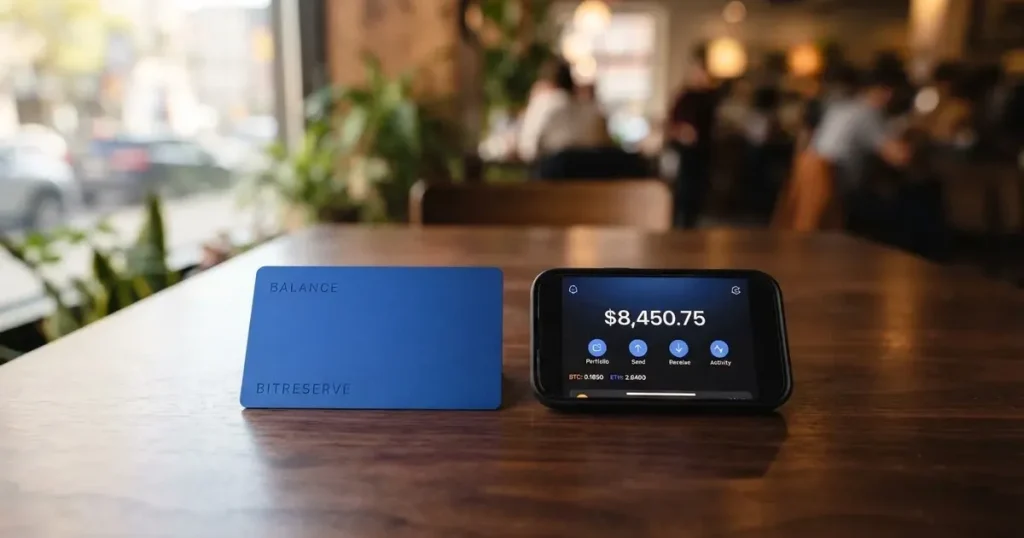
Coinbase is one of the largest crypto exchanges in the world, and its card is a prepaid Visa that draws on a cash or crypto balance inside the Coinbase app. The pitch is simple: pay anywhere Visa is taken, spend the crypto you already hold, and pick a reward coin on every purchase. Whether that works for you depends on where you live, what you plan to spend and how you feel about leaving your funds with a custodian.
The card is currently available only in the United States, in every state except Hawaii. That single fact shapes who the card is for: it is built for a US resident who already has a Coinbase account, holds crypto there and wants to spend it without first cashing out to a regular bank. If you live outside the US, or you want a self-custody card, or you need a multi-currency account, this card is not for you.
Conditions are current as of October 28, 2026.
Verdict
Coinbase’s card earns a 6.4 out of 10 in this review. That score reflects a card that is cheap to run and very easy to use in the country it supports, but limited in reach and held back by complaints about the wider Coinbase platform that the card sits on top of.
The card suits a fairly specific reader: a US-based Coinbase user who wants to spend crypto or a USD balance at Visa merchants, earn a small crypto reward on every purchase and not worry about an annual fee. If that is you, the card does the job and the day-to-day experience is close to a regular prepaid debit card.
It does not suit you if you are outside the US, if you want a non-custodial card, if you want a multi-currency wallet with a euro or pound balance, or if you expect strong customer service when things go wrong. The card is only as good as the exchange behind it, and Coinbase’s reviews are sharply split between users who never had a problem and users whose accounts were frozen for weeks.
| Criterion | Score | Why it matters |
|---|---|---|
| Who can get it | 4 / 10 | US residents only, every state except Hawaii; no other countries. |
| Cost | 8 / 10 | No annual fee, no spending fee from Coinbase, no ATM fee from Coinbase; only the conversion spread at payment. |
| Top-up options | 4 / 10 | Linked bank account or paycheck deposit, both free; spending crypto directly from the Coinbase balance; specific coins and networks not stated. |
| Reliability and complaints | 7 / 10 | Issued by Pathward, N.A. (FDIC member) on Marqeta; Trustpilot 4.0/5 across 23,282 reviews, but heavy complaints about frozen accounts and slow support. |
| Everyday use | 9 / 10 | Virtual or physical Visa prepaid, ATM withdrawals supported; unofficial reports of Apple Pay and Google Pay support. |
| Total | 6.4 / 10 | A clean, low-fee card for a narrow audience. |
Who can get the Coinbase card
The card is for US residents, and only US residents. Coinbase lists availability in every US state except Hawaii, and there is no separate international programme at the time of writing. If you are reading from Europe, the UK, Canada, Latin America, Asia-Pacific or anywhere else, this card is not offered to you, and the rest of the review will only be useful in the abstract.
Opening an account follows the standard US identity rules that come from the USA PATRIOT Act. You will be asked for your name, address, date of birth and an identification number, and Coinbase may also ask to see a driver’s licence or other photo ID. The earlier cardholder agreement also required the applicant to be 18 or older and either a US citizen or a permanent resident, and the card page today still says identity has to be verified before the card can be used.
There is no credit check and no staking requirement, which is unusual for a card from a crypto company. You do not have to lock any assets to qualify. The trade-off is that everything depends on your Coinbase account being in good standing; if Coinbase restricts or closes your account, the card stops working with it.
The one practical exception is Hawaii, where the card is not available at all. The reason is that Hawaii’s state money-transmitter rules have historically been a problem for crypto companies, and Coinbase has not been able to obtain the licence it would need there.
How to sign up
The application is built into the Coinbase app, and it is short. You sign in to an existing Coinbase account or create one, complete identity verification, and then either create a virtual card or order a physical card. The virtual card can be used immediately for online purchases; the physical card is mailed to you.
The card itself is a Visa prepaid debit card, available in virtual or physical form. It draws on a stored balance and is not a credit product, so there is no credit line, no interest and no late fees. The card can spend either a US-dollar balance or crypto held on Coinbase, and all crypto is converted to US dollars at the moment of payment, regardless of where in the world the merchant is.
One thing the card page does not state is the delivery time for the physical card; the older cardholder agreement said there was no fee for replacement cards sent because the card had expired, but it did not give a delivery window. If timing matters, plan around a worst case of one to two weeks.
There is no separate activation step beyond identity verification. The older agreement also said that, until identity was confirmed, use of the card may be limited — so a brand-new account that has not yet been verified may have a card that does not work at the till.
Fees: what the card really costs
The headline numbers are good. Coinbase says “zero spending fees and no annual fees” and that holds up under the surface. The cardholder agreement and user agreement are where the full fee list lives, and the practical fees you can see day to day are these.

| Fee or limit | What it is | What you pay |
|---|---|---|
| Issuance | Cost to order the physical card | Not stated on the current card page; older agreement showed no replacement fee for expired cards. |
| Monthly fee | Holding the card | $0. |
| Spending fee | Paying with the card at a merchant | $0 from Coinbase. |
| Crypto conversion | Spread when Coinbase converts your crypto to USD at payment | A spread applies; the exact figure is not published and varies with market conditions. |
| Foreign-currency purchase | Paying in a currency other than USD | 0% from the issuer per the older fee schedule; the card network (Visa) sets the conversion rate, and Coinbase may charge its own fee. |
| ATM withdrawal | Cash at an ATM | $0 from Coinbase; the ATM operator may charge its own fee. |
| ATM balance inquiry | Checking your balance at an ATM | $0. |
| Daily and monthly limits | How much you can spend or withdraw | Vary by customer; risk checks may lower them; shown in the app under Card > Support > “View spending and ATM limits”. Older combined terms (2021) capped ATM and over-the-counter cash withdrawals at no more than $1,000 in 24 hours and 6 cash withdrawals a day. |
The single most important cost on the card is the spread, not the named fees. Because the card converts your crypto into dollars at the moment you pay, the price you get is whatever Coinbase pays itself when it sells that crypto on the open market. That spread is the company’s margin, and it is not published as a percentage. In practice, you see it as a slightly worse price than the spot rate shown on the Coinbase app at the same moment.
For a few everyday payments, here is how the math works out.
A grocery shop paid from a USD balance: no fee from Coinbase, no FX because you are paying in dollars. The card works like any other Visa prepaid card and the merchant sees a domestic Visa transaction.
A $40 coffee paid from a Bitcoin balance: Coinbase sells the Bitcoin at the spot rate plus its spread and credits USD to the card. There is no separate “crypto payment fee” but the spread is the real cost, and the bigger the conversion, the more that spread matters. The 1-star Trustpilot reviews of Coinbase in 2026 repeatedly mention surprise fees on conversions and on debit-card transfers.
A €45 dinner in Paris paid from a USD balance: the card charges 0% on the international side, but Visa sets the EUR-to-USD rate, and Coinbase may add its own fee on top of that. If you pay in euro at a foreign merchant, you are exposed to the network’s FX margin and to whatever Coinbase charges for the conversion; if you let the terminal convert to dollars dynamically, you get the network’s DCC rate, which is usually worse.
The cleanest conclusion is that the card is cheap to use in the US for dollar spending, less cheap when you pay abroad, and never free when you convert crypto — there is always a spread, and it is the price of convenience.
How to top up the card
There are two top-up paths, and both are free from Coinbase’s side.
The first is a linked US bank account. You connect a bank in the app and pull dollars in; the older fee schedule calls this funding from a Coinbase USD Wallet, with $0 fee and $0 monthly fee. The current card page also says funding from a linked bank or from a paycheck deposit is “zero fees”. Minimum top-up amounts and on-chain network fees are not stated on the public card page.
The second is a paycheck. You can route part of your salary into Coinbase, again with no fee. For a US reader who is paid by direct deposit, this is the cheapest way to load the card because it skips any card-top-up step entirely.
The third path is the one that gives the card its point: spending your crypto. Any crypto balance sitting on Coinbase can be used at the till, and Coinbase converts it to dollars at the moment of payment. The card page does not list which coins or which networks this works on, so the practical answer is “whatever is in your Coinbase spot wallet at the moment you pay”.
There is no published minimum top-up, no separate stablecoin funding option described on the card page, and no on-ramp from a non-US bank. If you are topping up from a foreign bank, you are not really topping up the card; you are funding your Coinbase USD balance and then loading the card from there, which means you eat your bank’s wire fees and Coinbase’s deposit fees on the way in.
A practical note for the international reader: the card page does not say what happens if you move abroad. The older cardholder agreement said that if your address changes to a non-US address the card may be cancelled and any balance returned, so this card is not a tool for taking a US bank relationship with you when you leave.
Paying with the card every day
In daily use, the Coinbase card behaves like any other Visa prepaid card. You tap it at a contactless terminal, insert the chip at an older reader, or type the number in online. The card page says nothing about the merchant categories that are blocked, so as far as the public documentation goes, there is no published blocklist.
The card is denominated in US dollars only. Every crypto payment is converted to USD before the network sees it, and the merchant always sees a domestic US Visa transaction. That is good for acceptance, but it means there is no multi-currency balance on the card; if you travel, the network handles the conversion, not a wallet inside the app.
Crypto rewards are optional and you turn them on in the app. Coinbase describes them as a “rotating” reward: you pick from a list of coins, and you earn that coin back on every purchase, with the rate shown in the app. The rate is variable, not fixed, so it can change from week to week. The reward is offered to US card users only.
On the mobile side, the card can be used with Apple Pay and Google Pay according to unofficial sources, including a TechRadar headline and a CryptoSlate listing. Coinbase’s own card page does not explicitly mention either wallet as of the check date, so treat mobile-wallet support as unofficial and unconfirmed by the card itself.
The Coinbase app for iPhone requires iOS 16.4 or later and also runs on Mac and Vision. The interface is available in 18 languages, including Russian and Turkish. The App Store rating is 4.7 from 1.8 million ratings, read 2026-10-20. Google Play data was not available at the time of writing because the page returned no data.
If something goes wrong with a transaction, the older cardholder agreement says you should report unauthorised activity, after which the issuer decides within 10 business days, may take up to 45 days, and will credit the account within 10 business days in the meantime. Losses reported more than 60 days after the statement may not be recovered. Merchant refunds go back through the merchant and may post with a delay. Visa’s standard chargeback process is the route for a disputed purchase; the card page does not describe it in detail.
A few practical points worth knowing:
- Authorisation holds can stay on the card for several days after a declined transaction, so do not be surprised if your balance looks lower than expected after a failed tap.
- 3-D Secure may pop up the first time you use the card at a new online merchant; that is the Visa Secure check, not a Coinbase problem.
- Address Verification Service is mainly a US, Canada and UK thing, and merchants abroad sometimes decline prepaid or foreign-issued cards because the BIN lookup reveals the issuer country.
What can go wrong
Crypto cards live or die by the platform behind them, and the Coinbase card is no exception. The most useful risk picture comes from looking at the card, the issuer and the exchange together.
The card is issued by Pathward, N.A., a Member FDIC bank, under a licence from Visa U.S.A. Inc., and the programme is powered by Marqeta. There is a small wrinkle in the paperwork: the static-assets folder on Coinbase’s site still names MetaBank, N.A. as issuer, while the current card page names Pathward. Treat the current card page as authoritative. The change reflects an issuer switch that happened at some point between the older agreement and the live card.
Funds on the card are custodial. They sit with Coinbase and the issuing bank, not in your own wallet. The older agreement said that funds transferred from the Coinbase USD Wallet are eligible for FDIC insurance up to $250,000, provided the deposit-insurance requirements are met, and that Visa’s standard Zero Liability policy applies. The card agreement also said you should report a lost or stolen card at once. App-level card freeze and per-merchant spending controls are not mentioned in the public card page, so do not assume they exist.
Coinbase itself has a mixed public record. On Trustpilot, the whole Coinbase group sits at 4.0 out of 5 from 23,282 reviews, read 2026-10-20, with 45% five-star reviews and 43% one-star reviews. The most common complaints in 2026 are slow or absent support in fraud cases, account lockouts and heavy verification, multi-day holds on larger deposits and surprise fees on conversions and debit-card transfers. A US PIRG study ranked Coinbase third among digital wallets by the number of complaints filed with the CFPB, with the most common theme being “difficulty retrieving money”. Interesting Engineering reported that Coinbase confirmed some users had been mistakenly overcharged on their bank accounts.
The honest reading is this: most users never hit a serious problem, but a meaningful minority have had their accounts frozen for weeks during a verification or fraud review, and the support that follows is slow. Because the card is tied to the same account, a frozen account means a frozen card.
There are also category-level risks that come with any crypto card, not just this one:
- Custodial risk: a custodial platform can fail. Historical examples include Mt. Gox (about $350 million stolen, 2011–2014), Coincheck (about $400 million, 2018) and Ronin Network ($625 million, 2022). Holding your funds with Coinbase means trusting its security, its banking partners and its regulators.
- Stablecoin and network risk: although the card itself settles in USD, the wider Coinbase product uses stablecoins on multiple networks. Sending a deposit on the wrong network or to an address of a different chain can lose the funds, and a stablecoin can lose its peg — as seen in USDC’s brief depeg in March 2023 during the US banking crisis.
- Programme closure risk: a card programme can be wound down by its issuer or network. Visa terminated its global agreements with FTX in November 2022 and wound down the FTX US debit card, and WaveCrest was suspended by Visa in Europe in 2018, closing all WaveCrest-issued Visa programmes. If the same happened to Coinbase, the card would stop working and the balance would be returned in line with the closure notice.
There is one tax point worth flagging without giving advice. The IRS treats digital assets as property, and exchanging crypto for goods, services or dollars is generally a taxable event measured at fair market value on the date of the transaction. Every card payment funded from crypto can be a separate disposal with its own gain or loss. Coinbase issues the forms, but it is your record-keeping that closes the loop.
What to take instead
The card’s limits are sharp enough that it makes sense to look at three other products first, especially if you are outside the US, want a euro-denominated card or want to spend a stablecoin directly.
| Card | Score | Where it works | What it does | Rewards |
|---|---|---|---|---|
| Young Card | 5.7 / 10 | Not officially stated | Not officially stated | Cashback in YNG tokens, by Club tier: Essential 0.1%, Gold 1.8%, Platinum 3.6% (Bronze and Silver not stated). |
| OKX | 6.2 / 10 | EU plus Norway; Iceland and Liechtenstein excluded; rule by EEA user of OKX Europe Ltd. (MiCAR-licensed) | Mastercard euro-denominated virtual debit card linked to OKX Pay, no physical card mentioned; issued by an unnamed European licensed payment provider | Cashback only on USDG purchases (USDC earns none); monthly caps in EUR: Regular 2% cap 10, VIP1 4% cap 300, VIP2 4.5% cap 450, VIP3 5% cap 1,000, VIP4+ 10% cap 1,000; the text says 2–5%, the table says 10%, the two are inconsistent and should be checked at sign-up. |
| BingX | 5.8 / 10 | Europe (EEA), APAC, LATAM and “other selected regions”; no country list, contact support to confirm | Virtual (instant, no activation) and metal (mailed 15–30 business days) Visa debit; settles in USD | Not stated; no cashback mentioned. |
A few things to take away from the comparison. OKX is the natural fit for a European reader, with a euro-denominated card, MiCAR licensing and a clear stablecoin funding story through OKX Pay. Young Card is a higher-effort product for a user who is already inside the YNG ecosystem and is happy with token-based cashback. BingX is the broadest in reach but the thinnest in disclosed details, so you would have to confirm your country and the cost of the metal card before applying.
If you are specifically a US Coinbase user who just wants a cheap prepaid card, none of these alternatives will beat the Coinbase card on its home turf. The right comparison for you is the rest of the US prepaid Visa market, not the international crypto-card shelf.
Who I would recommend the card to
The honest answer is that this is a card for a narrow reader, and it does the right things for that reader.
It is a good fit if you are a US resident, you already have a Coinbase account with a working USD or crypto balance, you want a no-monthly-fee prepaid Visa, you want to spend crypto without selling it to yourself first, and you are comfortable with a variable crypto reward on every purchase. The card is also a good fit if you need a virtual card number for online subscriptions or travel booking and you want it issued in minutes inside an app you already use.
It is a bad fit if you are outside the US, if you want to keep control of your own private keys, if you need a euro or pound balance to avoid FX fees, if you want a card with a published FX rate and a published spread, or if a slow customer-service response would be a real problem for you. The card is also a bad fit if you plan to use it for large balances as a sort of savings account, because the underlying platform is a custodian, not a deposit-taker, and the card balance is prepaid, not insured the way a bank account is.
If those limits are fine with you, the card is a clean, low-fee way to spend the crypto or cash you already have on Coinbase. If they are not, the alternatives above are a better starting point.
Frequently asked questions
What is the Coinbase card?
The Coinbase card is a Visa prepaid debit card, available as a virtual or physical card, that draws on a US-dollar or crypto balance held inside the Coinbase app. All crypto is converted to US dollars at the moment of payment.
How does the Coinbase card work?
You fund it from a linked US bank account, a paycheck deposit, or by spending the crypto you already hold on Coinbase. At payment, any crypto is sold for dollars at the prevailing market rate plus a spread, and the dollars are sent to the merchant through the Visa network.
Is Coinbase a bank?
Coinbase itself is not a bank, and the card balance is a prepaid balance, not a deposit. The card is issued by Pathward, N.A., a Member FDIC bank, under a licence from Visa. Funds transferred from the Coinbase USD Wallet are eligible for FDIC insurance up to $250,000 if the deposit-insurance requirements are met.
Who owns Coinbase?
Coinbase Global, Inc. is a publicly listed company in the US (ticker COIN). The card is issued by a partner bank, not by Coinbase directly.
Is the Coinbase card available in my country?
Only in the United States, in every state except Hawaii. There is no international programme at the time of writing, and the card is not available to residents of the EU, the UK, Canada, Latin America or the Asia-Pacific region.
How do I get the Coinbase card?
Open the Coinbase app, complete identity verification, and then either create a virtual card for immediate online use or order the physical card. There is no credit check and no staking requirement.
Does the Coinbase card require KYC?
Yes. Coinbase applies the US customer identification programme, which requires name, address, date of birth and an identification number, and may also require a driver’s licence or photo ID. Use of the card may be limited until identity is verified.
How do I top up the Coinbase card?
The two main ways are a linked US bank account and a paycheck direct deposit, both of which are free from Coinbase. You can also spend the crypto balance on Coinbase directly, with the conversion happening at payment. The card page does not state a minimum top-up amount.
Is the Coinbase card free?
There is no annual fee, no monthly fee and no spending fee from Coinbase, and Coinbase charges $0 for ATM withdrawals. The real cost is the spread applied when Coinbase converts your crypto to dollars at payment; that spread is not published as a percentage.
Is the Coinbase card safe?
The card uses Visa’s standard protections including Zero Liability, and the issuing bank is FDIC-member, but the card is custodial — your funds sit with Coinbase and the bank, not in your own wallet. Trustpilot reviews of Coinbase are split, with slow support and account freezes the most common complaints, so the safety story depends on how you feel about that platform record.
Top exchange cards by score – cryptocardtop
Content created by the «cryptocardtop» team