
A crypto card that keeps your coins in your own wallet and charges 1.75% for currency exchange
 Available in US
Cadmos is a card product that connects a self-custodial crypto wallet to ordinary payment cards. You send USDC or USDT from a wallet you control, the card spends the resulting balance, and the card company’s own pages say the coins never sit with them. That last part is the genuinely interesting part, and it is also the part you carry yourself. There is a Premium version at $0 a month with a 1.75% currency exchange fee, and a Standard version whose price is only visible on the order screen inside the app.
I give it 7.0 out of 10. It is a well-shaped idea executed with more transparency than most crypto card launches, but the card does not publish which countries it serves, who issues the card, or what several ordinary fees are. If you already hold USDC or USDT in your own wallet and you spend in a currency other than dollars, the shape of it fits. If you are choosing your first card or your first stablecoin, the missing pieces matter more.
The conditions described here are current as of October 28, 2026.
Score
| Criterion | Mark | Why |
|---|---|---|
| Who can get it | 7 / 10 | No country list published; terms close only US-embargoed countries |
| Cost | 7 / 10 | Premium: $0 monthly, FX 1.75%; issuance and crypto-conversion fees undisclosed; Standard: prices on the order screen |
| Top-up options | 9 / 10 | USDC and USDT from your wallet, on Arbitrum, Solana, Tron |
| Reliability and complaints | 6 / 10 | Cadmos LTD, Limassol, Cyprus, since 2021; issuer and licence not named; no complaints found; non-custodial wallet |
| Everyday use | 6 / 10 | Premium: Apple Pay and Google Pay; Standard: Apple Pay; virtual or plastic and ATM not disclosed |
| Total | 7.0 / 10 | A strong funding model wrapped in a card whose issuer and country rules are still unstated |
The audience note that comes out of all of this is narrow: self-custody users who spend USDC and USDT from their own wallet. That is the group this is built for, and if you are not in it, the 7 becomes a much smaller number.
Will they give you the card
The honest answer is that the card’s public pages do not tell you. There is no published country list. Availability “depends on eligibility and options shown in the app” — which means the only place you learn whether you qualify is after you install it and start an order.
What the terms do state is a boundary: users must not be in a US-embargoed country. That is the exclusion rule, and the only geographic condition stated anywhere. I am not going to fill the gap with a guess about which countries work, because the gap is real. Anyone who tells you confidently that Cadmos works in your specific country is going beyond what the company has published.
Practically, this means two things. First, download the app and look at the order screen before you plan anything around the card — that is where the answer lives. Second, if you are in a sanctioned or embargoed jurisdiction, the terms exclude you and no account structure changes that. I am not going to describe ways around it, and neither should anyone selling you the card.
How to get it
You apply through the app. The verification step is where the product choice matters, because KYC differs by card product and the requirements are displayed on the order screen rather than published in advance. What the screen may ask for: government ID, personal information, and proof of liveness. What is not stated anywhere: proof of address, and any age requirement beyond the general rule that prepaid and debit cards are typically available to adults from 18.
The card itself comes in two forms. Premium is a Visa Signature. Standard is Visa or Mastercard, and the app shows which one you are getting at the point of order. Whether you receive a virtual card, a physical plastic card, or both is not stated — same for the currency the card is denominated in. Delivery time is not stated either, so if you need a card in your hand before a particular date, do not assume.
The app has a download page, so treat any review score you see there as something to check yourself.
Fees and what a payment really costs
Here is the honest fee picture. Premium gives you a $0 monthly fee and a 1.75% FX fee. Issuance cost is not stated. Standard states nothing at all beyond pointing you to the order screen where its costs appear. Crypto conversion fees are not disclosed on either product. Standard’s cross-border and FX fees are described as following its own programme terms with no figures attached.
| Item | Premium | Standard |
|---|---|---|
| Monthly fee | $0 | not stated — shown on order screen |
| Issuance fee | not stated | not stated — shown on order screen |
| FX fee | 1.75% | cross-border/FX fees per programme terms, no figures |
| Crypto conversion fee | not stated | not stated |
| ATM / cash withdrawal | not stated | not stated |
| Monthly spend limit | $175,000 | no wallet-balance or cumulative transfer cap by Cadmos; card limits set by the programme, shown in the app |
| Currency of the card | not stated | not stated |
| Benefits | Visa Signature: lounge access at 1,300+ lounges in 500+ cities, 24/7 concierge, Visa Airport Companion, $0 monthly | none listed |
Three everyday payments, so the fee lands somewhere real.
A coffee in your local currency on Premium, if your wallet holds dollars: the 1.75% FX fee applies on top of whatever the card network and merchant do, and the card’s own currency is not stated, so you cannot precompute the exact total. It is the one number you can rely on.
A monthly subscription — software, streaming, a cloud plan — same math, but now the percentage compounds over a year rather than a morning. 1.75% is not a rounding error at that frequency.
A cash withdrawal: I cannot tell you what it costs, because ATM fees are not stated for either product. If cash matters to you, that is a question to ask support before you rely on the card, not after.
The gap to keep in mind is the conversion fee. You are converting crypto into fiat, and that step’s price is unstated. On a small purchase it may be irrelevant. On a large one it may not be, and you have no published figure to weigh it against.
Premium’s benefits are real but conditional on your travel. Lounge access across 1,300+ lounges in 500+ cities, a 24/7 concierge by email and WhatsApp, and Visa Airport Companion, for $0 a month. If you never fly, those are not why you should pick Premium. If you do fly regularly, they are a genuine saving that costs you nothing — but read the comparison one more time and note that Standard lists no benefits at all.
How to top up
This is the strongest part of the product, and it is where the 9 in the table comes from. Cadmos tops up from a self-custodial wallet with USDC or USDT, and the cards settle in fiat at the merchant. The listed transfer networks are Arbitrum, Solana and Tron.
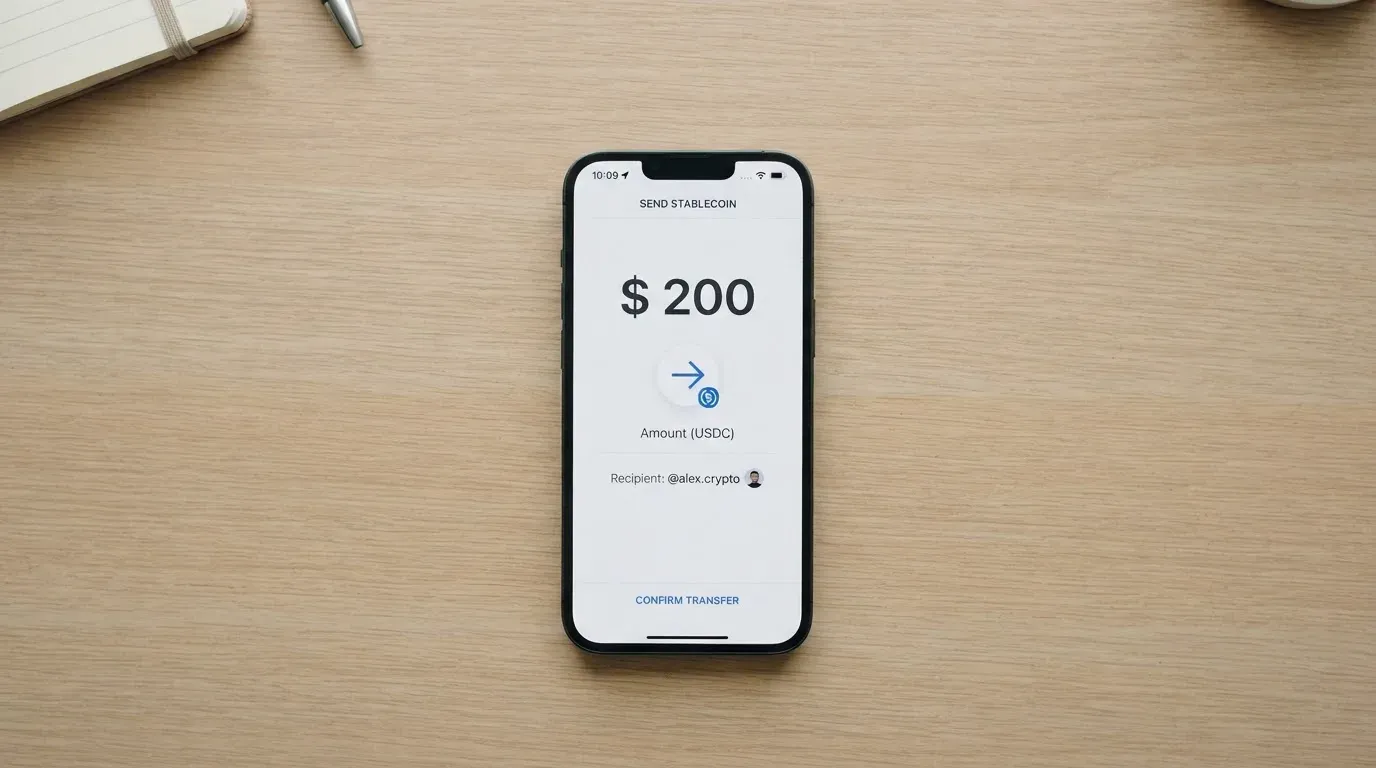
The mechanics are worth understanding. Your wallet balance stays self-custodial until a card top-up is approved. The coins are yours until the moment the top-up clears; Cadmos states that it “does not receive, hold, safeguard, or acquire title to your Digital Assets or fiat funds”. You hold the recovery phrase. That is the structural difference from custodial card platforms, and it is the thing to test the company against — if any part of the product ever asks you to export a seed phrase into their interface, something has changed.
Two practical notes. First, fees and minimums for a top-up are not stated, so plan the transfer size without guidance. Second, pick your network deliberately. A deposit sent on a network the provider does not support can be lost or need manual support recovery with no guarantee, because blockchain transfers do not reverse. USDC over Tron is not a native option either — Circle stopped supporting it in February 2024 — so on Tron you are dealing with USDT. On Arbitrum and Solana, both tokens are available to you.
Closure works by email. And a point people miss: closing does not freeze or move your digital assets. Whether you can withdraw a card balance is not stated. If you hold a balance on the card when you decide to leave, ask what happens to it before you get there, not after.
Paying with it every day
Mobile wallets are the practical route for most people. Premium works with Apple Pay and Google Pay. Standard works with Apple Pay, in both its Visa and Mastercard versions; Google Pay is not mentioned for Standard. Apple Pay stores a device-specific number in the phone’s Secure Element rather than on Apple’s servers, and each payment carries a one-time dynamic code, which is a real improvement over handing over a card number.
Which merchants are blocked is not stated. That matters more than it sounds: gambling sits under merchant category code 7995, and many issuers block it on specific cards by policy rather than by law, with the blocked list varying by issuer. Other categories can be restricted the same way and Cadmos does not publish its list.
Rewards are not stated for either product. That is a meaningful gap for a card that charges a percentage on currency exchange — there is no published cashback to offset it.
One more thing that shapes daily experience: because a merchant can look at the BIN and see which institution and country issued the card, a card issued in one country can look foreign to a shop in another. Some merchants decline prepaid or foreign-issued cards for that reason, and address verification is generally unavailable for foreign-issued cards, which causes declines. You may simply find a shop in your own city that says no.
Disputes and governing law: the terms specify French law and the courts of Paris, with a 30-day good-faith resolution window after written notice. The card chargeback process itself is not stated. If you are used to the chargeback rights that come with Regulation E in the US or Regulation Z for credit cards, note that prepaid-card coverage varies and should not be assumed.
What can go wrong
The company is Cadmos LTD, Limassol, Cyprus, registration number 457316, founded 2021. That is the entity behind the app. What is not named: the card issuer, and any licence named in the Terms. This is the gap I keep coming back to. A crypto card usually rests on two things — a crypto-side provider and a payment-side issuer licensed under the card network’s rules — and only one of them is visible here.
I searched for complaints and found none: no Trustpilot or Reddit reviews of Cadmos Pay surfaced, and no Trustpilot page exists. Read that carefully. No complaints about a young product with no review history is not the same as a clean record; it is often the absence of customers. There is no long public history to judge the company against either.
Self-custody moves risk rather than removing it. Control of crypto belongs to whoever holds the private key. A seed phrase — typically 12 to 24 words — is an unencrypted private key, and anyone who obtains it can restore the wallet and spend its funds. Transfers are typically irreversible, and a stolen key has no recovery path because the network cannot freeze or return anything. With a self-custody card you carry all of that yourself, with none of the custody that custodial platforms accept in exchange. And those platforms have a record: Mt. Gox (about $350 million reported stolen, 2011–2014), Coincheck (about $400 million, 2018), Ronin Network ($625 million, 2022). Both sides of that trade carry real risk.
Programmes can also close under you. Visa terminated its global agreements with FTX on 13 November 2022 and the FTX US debit card was wound down by its issuer. WaveCrest, a Visa issuer that supplied crypto card brands, was suspended by Visa in Europe in 2018, closing all WaveCrest-issued Visa programmes. The pattern is a notice period, then spending and loading stop, then you are asked to withdraw what remains.
Support is real and reachable: [email protected], tickets in Settings > Help Center, phone +1 (845) 588-8434, and for Premium a 24/7 concierge by email and WhatsApp. Whether anyone answers the fee questions above is another matter.
Regulatory context, since it bears on the missing issuer. MiCA is the EU’s crypto-asset regulation and took legal effect in June 2023; its rules on stablecoins applied from 30 June 2024 and the remaining provisions, including crypto-asset service provider rules, from 30 December 2024. Under MiCA, e-money tokens may be issued only by a credit institution or an electronic money institution. Transitional status runs until 1 July 2026 or until a provider gets or is refused authorisation, whichever comes first. A card itself is a payment service regulated separately, which is why a crypto card often depends on two licences — and why an unnamed issuer is a real gap rather than a technicality. ESMA keeps an interim register of authorised providers that you can check.
What to take instead
All three alternatives below spend from a balance you hold rather than lending you money, and all three are more transparent about who issues the card. All three also score close to Cadmos, which tells you this corner of the market is crowded and young.
| Cadmos | TokenPocket | MetaMask | KAST | |
|---|---|---|---|---|
| Score | 7.0 | 5.8 | 7.1 | 6.1 |
| Card network | Premium Visa Signature; Standard Visa or Mastercard | Visa/Mastercard debit | Mastercard | Visa Platinum, Visa Infinite metal/gold |
| Who serves you | Not published; terms exclude US-embargoed countries | Visa debit for a list of European countries/territories; Mastercard debit for Australia, Canada, Hong Kong, Japan, Taiwan, New Zealand, Singapore, South Korea, UK; Americas planned | Sign-up open in 45 listed countries/territories, others on a waitlist; US/UK sign-ups temporarily closed | Residence-based list shown at KYC; country list not published; ID citizenship also counts |
| Stated cost | $0 monthly Premium; Standard on order screen | NFT creation fee partly covered, user pays a small portion; no other fees | Virtual free; Metal $199/year | $0 / $1,000 / $10,000 a year by tier |
| Fees | 1.75% FX Premium; conversion not stated | 1% on crypto deposit, refunded later via rewards; FX not stated | Minimal per transaction, no figure; no FX fee, Mastercard rate | 0% top-up, spend, transaction; FX 0.5–1.75%; $0.10 under $25 non-USD; $0.50 decline |
| Top-up | USDC, USDT on Arbitrum, Solana, Tron | Crypto from TokenPocket wallet, coins and networks not listed | Spends directly from wallet on Linea, Base, Monad, Solana | USDT, USDC, PYUSD, RLUSD on Ethereum, Solana, Polygon, Arbitrum, Tron |
| Rewards | not stated | 1% deposit fee refunded via rewards | Cashback 1% virtual, 3% metal on first $10,000 then 1%, in mUSD | USD cashback 1.5% / 2% / 3% by tier on capped monthly spend |
MetaMask is the closest on score and the most conventional: a named issuer (Monovate) with Crypto Life as card provider, a virtual card issued instantly, a metal version at $199/year, no foreign transaction fee using the Mastercard rate, and cashback in mUSD. Its limits are sharper — 45 listed countries, a waitlist elsewhere, one card per user, and Solana-only wallets cannot withdraw credit.
KAST is the one to consider if you want the fee schedule spelled out. Zero on top-ups, zero on USD card spend, zero transaction fee, zero for Apple and Google Pay, and a stated 0.5–1.75% FX band by country. It also has the heaviest price ladder: $0, $1,000 or $10,000 a year, plus a $40 delivery on the Standard physical card and a $1/month inactivity fee after 12 months. Its KYC is strict on paper: only the account holder’s own ID is accepted, a VPN does not bypass it, and living in a supported country with an ID from a restricted region may still fail.
TokenPocket is the weakest of the four on the evidence, at 5.8. Its 1% deposit fee is refunded later through rewards or reduced transaction fees, which makes the net cost depend on behaviour the company controls. Its country coverage is the most explicit of the four, though.
Who I would recommend it to
I would recommend Cadmos to someone who already runs a self-custodial wallet, already holds USDC or USDT, and already understands that a transfer on the wrong network is gone. For that person the funding model is the best in this comparison, the monthly cost is genuinely zero, and 1.75% on currency exchange is a known price rather than an unknown one. Add the Visa Signature benefits if you travel and the calculation gets better still.
I would not lead anyone here first. If you do not yet hold stablecoins, you are buying two products — a stablecoin and a card — and you will learn both at once from your first mistake. If you want a published country list, a named issuer, a stated conversion fee, or cashback that offsets the FX charge, one of the three alternatives gives you all four on paper today.
And whatever you decide, check the issuer question first. Ask support who issues the card and under what licence. The answer determines what happens to your money in the bad scenarios, and it is the one thing a comparison table cannot tell you.
Frequently asked questions
What is the Cadmos card?
Cadmos is a card that lets you spend USDC and USDT held in your own self-custodial wallet. You send stablecoins on a supported network, the card converts them to a spendable balance, and you pay with it as you would with any bank card. Two products exist: Premium, a Visa Signature at $0 a month, and Standard, a Visa or Mastercard whose pricing appears only on the order screen inside the app.
Is Cadmos a bank?
No bank is named, and no licence appears in the Terms. The company behind the app is Cadmos LTD, Limassol, Cyprus, registration 457316, founded 2021. The card issuer is not named either, which is unusual — a payment card normally has a licensed institution behind it. Their stated position is that they never hold your assets.
Who can get the Cadmos card?
Nobody knows from the public pages, which is the truthful answer. There is no published country list; availability depends on eligibility and the options shown in the app after you install it. The one geographic rule stated is that users must not be in a US-embargoed country. Check the order screen — that is where your own answer lives.
Does the Cadmos card require KYC?
Yes, and the requirements vary by product and are shown on the order screen rather than published. The screen may ask for government ID, personal information and proof of liveness. Proof of address and any specific age requirement are not stated. Standard EU-style checks also cover nationality and sanctions screening, and if the checks cannot be completed the account can be refused or closed.
How do I top up the Cadmos card?
From your own wallet, in USDC or USDT, on Arbitrum, Solana or Tron. Your balance stays self-custodial until a top-up is approved, and the card settles in fiat at the merchant. Fees and minimums are not stated, so pick your network carefully: USDC over Tron is not a native option, and a transfer to an unsupported network can be lost.
What does the Cadmos card cost?
Premium charges $0 a month and a 1.75% FX fee; Standard shows its costs only on the order screen and applies cross-border and FX fees per its programme terms without published figures. Issuance fees are not stated on either product, and the crypto conversion fee is not disclosed at all. That last gap is the one I would ask support about before spending large amounts.
Is the Cadmos card safe?
Safe is the wrong question; the structure is. Cadmos states it does not hold, safeguard or take title to your digital assets or fiat, so a Cadmos failure should not directly cost you your coins — which is a real advantage over custodial platforms with histories like Mt. Gox, Coincheck and Ronin. In exchange you own key loss, phishing and wrong-network transfers entirely. No complaints or reviews exist yet, which tells you about the age of the product, not its quality.
Can I use the Cadmos card in my country?
You can check, but the answer is not published. Availability depends on eligibility and the options shown in the app, so install it and read the order screen before planning around the card. Countries under a US embargo are excluded by the terms. Nothing else is stated, and I would rather say that plainly than guess.
What are the Cadmos card’s limits?
Premium has a monthly spend limit of $175,000. Cadmos places no wallet-balance or cumulative transfer cap on Standard, but the card limits there are set by the programme and shown in the app. No daily limit is published for either product, and ATM withdrawal fees and cash-withdrawal availability are not stated — worth asking about if you rely on cash.
How do I close or delete my Cadmos account?
Closure is handled by email. The important part is what closure does not do: it does not freeze or move your digital assets, which stay in your self-custodial wallet. Whether a balance sitting on the card itself can be withdrawn is not stated, so ask before you close rather than after — and remember to revoke the card in your mobile wallet at the same time.
Top wallet cards by score – cryptocardtop
Content created by the «cryptocardtop» team